Port forwarding is a key element of efficient sea transport. Thanks to our direct presence in ports in Poland and Europe, Magemar provides fast, safe and comprehensive cargo handling at every stage of port operations.
Port Forwarding - call us or send an enquiry. We prepare every quote individually.

Port forwarding covers every activity between the ship's side and onward transport: cargo reception, transhipment, storage, supervision, documentation and customs clearance. Each stage has its own deadline and its own liability, and a single delay can hold up the supply chain and trigger storage charges.
We operate directly within the Port of Szczecin, so we monitor operations as they happen. Long-standing relationships with terminals, shipping lines and port services allow us to handle containers as well as bulk, break bulk and oversized cargo.
We look after the cargo for the whole time it stays in the port, from discharge off the vessel, through storage and supervision, to handover to the carrier, along with ship agency work and border inspections.
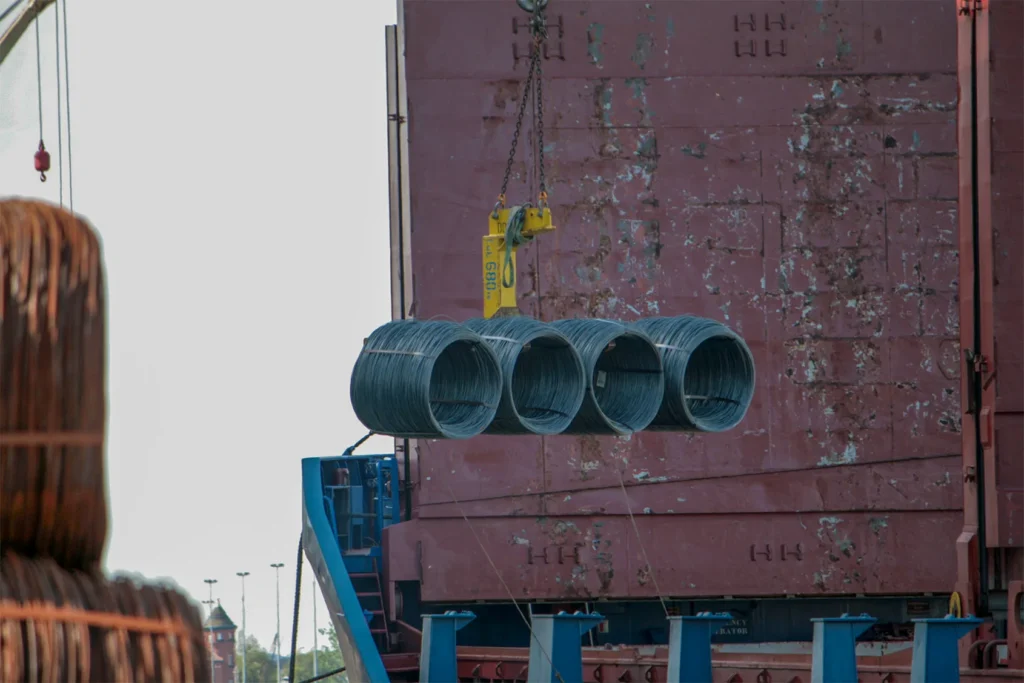
Every order follows the same path, from receiving the cargo in the port to preparing it for onward transport.
We accept the order and analyse the cargo
We coordinate port operations
We provide supervision and documentation
We prepare the cargo for onward transport
Our office sits directly at the Port of Szczecin with the operations team on site, so a change in a vessel schedule gets a response the same day. On top of that comes experience across cargo categories and control of the consignment from reception through to handover.
Office directly at the Port of Szczecin - shorter response times
Fast response to operational situations - our team is on site when vessel schedules change
Experience across cargo categories - bulk, containerised, oversized and hazardous goods
Full control over the process - from reception at the port to handover to the carrier
Comprehensive service within a single order - port forwarding, customs clearance and transport
Entrust us with the port handling of your cargo.
Contact us →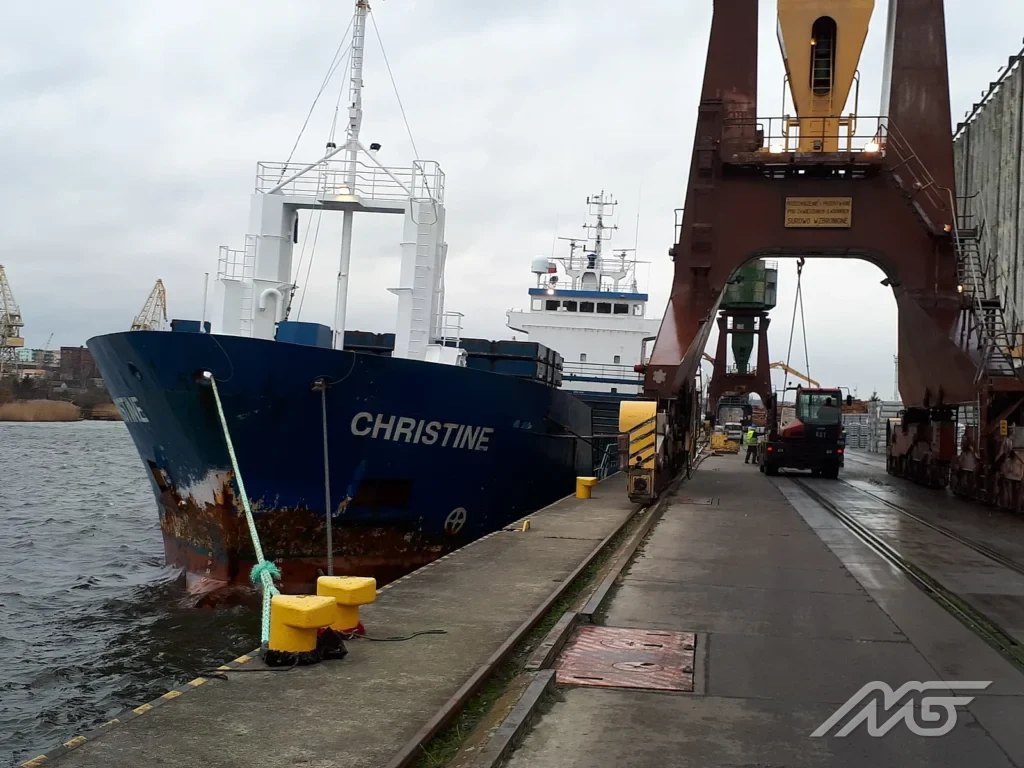
Port forwarding organises cargo handling where the ship meets the shore; sea freight forwarding covers the entire carriage by sea. The distinction is worth making early, because both services are often ordered in a single phone call and they charge for entirely different things.
This covers the leg that begins when the cargo reaches the port and ends when it is released onward. It includes transhipment, storage, cargo handling work, inspections, documentation and handover to the carrier. It is the shortest part of the logistics chain and the one where time and money are most easily lost.
This covers the organisation of carrying goods by sea from consignor to consignee: booking space with the shipping line, sea freight, transport documentation, customs clearance and inland haulage at both ends. Port handling is part of it, but it can also be ordered separately - for instance when the freight is paid by an overseas supplier and the client simply needs someone on the ground at the Polish port.
The difference is legal as well as practical. The carrier, meaning the shipping line, enters into a contract of carriage and performs the transport itself. A freight forwarder undertakes to dispatch or receive a consignment, or to provide other services connected with its carriage - that is how the Polish Civil Code defines a forwarding contract in Article 794. In practice the forwarder organises the job, selects the subcontractors and answers for the whole thing coming together on time.
Sea transport wins on unit cost and on the absence of any real limits on weight or dimensions. A vessel will take twenty thousand tonnes of ore, and it will take a turbine that no other mode could move, at the lowest emissions per tonne carried of any transport mode - a point successive International Maritime Organization reports on shipping emissions bear out.
The drawbacks come from the same place. Transit times published in Asia-Europe container service schedules run to 30 to 45 days, vessels keep to timetables the client cannot influence, and every delay at the port triggers storage and container charges. Transport by sea also needs inland haulage at both ends, because the port is rarely the final destination.
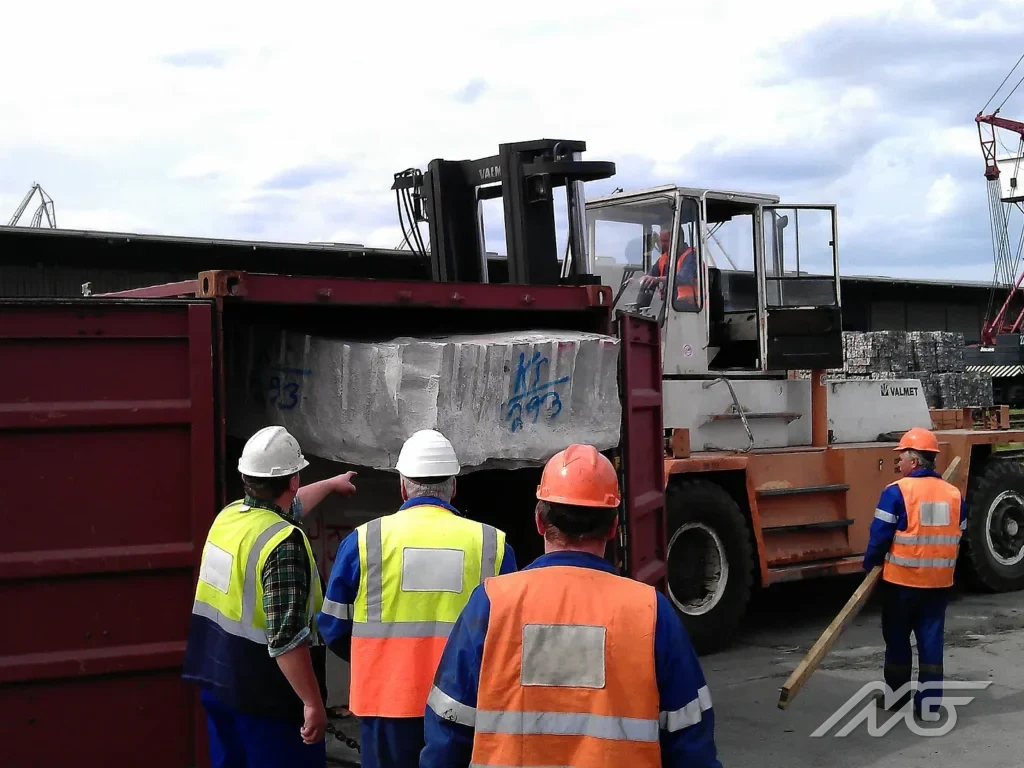
The forwarder is a single point of contact between the client and everyone who touches the cargo. On a single container import that usually means the shipping line, the terminal, a customs agency, a road haulier and at least one inspection body. When the client runs those conversations alone, each party answers only for its own leg.
The forwarder selects the route, the mode and the timing, books space with the shipping line and makes sure the documentation cut-off matches the readiness of the cargo. The decisions taken here determine the cost later on: FCL or LCL, which port, which terminal, how many days free of charge.
A full set of transport and commercial documents: bill of lading, waybill, packing list, certificate of origin, dangerous goods declaration, terminal notifications. An error in a container number or in the gross weight can hold up release for several days, even though the vessel is already alongside.
Day-to-day contact with the terminal, port services and inspection bodies, sequencing the cargo handling work, reacting when the vessel's time window moves. This part of the job cannot be planned in advance, which is exactly why it matters where the team physically sits.
A forwarder is answerable for the carriers and sub-forwarders they engage, unless no fault can be attributed to their choice. That is a meaningful difference from a situation where the client orders every leg separately and pursues every claim alone.
With non-standard cargo, with a first import from a new origin, with goods subject to sanitary inspection, and anywhere the deadline matters. On jobs like these, ordering comprehensive services from one provider shortens response times, because nobody passes the client on. Where the trade lane is repetitive and the company has its own logistics department, many firms manage alone - and then the forwarder is needed only for the port leg, without the freight.
Port handling comes down to six recurring groups of activities, and most jobs need several of them at once. Efficient port handling means running them one after another with no idle time in between. Here is what actually happens to the cargo between the vessel and the port gate.
Discharge from vessel to yard, from yard to wagon or trailer, direct ship-to-wagon transfer for bulk cargo. Plus cargo handling equipment matched to the goods: container gantry, crane, grab, loader. For heavy and project cargo the lifting plan is drawn up before the order itself is confirmed.
On open yards, under cover or in an enclosed warehouse, depending on how sensitive the goods are. Terminals normally allow a few days free of charge; after that a rate per day and per unit applies. This is the most common source of costs importers do not see coming.
Non-EU goods can wait for clearance in a temporary storage facility, for which the Union Customs Code (Regulation 952/2013, Article 149) allows a maximum of 90 days. A customs warehouse allows longer storage with duty and VAT suspended until the goods actually enter the market. For an importer that is often a cash flow question rather than a logistics one.
Repacking, palletising, forming cargo units, distributing and securing goods in the container or on the trailer. Badly distributed weight is not only a damage risk, it is also a problem at the weighbridge on the way out of the port.
Phytosanitary, veterinary and quality inspections, carried out in Poland by Wiorin, Sanepid and WIJHARS. Each has its own notification procedure and its own lead time, and the cargo waits at the port until the procedure closes. Booking an inspection in parallel with discharge can cut the stay by several days.
Port formalities for the calling vessel, contact with the harbour master, provisioning, coordination of operations alongside. This is a service for the shipping line rather than the cargo owner, but it lands in the same operational calendar.
A standard container import from Asia has seven stages and usually fits into six to eight weeks from order to unloading at the consignee - that is what our own jobs come out at, counting the booking, the clearance and the final delivery. On export the sequence is the same, only reversed.
What we need: place of dispatch and final destination, cargo type and weight, dimensions or number of pallets, readiness date and any special requirements. On that basis we quote the freight, port handling, clearance and delivery.
A booking on a specific vessel and voyage, with documentation and cargo cut-off dates. That first cut-off is critical: after it, every change to the data carries a charge. For non-standard cargo the line has to approve dimensions and securing arrangements in advance.
An empty container is positioned at the consignor, or the goods are loaded at a consolidation warehouse in the case of LCL. The cargo must be in the port before the loading cut-off, otherwise it misses the sailing and waits for the next one, usually a week later.
Customs declaration, full set of commercial documents, issue of the bill of lading. From this point the cargo is formally on its way and every amendment costs money.
A direct sailing or a service with transhipment at a hub port. Every additional transhipment means a few more days and one more point of risk.
Discharge, arrival notification, inspections, import clearance with duty and VAT, and storage where required. This is where the whole of port forwarding described above comes in.
Handover to the road or rail carrier and delivery to the final destination - and, with a container, the return of the empty unit within the agreed deadline. That last step is the one most often left out of the plan, and it is the one that generates detention charges.
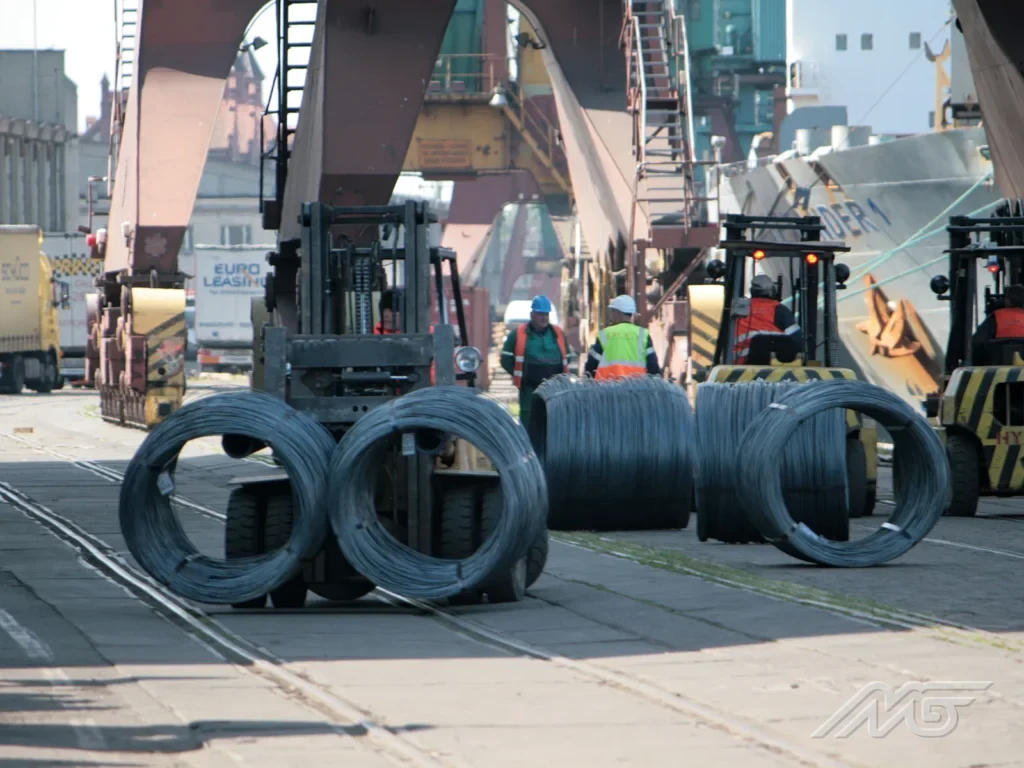
Almost any product that can spend a few weeks in transit travels by sea, and how it is handled at the port depends not on the industry but on the form the cargo takes. The same machinery travels in a container on one shipment and as break bulk on the next.
Industrial and consumer goods, components, electronics, textiles, packaged chemicals. The container protects against weather and theft, and the seal simplifies customs clearance.
Coal, grain, ores, fertilisers and aggregates travel loose, without packaging, and are discharged at the port by grab or conveyor. Two things matter with this group: the discharge rate and reliable measurement of quantity, because a fraction of a per cent on fifteen thousand tonnes is real money.
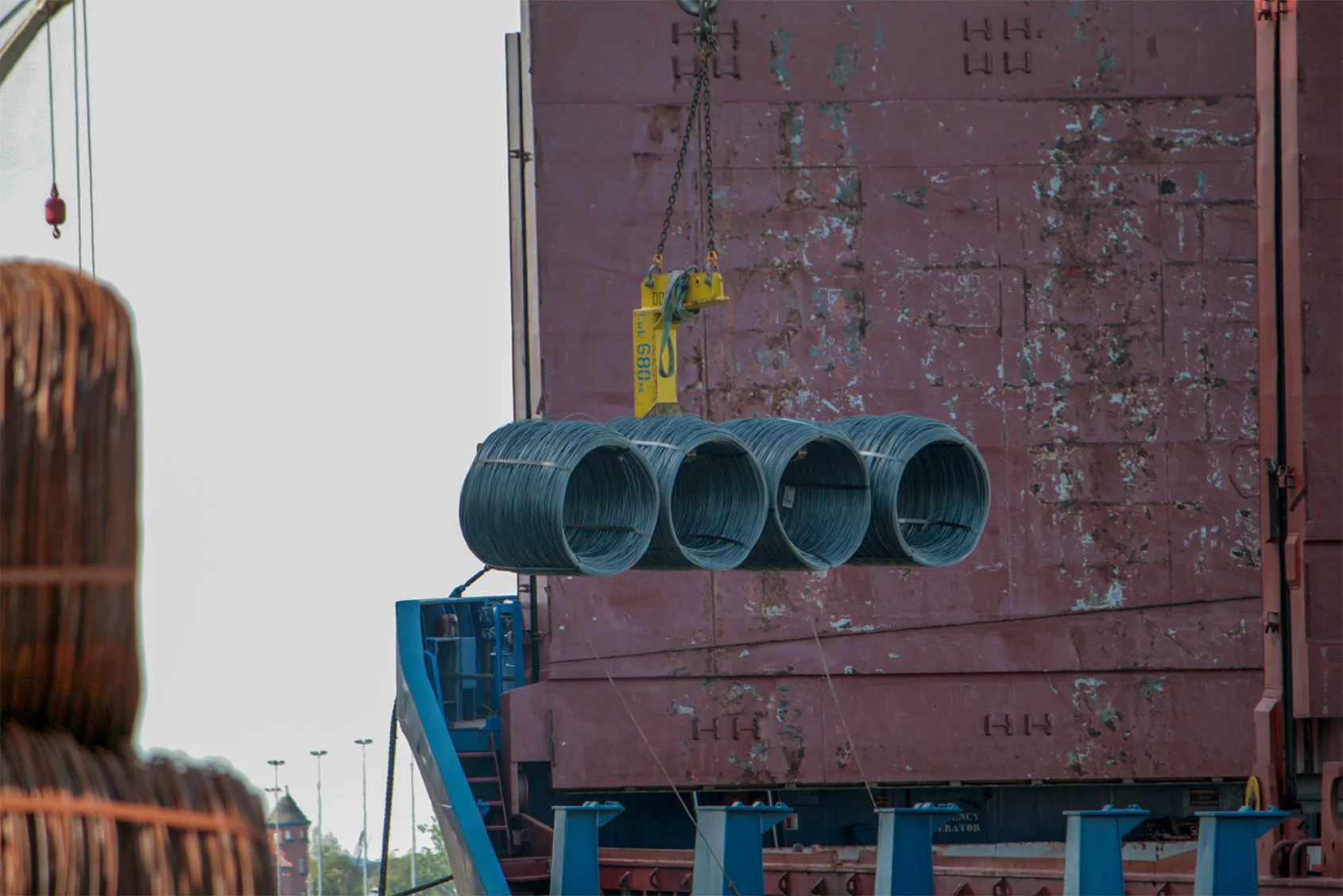
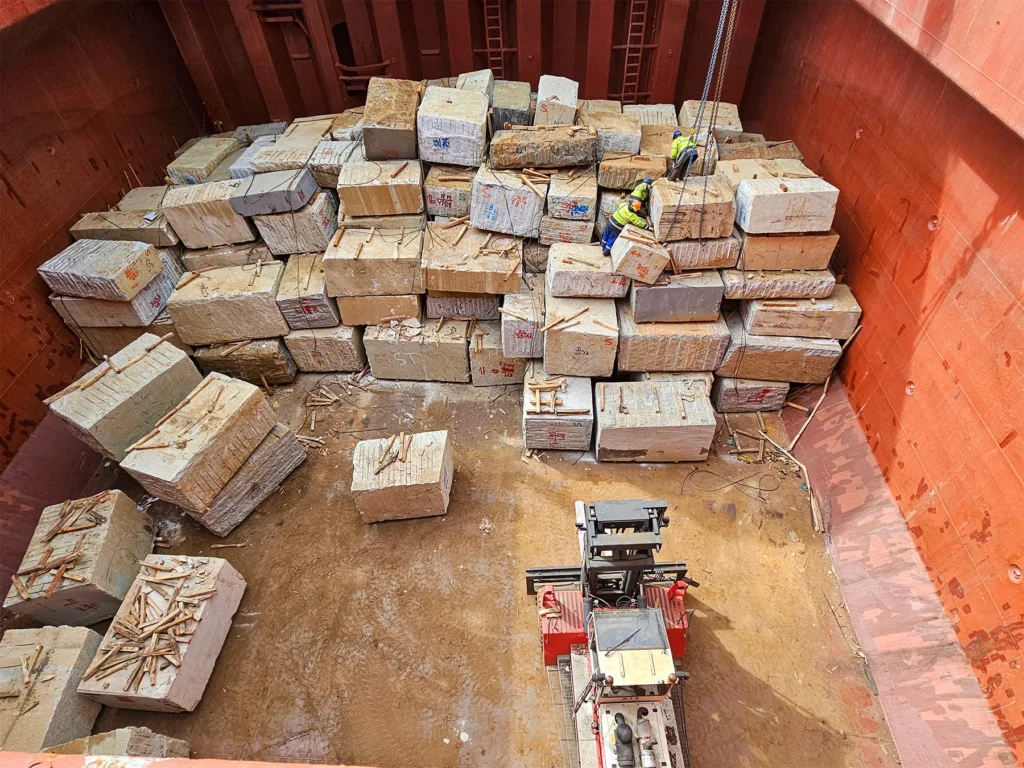
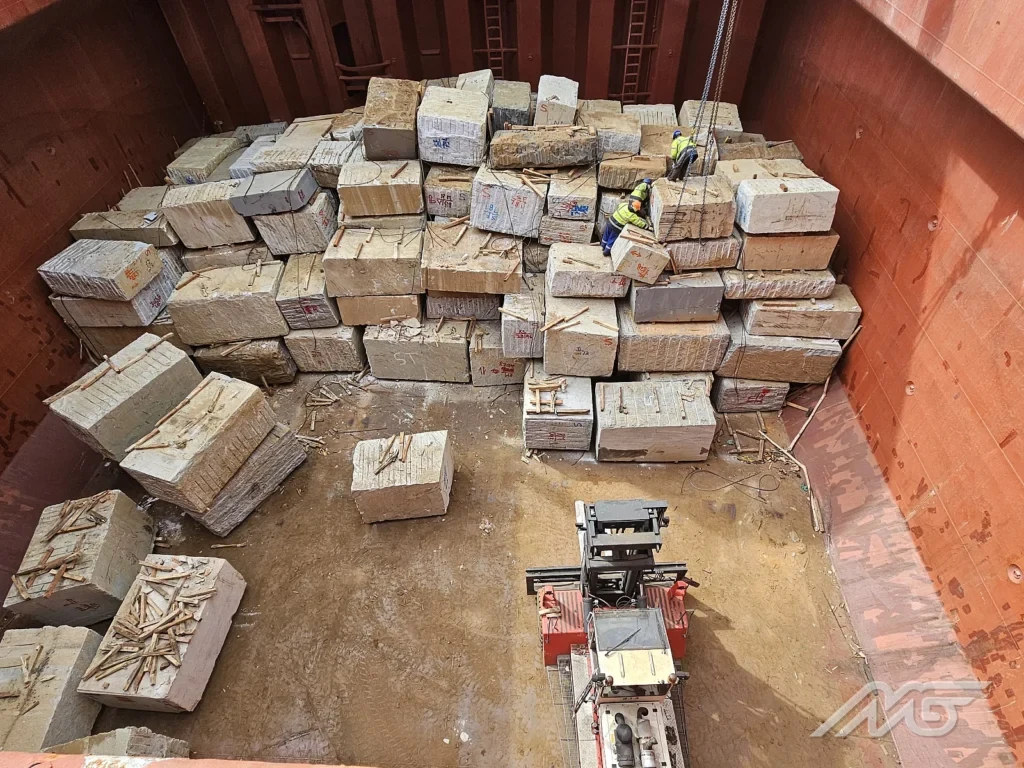
Conventional cargo that is not worth containerising: steel products, structural steel, stone in blocks, paper, timber. Break bulk transport calls for an individual stowage and lashing plan.
Anything that drives aboard up a ramp: trailers, construction machinery, vehicles. Faster turnaround alongside, but fewer services and a schedule you have to fit into.
Turbines, tanks and complete production lines are handled differently from everything else: the job starts with measurements and a lifting plan and ends with permits for the inland leg. On cargo like this the road out of the port is often harder to arrange than the voyage itself.
These are classified under the IMDG Code, issued by the International Maritime Organization and applied identically in every port. Each class calls for separate documentation, marking and a declaration to the shipping line, and some carry restrictions on stowage aboard and on storage at the port.
Fruit, frozen goods and pharmaceuticals travel in refrigerated containers that have to stay connected to power both aboard and at the terminal. The port call is the most sensitive moment for them, because the temperature has to be monitored without a break, including between discharge and release.
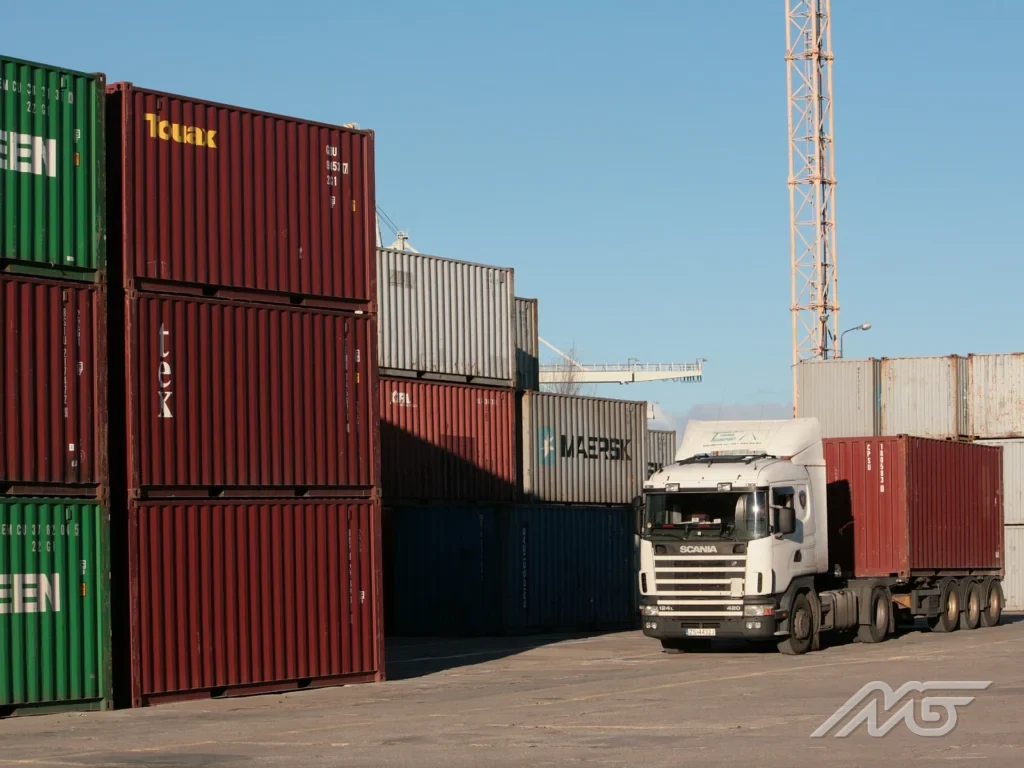
The container is now the default cargo unit in sea transport, and the whole choice comes down to one question: does your cargo fill it. The answer determines cost, transit time and the number of operations at the port.
Full container load, in other words a full container consignment. The unit travels sealed from consignor to consignee, without being opened en route. Shorter transit, less risk of damage and simpler clearance, because everything inside belongs to one owner.
Less than container load. The client pays for the space occupied and the goods travel alongside other companies' consignments. Consolidation before loading and deconsolidation at the destination port are added to the process, which means a few more days and two extra handling operations.
In our own calculations the threshold sits around 13 to 15 cubic metres: above that volume a full container is often cheaper than paying for space in a shared one. On any larger shipment it is worth pricing both options, because sea freight rates move from week to week and the threshold moves with them.
External dimensions are set by the ISO 668 standard, while usable capacity depends on the build of a given series. A standard twenty-foot container holds roughly 33 cubic metres and takes around 28 tonnes of cargo; a forty-foot around 67, and the High Cube version around 76. Beyond those there are reefers, open top units for loading from above and flat racks for cargo that will not fit inside a box.
The same goods move from vessel to wagon to trailer without being repacked, and every unit carries a number you can track it by. Handling costs become predictable and losses or damage are rarer than with break bulk. That repeatability is what made the container the backbone of international trade.
A port handling invoice rarely has one line on it - it is usually five to eight charges, and some of them depend purely on how quickly the cargo leaves the port. That is why a quote prepared before the vessel arrives almost always works out cheaper than reacting after the fact.
Rates change from week to week and depend on the trade lane, the season and the space available aboard. On top of the freight itself come bunker and seasonal surcharges, which can move the invoice by a double-digit percentage.
THC, the terminal handling charge, plus gate, weighing and notification fees. All of them come from the published tariff of the terminal in question, identical for every customer, so on a single shipment they are not open to negotiation.
Once the free time is used up, a rate per day and per unit applies, rising in steps across successive bands. Where inspections or queried declarations are involved, this is the line that most often gets out of hand.
Two different charges that are frequently confused. Demurrage is charged for a container sitting at the terminal beyond the free time; detention is charged for keeping the unit outside the terminal, that is for returning the empty container to the line too late. The rates and the length of the free time come from the shipping line's tariff rather than the terminal's, so on the same trade lane they differ from carrier to carrier. Both accrue per day and both can be contained by planning collection properly.
An inspection is not only its own cost, it is also extra storage days and a rescheduled inland leg. For goods subject to inspection we lodge the notification in parallel with discharge rather than after it.
Assessed on import clearance according to the tariff and the customs value of the goods. With clearance handled by our own AEO certified customs agency, the client gets one quotation covering both the charges and the handling, without splitting the job between two companies.
Four ports of primary importance to the national economy handle the overwhelming majority of cargo in Polish ports, and each of them suits something different. The choice of port affects the cost of the inland leg more than any difference in handling rates.
A universal port: bulk cargo, break bulk, project and oversized cargo, grain, ore, steel products. Since the Szczecin-Świnoujście fairway was deepened to 12.5 metres - a Maritime Office of Szczecin project completed in 2022 - it takes vessels drawing up to 11 metres. Its main advantage is location: for consignees in western and central Poland, and in Germany, the inland route is the shortest from here. This is where our office is and where we handle cargo directly within the port area.
Part of the same port complex as Szczecin but with a different specialisation: the LNG terminal, bulk handling at deep-water berths and Poland's largest ferry traffic to Scandinavia. It takes vessels that cannot navigate the fairway up to Szczecin.
The only Polish port with a deep-water terminal serving direct ocean services from Asia, without transhipment in Western Europe. For containers from the Far East it is usually the fastest way onto the Polish market. Beyond containers: fuels, coal and grain.
A break bulk and container port with well-developed ro-ro, cold store and grain facilities. Short ferry connections and container terminals working mainly in Baltic and feeder services.
For containers from Asia bound for a consignee in southern Poland, Gdańsk usually wins; for bulk and project cargo destined for western Poland and Germany, Szczecin with Świnoujście. Where the goods carry on further west, it pays to price both options together with the inland transport, because the difference in haulage cost is often larger than the difference in freight.
Every container carries one unique number, and it is that number, not the vessel name, that tells you where your cargo stands at any given moment. The ISO 6346 standard requires it to consist of four letters and seven digits, and the same string appears with the shipping line, at the terminal and on the customs documents.
The container number, the booking number or the bill of lading number. Every shipping line provides a status search, and container terminals run their own services showing whether a unit is available for collection.
The basic events are gate-in at the terminal before loading, loading aboard, departure, transhipment at a hub port, discharge at the destination port and gate-out. Between discharge and release sit customs clearance and every inspection, which is precisely where most delays appear.
Line statuses describe the unit, not the goods inside it. They will not tell you that the cargo is waiting for an inspection, that a document needs correcting, or that the free time is about to run out. For that you need someone watching the case from the port side.
With bulk and break bulk cargo what counts is physical checking: measuring quantity, verifying the condition of the goods on discharge, photographing any discrepancy. Our team does this on site and hands over a report that carries weight in any subsequent claim against the line.
When a vessel schedule moves or an inspection drags on, we reschedule the inland transport, negotiate an extension of the free time and tell the client before the charge starts accruing. That is the real value of being present at the port, rather than merely having access to a system.
Port forwarding is the organisation of every activity involving cargo within the port area: reception, transhipment, storage, cargo handling work, inspections, documentation and release for onward transport. It covers the leg between the vessel and the port gate, and it is where delays and unexpected costs most often arise.
Sea freight forwarding covers the entire carriage of goods by sea, from booking space with the shipping line, through the freight, to delivery at the consignee. Port forwarding covers only the leg at the port. In practice one is often part of the other, but port handling can be ordered on its own - for example when an overseas supplier pays the freight and the client simply needs someone on the ground at the Polish port.
A forwarder organises the transport but does not perform it. They select the route and the shipping line, book space aboard, prepare the documents, coordinate port handling, customs clearance and inland transport, and when something goes wrong they take it up with the terminal and the line. Under Article 794 of the Polish Civil Code a forwarder undertakes to dispatch or receive a consignment, or to provide other services connected with its carriage. For the client it means one point of contact instead of five.
Transhipment and discharge of containerised, bulk and project cargo, storage on yards and in warehouses, customs warehousing, supervision and reporting, cargo consolidation and securing, internal port transport, ship agency services and the organisation of phytosanitary and veterinary inspections. All of it within a single order, together with customs clearance through our own agency inside the port.
The cost is made up of terminal charges, transhipment, storage once the free time expires, any additional work, inspections where required and customs clearance with duty and VAT. Rates depend on the type of cargo, the terminal and how long the goods remain at the port, so we prepare every quote individually. When the enquiry reaches us before the vessel arrives, the handling can usually be planned so that storage charges never arise.
Almost anything that can spend a few weeks in transit: containerised cargo, bulk such as coal or grain, break bulk, ro-ro cargo, dangerous goods classified under the International Maritime Organization's IMDG Code, refrigerated cargo and oversized consignments that cannot travel by road. A vessel has no bridge clearance or axle load limits, which for large and heavy items often makes it the only option.
FCL is a whole container hired for one consignment; LCL is payment for space in a container shared with others. With FCL the unit travels sealed from consignor to consignee, which shortens transit and simplifies clearance. LCL pays off on smaller volumes, roughly up to a dozen or so cubic metres. Above that threshold it is worth pricing both, because the difference is often small once consolidation and deconsolidation are added.
By the container number - four letters and seven digits assigned under the ISO 6346 standard and marked on the doors - or by the booking or bill of lading number. Shipping lines provide status searches and terminals run their own services showing readiness for collection. Those statuses describe where the container is, not what is happening to the goods: that an inspection is pending, or that the free time is running out, you will hear from your forwarder rather than from a system.
Four ports of primary importance to the economy: Szczecin, Świnoujście, Gdańsk and Gdynia. Szczecin handles bulk, break bulk and project cargo and lies closest to consignees in western and central Poland. Świnoujście takes vessels with deeper draught, has the LNG terminal and the largest ferry traffic. Gdańsk is the only one serving direct ocean services from Asia. Gdynia specialises in break bulk, ro-ro and grain.
Yes. We handle import and export customs clearance through our own AEO certified customs agency inside the Port of Szczecin. The declaration is prepared in parallel with the cargo handling rather than after it, which shortens the time the goods spend at the port. We also operate customs warehousing for non-EU goods awaiting clearance or onward transport.