Oversized transport covers cargo whose weight or dimensions exceed the limits set by the Polish Road Traffic Act: 2.55 m in width, 4 m in height and 40 tonnes gross weight. It requires a permit, an approved route and, above certain sizes, pilot vehicles. We have been organising such projects since 1999, from our base at the port of Szczecin.
Oversized & Heavy Cargo - call us or send an enquiry. We prepare every quote individually.

Oversized transport means moving cargo that exceeds the permissible dimensions or weight limits. The status of a journey is determined by the vehicle together with its load, not by the load alone, so the choice of trailer can decide whether a permit is needed at all.
We run each project individually - from the analysis of dimensions and weight, through the selection of transport equipment, to piloting arrangements and liaison with the road authorities. We handle industrial cargo, steel structures, machinery components and wind turbine parts.
Being close to the port of Szczecin allows us to take the cargo over as soon as it comes off the vessel.
The scope covers the whole transport project, from measuring the cargo to unloading at destination. Individual elements can also be ordered separately - most often route planning together with the permits.

Every oversized movement follows the same order, because the order comes from the regulations: no measurement, no application; no permit, no route; no route, no delivery date.
Cargo analysis
Logistics project design
Transport organization
Safe delivery
Oversized transport is entrusted to a company that takes responsibility for the formalities, not merely for supplying a trailer. A penalty for travelling without a permit can also reach the consignor and the loader, so choosing the organiser is a decision about where the risk sits.
Experience in special projects - hundreds of movements for industry, energy and construction
Cooperation with specialised hauliers
Formalities on our side - permits, arrangements with road authorities and piloting
Individual approach - a separate plan of action for every project
Comprehensive service from planning to delivery - including customs and port formalities
Location at the port of Szczecin

Entrust us with your oversized cargo transport
Contact us →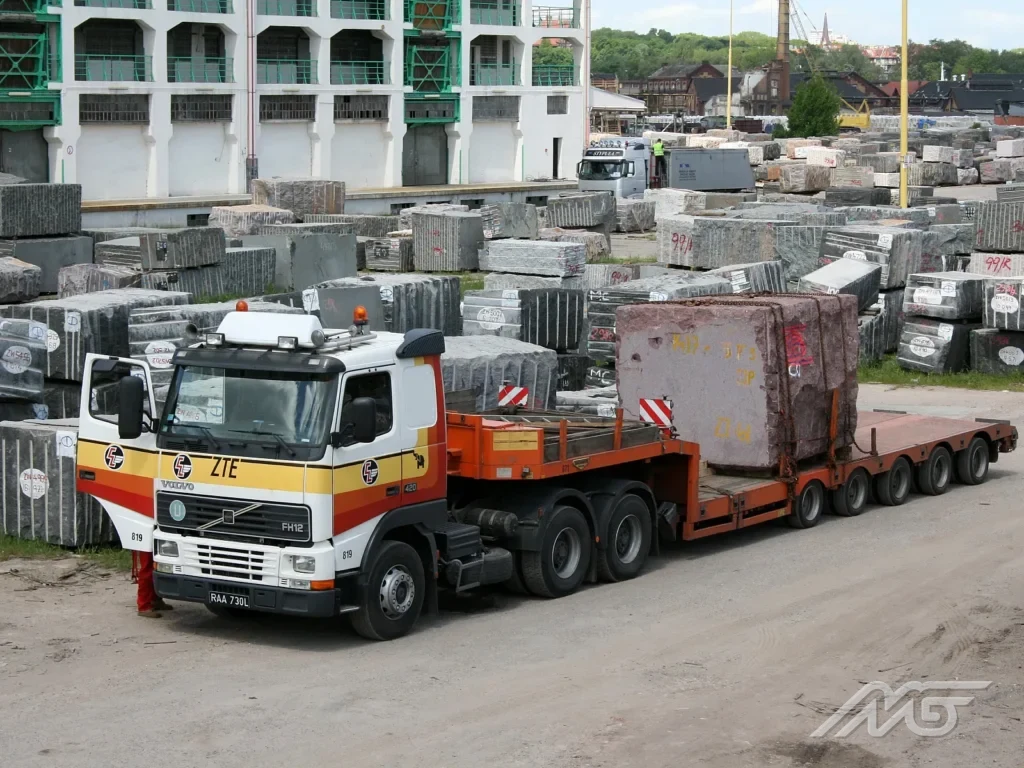
Oversized transport means moving cargo whose weight or dimensions make standard carriage impossible, because they exceed the limits set out in the road traffic regulations. The threshold is not a matter of custom or industry practice: it follows from the Act and from the regulation on the technical conditions of vehicles. Exceeding a single parameter by a few centimetres changes the status of the entire journey and triggers obligations that ordinary road transport does not have.
Polish law defines the matter through the vehicle, not the cargo. Under Article 2(35a) of the Road Traffic Act, a non-standard vehicle is a vehicle or combination of vehicles whose axle loads, with or without a load, dimensions or actual gross weight exceed the permissible values laid down in that Act. What counts is therefore the sum: trailer plus cargo, tractor unit plus combination, not the machine standing on the yard.
The practical consequence often surprises clients. The same item may stay within the height limit on a low-loader and exceed it on a standard curtain-sided trailer. The choice of equipment can decide whether a permit is needed.
Several names circulate for the same thing, and that is a difference of register rather than an error. Non-standard is the statutory term used by the authorities and the police. Oversized and overweight are trade terms: the first closer to dimensions, the second to mass. On the British market the same movement is called an abnormal load. Where an entire industrial project is involved, the usual name is project cargo.
Only the statutory wording will appear on the application and in the decision issued by the authority. If you receive a document referring to the movement of a non-standard vehicle, that is the journey you asked about.
The duty to check whether the combination with its load stays within the limits rests with the haulier and with the transport organiser. In practice the forwarder does it, because the forwarder collects the cargo data and selects the vehicle. A mistake at this stage is the most expensive one available: the transport sets off without a permit and ends with a roadside check by the Road Transport Inspectorate, a financial penalty and a standstill until the paperwork is put right.
Oversized cargo is above all cargo that cannot be split: welded structures, castings, complete machines and infrastructure components. The regulations call these indivisible loads - loads that cannot be divided into two or more parts without disproportionate cost or risk of damage. The notion is a formal one: permits of categories II to V are issued precisely for indivisible loads.
Wind farm components are today the most recognisable type of oversized movement. A blade, a tower section and a nacelle are three entirely different transport tasks: the first extremely long, the second of great diameter, the third extremely heavy. Moving wind turbine parts calls for a survey of the route on the ground, because the outcome is decided by the radii of bends and roundabouts rather than by the width of the carriageway.
Presses, machine tools, boilers, injection moulding machines and complete process lines usually travel in one piece, because dismantling means losing the manufacturer's warranty or paying for recalibration. Moving industrial machinery is often combined with handling inside the plant and entry onto the site, where the constraint is the gate rather than the public road.
Bridge girders, masts, tanks, silos, pipeline sections and precast concrete units. Cargo of this kind is frequently non-standard in length alone and looks like a straightforward job, right up to the moment a railway viaduct with overhead lines appears on the route.
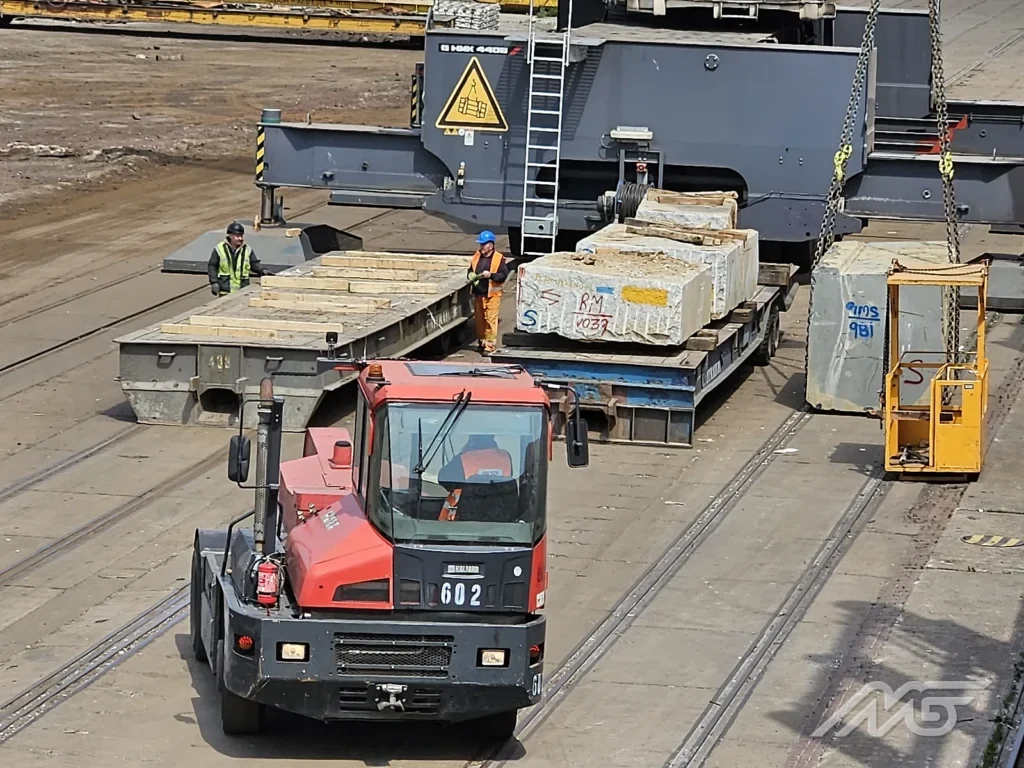
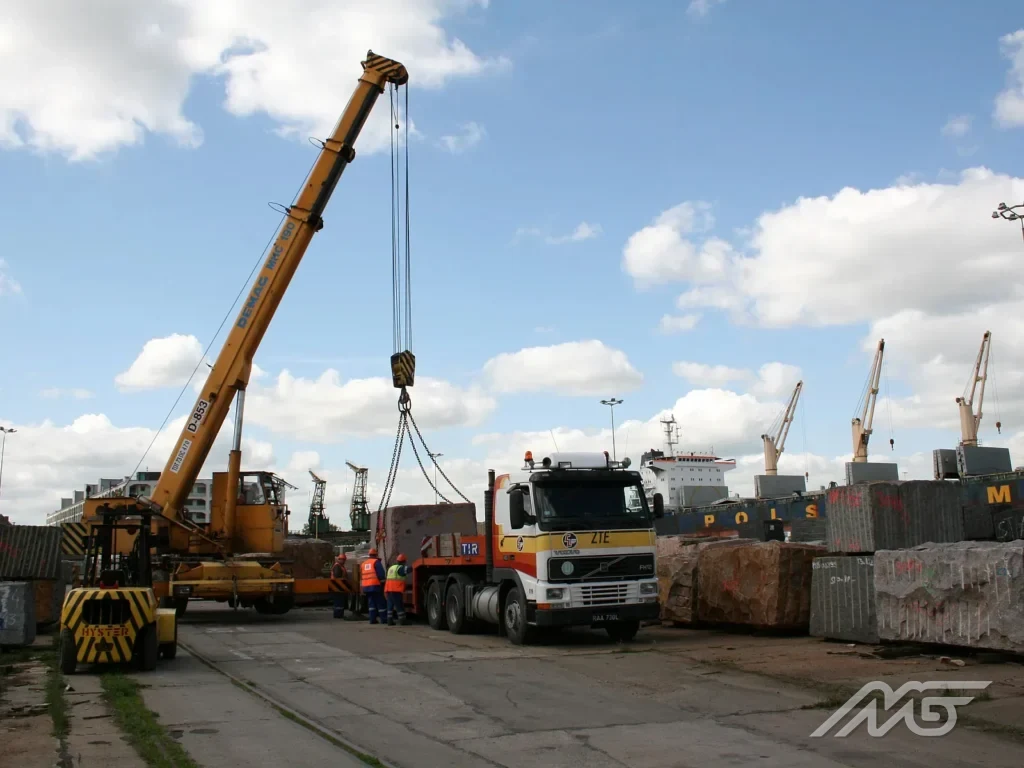
A separate group is cargo that arrives by sea and goes straight from the quay onto a road unit: stone blocks, mining machinery, vessels, transformers. Here the oversized movement is the final leg of a longer chain and is planned together with sea transport and port forwarding, because the trailer has to be on the quay within the ship's handling window.
Large cargo does not always mean formalities. A forty-foot container, a construction machine on a low-loader or a bundle of steel plate stay within the limits as long as the combination does not exceed the permissible dimensions and weights. That is why the first step is always measurement and calculation, rather than the assumption that a large item must automatically cost several thousand zloty in paperwork.
A combination travels without a permit if it stays within four limits at the same time: 2.55 m in width, 4 m in height, 16.5 m in length for a tractor unit with a semi-trailer and 40 tonnes actual gross weight. Exceeding any one of them makes the vehicle non-standard. A movement within the limits requires no consent at all, so the difference between the two can amount to a few centimetres and several thousand zloty.
The permissible width of a vehicle is 2.55 m, or 2.60 m for insulated and refrigerated bodies. The height of the vehicle with its load may not exceed 4 m. Length depends on the combination: a single vehicle 12 m, a tractor unit with a semi-trailer 16.5 m, a combination with a drawbar trailer 18.75 m. Height is the parameter that produces the most surprises, because it is measured together with the load and the deck of the trailer, not for the load alone.
The permissible gross weight of a combination is 40 tonnes. In combined transport - where the container travels by rail, inland waterway or sea for at least one leg - the limit rises to 42 tonnes for a five-axle combination and 44 tonnes for a six-axle one. This exception is worth checking for every heavy container leaving the port: a movement within that regime may need no permit at all, even though it weighs more than the standard forty tonnes.
Axle loads used to be a separate problem. Poland restricted vehicles with an 11.5-tonne drive axle load to a designated road network and required a permit elsewhere. In its judgment of 21 March 2019 in case C-127/17 the Court of Justice of the European Union held that system to be contrary to EU law, and the 2021 amendment opened all public roads to loads of up to 11.5 tonnes. The restriction remains only on unsurfaced roads, where the limit for a single drive axle is 8 tonnes.
The limits are only the first filter. Local bans and weight restrictions posted by road authorities, the load-bearing capacity of bridges and viaducts and the vertical clearance under structures all apply independently. A combination comfortably within the statutory limits still will not pass under a viaduct with a clearance of 3.9 m. Route planning therefore starts from a map of constraints, not from the shortest way offered by a satnav.
A permit for oversized transport comes in five categories, and which one is needed depends on dimensions, weight and the class of roads on the route. The rules are set out in Articles 64a-64d of the Road Traffic Act, and the fees in the regulation of the Minister of Infrastructure of 16 February 2021 (Journal of Laws item 315). Permits from category II upwards are issued for indivisible loads only.
Covers slow-moving vehicles, agricultural tractors and combinations with a special trailer up to 3.5 m wide, with all other parameters within the limits. It applies to public roads other than motorways and expressways. The permit is issued by the district authority (starosta) for 12 months and costs PLN 100. It rarely appears in freight transport.
For combinations up to 3.2 m wide, 15 m long for a single vehicle and 23 m for a combination, up to 4.3 m high, with axle loads and weight within the limits. Issued by the district authority and, for a vehicle entering Poland, also by the head of the customs and tax office. The permit is available for 1, 6, 12 or 24 months at PLN 200, 400, 1,200 and 2,000 respectively.
Extends the permissible width to 3.4 m and the length of a combination to 30 m where it has steered axles. Issued by the General Directorate for National Roads and Motorways (GDDKiA), and it also confers the rights attached to category II. Fees: PLN 500, 1,000, 2,000 and 3,000 for 1, 6, 12 and 24 months.
The category for heavy cargo: actual gross weight up to 60 tonnes, width up to 3.4 m and, on dual carriageways of class A and S, up to 4 m. Issued by GDDKiA, with fees of PLN 800, 1,600, 3,200 and 4,800. This is the most common permit in the transport of industrial machinery and steel structures.
Applies where the movement cannot be made under a category I-IV permit, that is for genuinely large loads. Issued by GDDKiA or, within a city with district status and away from motorways and expressways, by the mayor. The permit covers a designated route and requires the consent of every road authority along it. It is issued for a single journey within 14 days or for multiple journeys within 30 days. A single journey costs PLN 500 or PLN 1,600 depending on the extent of the excess, and multiple journeys are calculated using the formula set out in the regulation.
Category II-IV permits are issued within 3 working days of the application and payment of the fee. Category V has a deadline of 14 working days, extended to 30 days where the journey requires infrastructure on the route to be adapted. That last case is the most common reason for a delivery date to move, and clients usually learn about it too late.
Piloting becomes compulsory once a movement exceeds 23 m in length, 3.2 m in width, 4.5 m in height or 60 tonnes actual gross weight - any one of these is enough. The rules are laid down in the regulation of the Minister of Infrastructure of 8 November 2023 on the piloting of non-standard vehicles, in force since 17 February 2024, which replaced the 2012 rules.
One pilot vehicle is required once any of the thresholds is exceeded: 23 m in length, 3.2 m in width, 4.5 m in height or 60 tonnes. Two pilot vehicles, one ahead and one behind, are required above 30 m in length, 3.6 m in width, 4.7 m in height or 80 tonnes. The number of pilots is planned together with the route, since it drives both the cost and the feasibility of the narrower sections.
A pilot is not simply anyone with a car. The role requires completion of training in the performance of certain activities connected with directing road traffic, run by a provincial road traffic centre (WORD), and a valid certificate confirming those qualifications. On that basis Article 6 of the Road Traffic Act allows a pilot to give instructions and signals to road users - something otherwise reserved for the police.
The 2023 regulation tidied up the appearance of pilot vehicles. The compulsory roof sign was withdrawn, a minimum vehicle height of 1.70 m was introduced and van, pickup and multi-purpose bodies were allowed. The markings on the bonnet, sides and rear doors were standardised so that a pilot can be recognised from any direction. The vehicle must carry amber flashing beacons, radio communication equipment and a loudhailer.
The pilot's task is to ensure the movement is properly organised and to monitor conditions as they change: holding traffic during a manoeuvre, warning oncoming drivers, checking clearances ahead of structures and keeping in contact with the driver of the combination. Night movements add coordination with the road authority wherever a sign or signal head has to be removed temporarily or overhead lines lifted.
An oversized movement is planned backwards: first you establish where the combination can physically pass, and only then do you give a delivery date. The reverse order is the most common cause of delay, because the statutory deadlines for permits are fixed and cannot be shortened by paying more.
You need the overall dimensions in three axes, the weight, the position of the centre of gravity and the support and lashing points, together with a drawing or a photograph with dimensions. With machinery it is worth establishing at once whether the manufacturer allows protruding parts to be removed, since taking off a single stack can bring the height below the threshold and eliminate piloting altogether.
The dimensions and weight determine the equipment: a low-loader, a step-frame trailer, a modular trailer with steered axles or, for the heaviest cargo, a combination spreading the load over a dozen or more axles. The choice changes the overall height and the number of axles, and therefore feeds directly into the permit category and the whole logistics project. The same load may require category IV on one combination and category V on another.
The route is checked for bridge capacity, viaduct clearances, the radii of bends, roundabouts, level crossings and local restrictions. Route planning therefore starts from a map of constraints onto which the dimensions of the cargo are plotted. For large sizes a survey run is made in a car with measurements taken at the critical points. The route has to be planned together with a fallback in case a road is closed, because a category V permit ties the haulier to one specific alignment.
The application goes to the competent authority together with the fee and, for category V, with the consents of the road authorities. Allow 3 working days for categories II-IV and 14 working days for category V. If the route requires infrastructure to be adapted, the period rises to 30 days.
Once the route is fixed, the number of pilot vehicles is known and so is whether police assistance is needed. Time windows are agreed, usually at night, along with any temporary removal of road furniture and lifting of overhead lines.
The cargo is secured in line with EN 12195-1 and the method is documented with photographs. During the journey the position of the combination is monitored and contact with the pilots is maintained. The driver and the pilots work on a shared radio channel.
At destination you need a surveyed hardstanding, lifting equipment of adequate capacity and a person authorised to take delivery. Once delivered, the transport documents are closed - and, for imported cargo, the customs file as well.
The cost of an oversized movement has four parts: the work of the combination, the official permit fees, piloting and adapting the route. Any one of them can outweigh the others, which is why the price varies with the cargo more than in any other branch of road haulage.
This is the only component with a published tariff. A category II permit for one month costs PLN 200, category III PLN 500, category IV PLN 800, and a single journey under category V from PLN 500 to PLN 1,600. For repeat movements an annual permit usually pays for itself; for a one-off project each journey is counted separately.
The rate depends on the type of trailer, the number of axles and whether the unit returns empty. A modular trailer with steered axles costs a multiple of an ordinary low-loader, and for the heaviest cargo a second tractor unit is added as a pusher. Time has to be priced in as well: an oversized movement runs slowly and often only at night, so a route normally covered in one day takes three.
Every pilot vehicle is a separate day's work with a driver holding the required certificate. Above 30 m in length, 3.6 m in width, 4.7 m in height or 80 tonnes there are two of them, which doubles this component. Movements through built-up areas add the cost of police assistance.
The least predictable item. Temporary removal of a sign, a signal head or a barrier, lifting overhead lines, strengthening a verge or hiring road plates for access to a site. These works are paid for by the party moving the cargo, and their scope only becomes clear after the survey run.
Insurance for cargo whose value is far above that of an ordinary consignment, road tolls in the e-TOLL system, ferry crossings and, for imported cargo, port charges and customs clearance. What speeds up a quotation most is a complete set of data: dimensions, weight, loading and unloading addresses, the intended date and whether lifting equipment is available at both ends.
Moving a non-standard vehicle without a permit carries a financial penalty of between PLN 1,500 and PLN 15,000, and liability does not stop with the haulier. The applicable rules are precise: the amounts follow from Article 140ab of the Road Traffic Act and the range of parties who can be penalised from Article 140aa of the same Act. This is why the formalities on such a movement are entrusted to an organiser rather than dealt with in haste.
Travelling without a category I permit costs PLN 1,500, without a category II-IV permit PLN 5,000. Where the parameters call for category V, the penalty rises with the extent of the excess: PLN 6,000 up to 10 per cent, PLN 10,000 between 10 and 20 per cent and PLN 15,000 above 20 per cent. The penalty is imposed by administrative decision of the body carrying out the check: the police, the Road Transport Inspectorate, the Border Guard, the National Revenue Administration or the road authority.
Article 140aa(3) allows a penalty to be imposed not only on the party performing the movement but also on the transport organiser, the consignor, the consignee, the loader or the forwarder, where the circumstances or the evidence show that they influenced the infringement or acquiesced in it. A company that awarded the job to the cheapest offer on a freight exchange and never asked about the permit is not safe under that construction.
Separate amounts apply to piloting: PLN 3,000 for failing to provide the required number of pilot vehicles, PLN 2,000 for a vehicle without the required equipment or markings and PLN 2,000 where the pilot holds no certificate of completed training.
Taking a non-standard vehicle across a bridge or viaduct requires notice to the authority responsible for the structure. Failure to give notice costs PLN 5,000, crossing contrary to the conditions set by that authority PLN 3,000, and crossing despite its objection PLN 6,000. Civil liability for damage to the structure comes on top, and next to it the administrative penalty tends to be the smaller problem.
Beyond penalties there are delays. A road closure on the route named in a category V permit means applying for a new permit, not taking a diversion. Winter and wind hold up movements of tall components, because moving a turbine blade safely in a strong crosswind is simply not feasible. Risks of this kind are planned for in advance, by building slack into the schedule rather than explaining them to the client after the event.
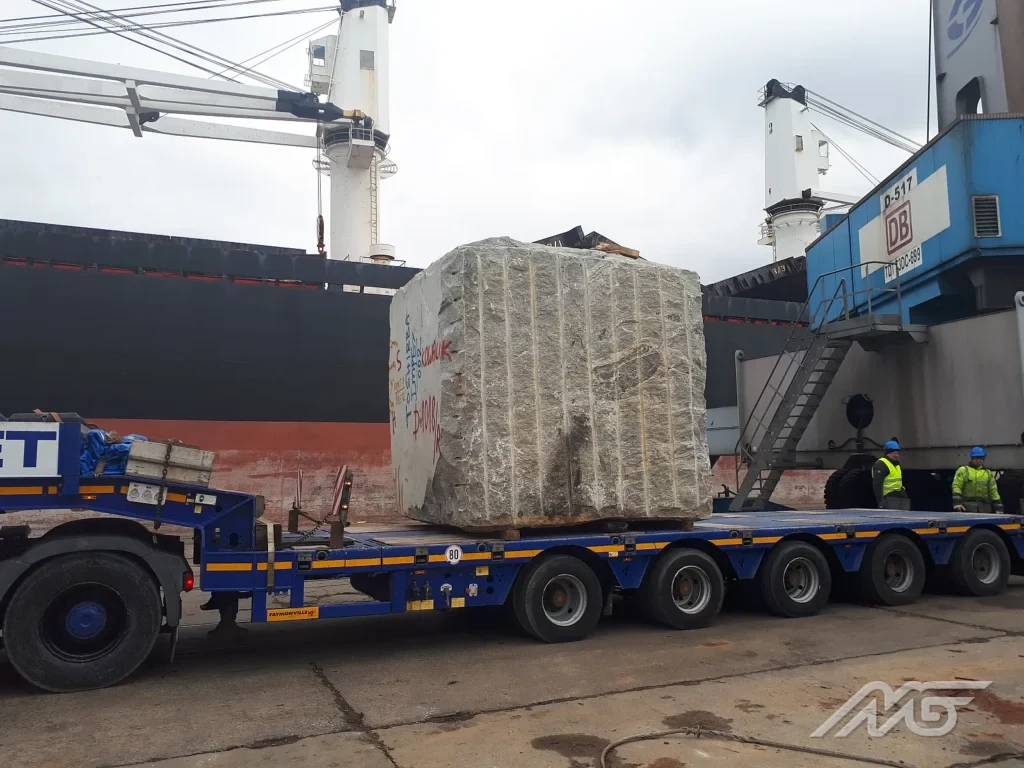
For cargo arriving by sea, the most expensive point of the project is where the port meets the road - and that is where we have worked since 1999. A base at the port of Szczecin lets us run the handling, the customs formalities and the oversized road movement under a single order, instead of stitching together three suppliers and three schedules. We work in both directions: for cargo coming off a vessel and for exports still due to be loaded.
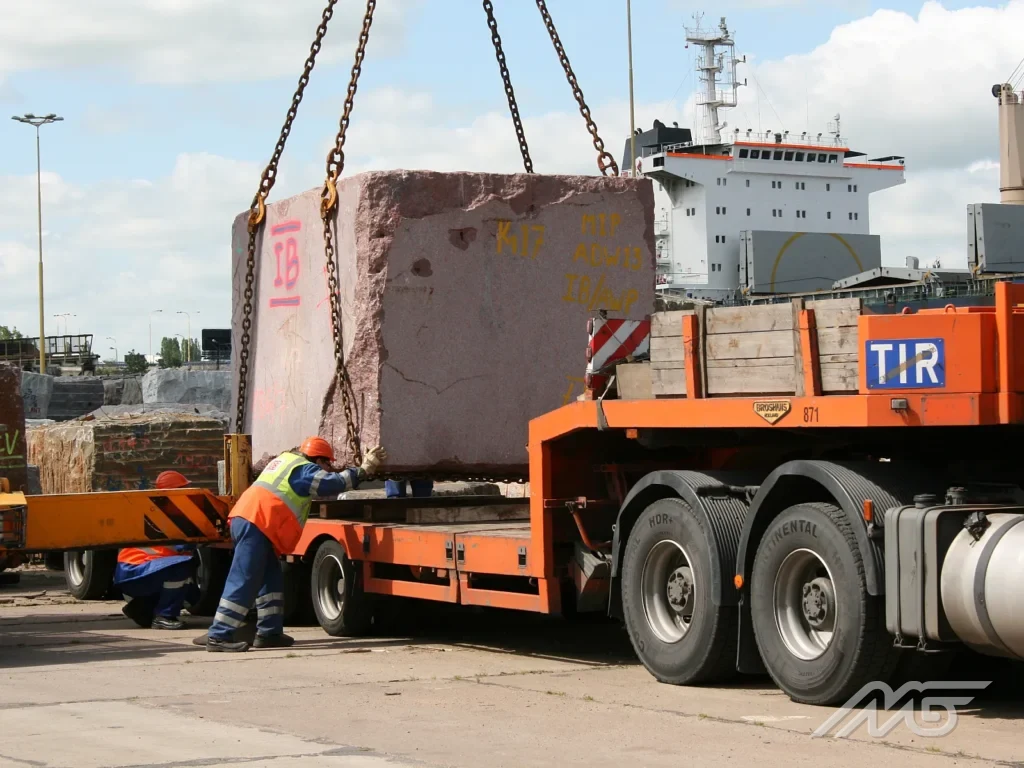
For heavy items direct transhipment is the most economical option: the port crane lifts the piece off the vessel straight onto a waiting combination. There is no storage, no second lift and no risk added by every further movement. The condition is matching the ship's handling window to the arrival of the trailer, which is exactly what port forwarding coordinates.
Imported cargo needs a customs declaration before it can travel. We handle it in-house as a customs agency with AEO status, so the transport does not wait for documents prepared by an outside party.
The question of where to find hauliers specialising in oversized transport comes up in every conversation. The criteria are measurable: who submits the permit applications and in whose name, whether the company has already run a movement of similar parameters, what carrier's liability insurance it holds and whether the cargo will be covered by a goods-in-transit policy, and whether it can show the route with its critical points marked. A haulier that does not ask about the centre of gravity and the support points at the quotation stage is not planning the movement, only quoting a rate.
Some clients have their own haulier and need only the route and the permits. We take on that scope as well - choosing to move the cargo yourself does not mean you have to take on the part where the penalties arise. Call us or send an enquiry with the dimensions and weight, and we will tell you which permit category the movement requires and how long it will take to obtain.
Oversized transport means moving cargo whose weight or dimensions exceed the limits set out in the road traffic regulations. Under Article 2(35a) of the Polish Road Traffic Act, a non-standard vehicle is one whose axle loads, dimensions or actual gross weight, with or without a load, exceed the permissible values. The status is assessed for the combination together with its cargo, so the same item may require a permit on one trailer and none on another.
A combination travels without a permit if it stays within four limits at once: 2.55 m in width (2.60 m for insulated bodies), 4 m in height including the load, 16.5 m in length for a tractor unit with a semi-trailer or 18.75 m for a combination with a drawbar trailer, and 40 tonnes actual gross weight. In combined transport the weight limit rises to 42 tonnes for a five-axle and 44 tonnes for a six-axle combination. A single drive axle load of up to 11.5 tonnes is permitted on all surfaced public roads.
Category II, III and IV permits are issued within 3 working days of the application and payment of the fee. A category V permit has a deadline of 14 working days, extended to 30 days where the journey requires elements of the road infrastructure to be adapted. These periods are statutory and cannot be shortened, which is why the application is filed in parallel with the route work rather than after a delivery date has been promised.
The rates follow from the regulation of the Minister of Infrastructure of 16 February 2021. Category I costs PLN 100 for 12 months. Category II costs PLN 200 for one month, PLN 400 for six months, PLN 1,200 for a year and PLN 2,000 for two years. Category III costs PLN 500, 1,000, 2,000 and 3,000 respectively, and category IV PLN 800, 1,600, 3,200 and 4,800. A single journey under category V costs PLN 500 or PLN 1,600, depending on the extent to which the parameters are exceeded.
One pilot vehicle is required once the movement exceeds 23 m in length, 3.2 m in width, 4.5 m in height or 60 tonnes actual gross weight - any one parameter is enough. Two pilot vehicles, ahead and behind, are required above 30 m in length, 3.6 m in width, 4.7 m in height or 80 tonnes. The rules are set out in the regulation of the Minister of Infrastructure of 8 November 2023, in force since 17 February 2024.
A pilot must hold a valid certificate of completed training in the performance of certain activities connected with directing road traffic, run by a provincial road traffic centre (WORD). Only then does Article 6 of the Road Traffic Act allow the pilot to give instructions and signals to road users. The pilot vehicle must carry the required markings, amber flashing beacons, radio equipment and a loudhailer, and since 17 February 2024 must be at least 1.70 m high. Where the pilot has no certificate, the penalty is PLN 2,000.
The regulations provide no separate licence for oversized loads. The driver needs a driving licence of the category matching the combination, usually C+E, together with a Driver CPC and the current medical and psychological examinations required in road transport. In practice hauliers assign such work to drivers with years of experience, because manoeuvring a modular trailer with steered axles and running in convoy with pilot vehicles is an entirely different job from pulling a curtain-sided trailer.
The penalty is PLN 1,500 where a category I permit is missing, PLN 5,000 for categories II-IV and between PLN 6,000 and PLN 15,000 where the parameters call for category V, depending on the extent of the excess. The basis is Article 140ab of the Road Traffic Act. What matters for those placing the order: Article 140aa(3) allows the penalty to be imposed on the transport organiser, the consignor, the consignee, the loader or the forwarder as well, where they influenced the infringement or acquiesced in it.
Yes, and for heavy items it is usually the cheapest route. A vessel has no clearance limits and no bridge capacity to worry about, so components weighing tens of tonnes cover most of the distance by sea and the road leg is reduced to the run from the port. Oversized cargo can also travel by air, but at these sizes and weights that is a marginal and extremely costly solution, used in practice for emergency deliveries. Magemar arranges the sea and road options and the combination of the two.
Four groups of data: the overall dimensions and weight of the cargo, the loading and unloading addresses together with information on access and lifting equipment at both ends, the intended date, and the type of cargo with its support and lashing points. A drawing or a photograph with dimensions helps. With that set we can tell you which permit category the movement requires, whether pilot vehicles will be needed and how long the formalities will take.