

We organise ADR transport of dangerous goods of all classes, domestic and international. The carriage is entrusted to carriers whose vehicles are equipped in line with ADR and whose drivers hold a valid ADR certificate, while classification, documents, marking and customs clearance are handled by us.
ADR Transport - call us or send an enquiry. We prepare every quote individually.

ADR transport is the carriage of dangerous goods by road under the ADR agreement, a set of international rules which in Poland also apply to domestic journeys. The agreement sets out how goods must be classified, packed and marked, what documents the driver must carry, how the vehicle must be equipped and who is responsible for what.
Every job starts with checking the classification: the UN number, class and packing group taken from the safety data sheet. This decides whether the load needs full ADR treatment or falls within the small-quantity exemption, which vehicle has to be provided and what qualifications the driver needs. A mistake at this stage carries through the whole movement and ends with the vehicle being stopped at a roadside check or a fine for the consignor.
We do not own a fleet. We work with carriers whose vehicles and drivers are approved for the relevant class, and we handle the documents, marking and supervision of the movement on our side. We also offer DGSA advisory services, and for imports and exports we combine ADR transport with customs clearance and sea freight forwarding.
The scope covers the entire carriage of dangerous goods, from verifying the classification to confirmed unloading. The services are usually ordered as a package, because the transport document, marking and choice of vehicle all follow from the same data about the goods.

We run ADR jobs in a fixed order, because each step builds on the previous one: without a confirmed classification the vehicle cannot be chosen, and without the vehicle and driver the documents cannot be completed.
Verification of ADR classification
Selection of appropriate transport means
Preparation of documentation
Execution and supervision
When dangerous goods are carried, responsibility does not end with the carrier. The regulations also place duties on the consignor, and a fine for an error in classification or in the transport document goes to whoever made it. Choosing the organiser of an ADR movement is therefore a decision about who checks that data before an inspector does.
Experienced personnel - our team knows the ADR regulations and regularly attends refresher training
Vetted carriers - only companies with current ADR qualifications and vehicles equipped for the class
Classification checked before quoting - the UN number, class and quantity determine the vehicle, documents and price
Road and sea in one job - ADR, the IMDG Code and AEO customs clearance without handing the cargo between companies
Based by the port in Szczecin - in business since 1999, collecting cargo from any location in Poland
One handler per job - from checking the documents to confirmation of unloading

Contact us regarding ADR transport
Contact us →ADR transport is the carriage of dangerous goods by road under the ADR agreement, which lays down the classification of the goods, packaging, marking, documents, vehicle equipment and driver qualifications. The abbreviation comes from the French title Accord relatif au transport international des marchandises dangereuses par route. In English it is the Agreement concerning the International Carriage of Dangerous Goods by Road.
The agreement was drawn up in Geneva on 30 September 1957 under the auspices of the United Nations Economic Commission for Europe (UNECE) and entered into force on 29 January 1968. Until the end of 2020 its full title was the European Agreement concerning the International Carriage of Dangerous Goods by Road. From 1 January 2021 the word "European" was dropped, because the contracting parties include countries outside Europe, among them Morocco, Tunisia and Kazakhstan.
ADR is updated every two years. The current edition is ADR 2025, applicable from 1 January 2025. Each edition changes details of classification, marking or equipment, so documents prepared under an older edition may not pass a check.
The agreement itself covers international carriage, but Directive 2008/68/EC requires EU member states to apply its provisions to domestic transport as well. In Poland this is done by the Act of 19 August 2011 on the Carriage of Dangerous Goods. In practice, drums of solvent travelling from Szczecin to Poznan are subject to the same requirements as those going to Hamburg. The Act adds Polish rules on inspections and financial penalties.
The ADR agreement deals only with the road transport of dangerous goods. Rail has its own RID regulations, inland waterways ADN, and sea transport the IMDG Code. All of them are based on the same UN recommendations, so a product's class and UN number are the same everywhere, but the documents and stowage rules differ. A load that travels by lorry to the port and then by ship has to meet two sets of rules at once. In Szczecin this is routine rather than the exception.
Dangerous goods within the meaning of ADR are any substances or articles listed in the regulations or meeting the criteria of one of the nine hazard classes. Hazardous materials are not just fuels and industrial chemicals. ADR also covers paints, adhesives, aerosols, batteries, lithium cells, perfumes, cleaning products in larger quantities and many items that sit on an ordinary shop shelf.
Every product in ADR has a four-digit UN number and a proper shipping name. Petrol is UN 1203, diesel UN 1202, paint UN 1263. The UN number opens a row in Table A of the regulations, from which everything else is read: packaging, marking, quantity limits and transport category.
Most goods are also assigned a packing group: I means high danger, II medium and III low. The same substance in a different packing group may require different packaging and score a different number of points under the small-quantity exemption.
Classification is the consignor's duty, not the carrier's. The main source is the product's safety data sheet, where section 14 contains transport information: UN number, shipping name, class and packing group. We check this data before quoting, because data sheets are sometimes out of date or incomplete, and one class of difference changes the vehicle, the documents and the price.
Not all ADR dangerous goods need a vehicle with orange-coloured plates and a driver with ADR qualifications. The regulations provide exemptions depending on the quantity of goods and the way they are packed. Applied correctly, they can lower the cost of carriage; applied wrongly, they end with a fine at the first check.
Each product is assigned a transport category from 0 to 4 in Table A. The quantity in kilograms or litres is multiplied by the category factor: 50 for category 1, 3 for category 2 and 1 for category 3. Category 4 goods are not counted, and category 0 goods cannot be exempted at all. If the total for the whole vehicle does not exceed 1,000 points, the carriage takes place under simplified rules.
Example: 300 litres of paint UN 1263 in packing group II is transport category 2, so it scores 900 points and stays within the limit. The vehicle then needs no orange-coloured plates and the driver no certificate. A transport document, correctly marked packages, a fire extinguisher of at least 2 kg and driver training covering the goods carried are still required.
Goods packed in small inner packagings, below the limits given for each UN number, can be carried as limited quantities, marked with the LQ symbol. Cosmetics, aerosols and household chemicals typically travel this way. The consignor informs the carrier of the total gross mass of such goods, and the vehicle must display the LQ mark at the front and rear only when a transport unit over 12 tonnes carries more than 8 tonnes of goods in limited quantities.
Even smaller amounts, counted in grams and millilitres per inner packaging, may be carried as excepted quantities, marked with the EQ symbol. This mainly concerns samples, laboratory reagents and courier parcels. For palletised loads this exemption rarely applies.
Which exemption can be used is decided when we verify the classification, before the movement is quoted. The cost difference between full ADR and the 1.1.3.6 exemption can be significant, so it is worth checking for every load.
The carriage of ADR goods requires three kinds of qualification: the driver must hold a valid certificate, the vehicle must meet the requirements for the class, and the business must appoint a safety adviser. Without any one of them the movement stops, however well the load itself has been prepared.
The driver of a vehicle carrying dangerous goods above the exemption thresholds must hold an ADR driver training certificate, issued after a course and an examination. The basic course covers carriage in packages. Carriage in tanks and of Class 1 and Class 7 goods requires specialist courses. The certificate is valid for five years, and renewal requires a refresher course and a passed examination in the final year of validity.
Anyone wanting to become an ADR driver therefore starts with the appropriate ADR course at a training centre and chooses the scope of the certificate according to the work they intend to do. When selecting a carrier, we check whether the driver's certificate covers the class of goods and the method of carriage for that particular job, not merely whether the driver holds one.
A haulier needs authorisation to operate road transport and, for international journeys, a Community licence. ADR adds requirements for the vehicle: equipment, marking and, for certain vehicle types such as tankers for flammable liquids, a certificate of approval valid for one year. Only some transport companies have vehicles and drivers approved for every class, which is why the choice of carrier for ADR is narrower than for ordinary cargo.
Every business whose activities include the carriage of dangerous goods, or the related packing, loading, filling or unloading, must appoint a dangerous goods safety adviser, known as a DGSA or simply as an ADR adviser. The adviser oversees the conditions for the safe carriage of goods within the business, monitors compliance with the regulations, advises the company, prepares an annual report and reports on accidents. The adviser's certificate is valid for five years. DGSA advisory is part of our offer for consignors who prefer not to build this function in-house.
A roadside check of an ADR vehicle looks at three things: marking, equipment and the full set of documents in the cab. Gaps in any of them are separate infringements, and a fine can be imposed on the carrier as well as the consignor.
A vehicle carrying dangerous goods under full ADR displays orange-coloured plates measuring 40 by 30 cm at the front and rear. On tankers and bulk vehicles the plates carry two numbers: the upper one is the hazard identification number, the lower one the UN number. Petrol, for example, is marked 33 over 1203. These numbers tell the fire service what it is dealing with before anyone approaches the vehicle. Containers and tanks also carry placards showing the class symbol, and packages are marked with the UN number.
The minimum fire extinguisher capacity depends on the permissible maximum mass: 4 kg up to 3.5 tonnes, 8 kg up to 7.5 tonnes and 12 kg above 7.5 tonnes, including one extinguisher of at least 2 kg suitable for fighting an engine or cab fire. On top of that come a wheel chock, two self-standing warning signs and eye rinsing liquid, and for each crew member a warning vest, a torch, gloves and eye protection. Some classes also require emergency escape masks, a shovel, a drain seal and a collecting container for spills.
On international journeys a CMR consignment note is added, and outside the EU customs documents too. The ADR transport document and the CMR note can be a single document, provided it contains all the required information.
ADR spreads responsibility across all participants in the carriage, not only the carrier. The consignor, loader, packer, filler, carrier, consignee and unloader each have their own list of duties. That is why a fine for incorrectly described goods can go to the consignor and one for a missing extinguisher to the carrier, even though both infringements are found during the same check.
The consignor is responsible for ensuring that the goods are correctly classified and authorised for carriage, packed in packagings approved for the UN number and properly marked. The consignor hands the carrier the transport document and all information needed for the journey. Where the consignor uses the services of others, such as a freight forwarder, it remains responsible for the accuracy of the information passed on.
The carrier checks that the goods are authorised for carriage, that the documents are on board, that the load and vehicle have no visible defects, that the vehicle is not overloaded and that it carries the required marking and equipment. The carrier gives the driver the instructions in writing and makes sure the driver holds a certificate appropriate to the job.
While carrying hazardous materials, the driver may not take passengers or smoke during handling operations or near the vehicle. For certain quantities of goods, a parked vehicle must be supervised or left in a secure parking area. The driver also needs to know the route in terms of restricted tunnels - tunnels are assigned categories B to E, and the tunnel restriction code in the transport document shows which of them the vehicle may pass through.
The consignee may not delay accepting the goods without good reason and, after unloading, checks that the requirements concerning it have been met, such as cleaning the vehicle or container. For deliveries to industrial sites it is worth agreeing unloading times and conditions in advance, because a vehicle carrying dangerous goods cannot wait just anywhere.
When a dangerous load travels by lorry to the port and on by ship, it must comply with both ADR and the International Maritime Dangerous Goods Code (IMDG) at the same time. The Code is mandatory under the SOLAS Convention and in many respects asks for more than ADR, particularly in documentation and stowage on board.
The sea leg requires a dangerous goods declaration in the IMDG Code format and, for a container, a container packing certificate signed by the person responsible for packing it. The certificate confirms that the goods have been stowed and secured correctly, that the container holds no goods that must not be packed together, and that placards are fixed on all four sides. Without these documents the terminal will not accept the container for loading.
On ro-ro ferries in the Baltic Sea area, including the routes from Swinoujscie to Sweden, a Memorandum of Understanding between the Baltic states applies; its current edition has been in force since 1 January 2023. Under specified conditions it allows vehicles prepared in accordance with ADR to be carried without full application of the IMDG Code. The dangerous goods must still be declared to the shipping line before sailing, and the number of spaces for such cargo on each ferry is limited.
When ADR goods are imported or exported, three sets of procedures meet at the terminal: port rules, dangerous goods regulations and customs clearance. Magemar handles sea freight forwarding and customs clearance as an AEO-accredited agency, so the goods data, transport documents and customs declaration are produced within one company. A container of dangerous goods collected from the quay continues as ADR transport without documents being passed between several parties.
Breaching the rules on the carriage of dangerous goods in Poland carries a fine of PLN 200 to PLN 10,000, imposed separately on each participant who has failed in their duties. The legal basis is Article 107 of the Act of 19 August 2011 on the Carriage of Dangerous Goods, and the list of infringements and their seriousness is set out in Commission Regulation (EU) 2016/403.
The total of fines imposed on a single participant during one roadside check may not exceed PLN 10,000. At an inspection carried out at the company's premises the limits are higher and depend on the number of drivers employed: from PLN 15,000 for businesses with up to 10 drivers to PLN 30,000 for those with more than 250. For other participants, such as the consignor or loader, the limit is PLN 40,000. These thresholds have applied since the Act was amended in 2018.
The carriage of dangerous goods in road traffic is inspected by, among others, the Road Transport Inspectorate, the Police, the Border Guard and the National Revenue Administration. The most common infringements are a missing or incorrect transport document, missing instructions in writing, incomplete vehicle equipment, a driver without a certificate or with one that does not cover the class, incorrect marking and poorly secured cargo.
Where an infringement creates an immediate risk, the inspector may stop the journey until it is put right, which means extra standing costs and a late delivery. If incorrect carriage leads to an accident, environmental contamination or harm to third parties, civil and criminal liability arise under the general rules. That is why we check the documents before departure, not after an inspection.
ADR transport costs more than moving ordinary cargo on the same route, but the difference depends mainly on the class and quantity of the goods, not on the mere fact that they are dangerous. A load within the 1.1.3.6 exemption may cost little more than an ordinary pallet, while carrying explosives requires a separate operation. We quote rates for each specific job, but the way they are built up can be shown.
Correct classification helps most, together with checking whether the load fits within the small-quantity exemption or limited quantities. The second factor is a flexible loading window, which lets the job be matched to an ADR vehicle already heading that way. The third is regularity: on repeat routes the carrier can plan return loads and the rate falls.
To quote we need the UN number and class of the goods or the safety data sheet, the quantity and type of packaging, the gross weight, the places of loading and unloading, and the date. We collect cargo from any location in Poland. On that basis we check whether an exemption applies, select a carrier and give a rate together with the date until which it stands. Quotations are free of charge and carry no obligation to place an order.
We quote each job individually, because the rate depends on the class and quantity of the goods, the route and the date. ADR transport costs more than ordinary carriage, since the vehicle must have ADR equipment and the driver a certificate for the class, which narrows the choice of carriers. Ferry crossings, detours forced by tunnel restrictions and empty running also raise the price. Correct classification lowers it: a load within the 1.1.3.6 exemption or in limited quantities costs noticeably less than carriage under full ADR. Quotations are free of charge.
It is the carriage of dangerous goods by road under the ADR agreement, drawn up in Geneva in 1957 under the auspices of the UN. The agreement lays down the classification of goods, packaging, marking, documents, vehicle equipment and driver qualifications. In the European Union, under Directive 2008/68/EC, its provisions also apply to domestic transport, and in Poland they are supplemented by the Act of 19 August 2011 on the Carriage of Dangerous Goods. The current edition is ADR 2025.
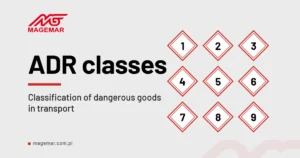
Dangerous goods are divided into nine classes: 1 - explosive substances and articles, 2 - gases, 3 - flammable liquids, 4.1, 4.2 and 4.3 - flammable solids, substances liable to spontaneous combustion and substances emitting flammable gases in contact with water, 5.1 and 5.2 - oxidizing substances and organic peroxides, 6.1 and 6.2 - toxic and infectious substances, 7 - radioactive material, 8 - corrosive substances, 9 - miscellaneous dangerous substances and articles, such as lithium batteries. The class, UN number and packing group of a product are given in section 14 of its safety data sheet.
A carrier authorised to operate road transport, with a vehicle meeting the ADR requirements for the class and a driver holding a valid certificate. The certificate is issued after a course and an examination, and carriage in tanks and of Class 1 and 7 goods requires specialist courses. Some vehicle types, such as tankers for flammable liquids, need a certificate of approval. A business involved in the carriage must also appoint a dangerous goods safety adviser (DGSA). We select the carrier by checking all of these qualifications against the specific load.
The cab must contain: the ADR transport document with the UN number, shipping name, class, packing group, tunnel code and quantity of goods; instructions in writing for emergencies, in a language the crew understands; the driver's certificate and photo identification for each crew member; and the vehicle's certificate of approval where that vehicle type requires one. International journeys add a CMR consignment note, and a sea leg requires a dangerous goods declaration under the IMDG Code and a container packing certificate.
Not always. The exemption in ADR 1.1.3.6 allows goods to be carried under simplified rules if the total points for the vehicle do not exceed 1,000. Points are calculated by multiplying the quantity by the factor for its transport category: 50, 3 or 1. For example, 300 litres of paint in packing group II scores 900 points. The vehicle then needs no orange-coloured plates and the driver no certificate, but the transport document, package marking, a 2 kg extinguisher and driver training still apply. Separate exemptions cover limited quantities (LQ) and excepted quantities (EQ).
In Poland, a fine of PLN 200 to PLN 10,000 for each infringement, under Article 107 of the Act on the Carriage of Dangerous Goods. The total for one participant at a roadside check may not exceed PLN 10,000. At an inspection on company premises the limit is PLN 15,000 to PLN 30,000 for carriers, depending on the number of drivers, and PLN 40,000 for other participants, including consignors. The fine goes to the participant who failed in their duties, so a classification error is charged to the consignor, not the driver.
Yes, but the rules for carrying dangerous goods on a ferry differ from those on land. On ro-ro ferries in the Baltic, including the routes from Swinoujscie, a Memorandum of Understanding between the Baltic states applies, which under specified conditions allows vehicles prepared in accordance with ADR without full application of the IMDG Code. The load must be declared to the shipping line before sailing, and space for dangerous goods on each ferry is limited, so it is worth booking well ahead.
Five years from the date of issue. To renew it, the driver must complete a refresher course and pass an examination in the final year of validity. The scope of the certificate depends on the courses completed: the basic course covers carriage in packages, while carriage in tanks and of Class 1 and Class 7 goods requires specialist courses. For every job we check not only that the certificate is valid but also that it covers the class of goods and the method of carriage.
A phone call to +48 669 331 331 or the contact form is enough. To quote we need the UN number and class of the goods or the safety data sheet, the quantity and type of packaging, the gross weight, the places of loading and unloading, and the date. We check the classification and any exemptions, select a carrier qualified for the class and give a rate with the date until which it stands. We collect cargo from any location in Poland. Our office is by the port in Szczecin, at ulica Bytomska 7.