ADR Classes - Classification of Dangerous Goods in Transport
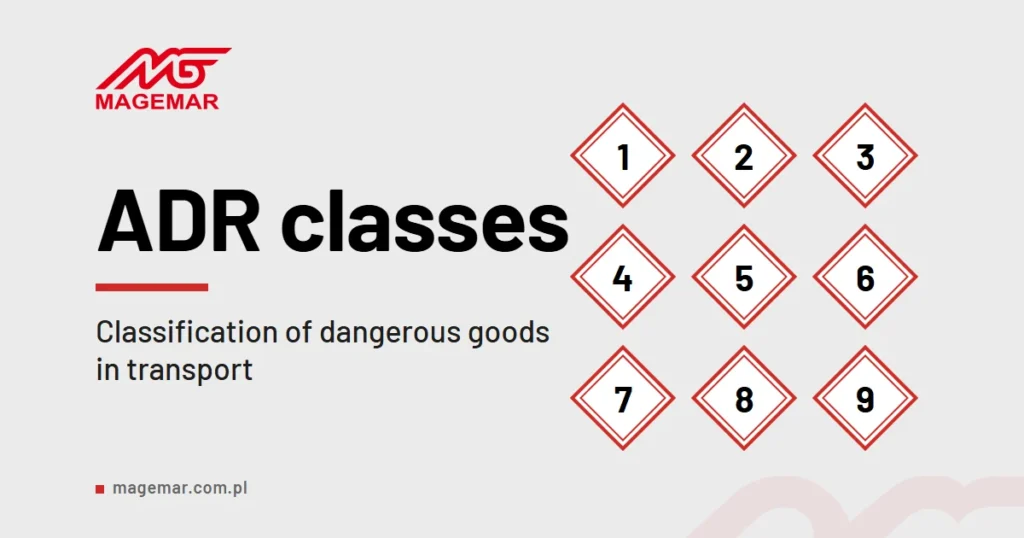
The ADR agreement divides dangerous goods into 9 classes: 1 - explosives, 2 - gases, 3 - flammable liquids, 4 - flammable and reactive solids, 5 - oxidizing substances and organic peroxides, 6 - toxic and infectious substances, 7 - radioactive material, 8 - corrosive substances and 9 - miscellaneous dangerous substances and articles. Petrol, a forklift battery, tins of paint and a box of lithium batteries all fall into different classes, and the class determines how the load must be packed and marked, which vehicle may carry it and which documents must travel in the cab. The ADR classification therefore has to be settled before the load even leaves the warehouse. Below we describe each class, give examples from a freight forwarder’s day-to-day work and explain what the classification means for the consignor.
What ADR is and how many classes of dangerous goods there are
ADR, the European Agreement concerning the International Carriage of Dangerous Goods by Road, was signed in Geneva on 30 September 1957. Poland has applied ADR since 1975, and in Poland the rules also cover domestic carriage. The text of the agreement is updated every two years. The version currently in force is ADR 2025, published in Polish in the Journal of Laws 2025, item 642, and the next amendment comes into force on 1 January 2027.
The ADR classification divides goods into 9 classes. Some of them have divisions, which is why tables often show 13 entries. Under the regulations, the split is based on the type of hazard a substance presents in transport: explosion, fire, poisoning, radiation, corrosion or harm to the environment. A single product may also carry subsidiary hazards, in which case it receives additional labels on top of its main class.
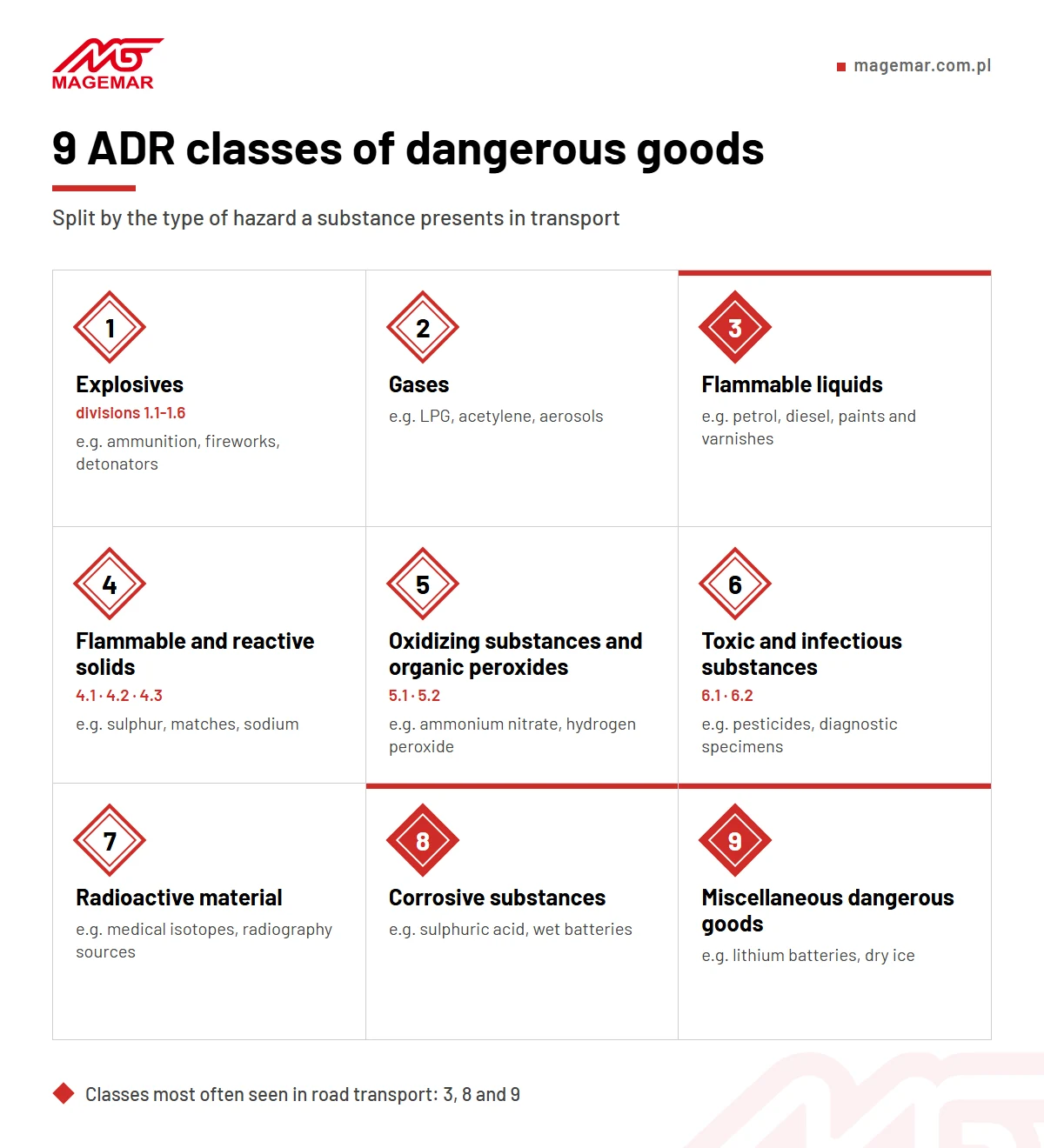
Classification of dangerous goods - table of ADR classes
Split into divisions, the nine ADR classes give 13 entries. In road transport the most common are classes 3, 8 and 9: fuels and paints, acids and batteries, and lithium batteries. The table brings the classes together in one place, with the name of each class and typical examples of goods.
| Class | Name | Examples of goods |
|---|---|---|
| 1 | Explosive substances and articles | ammunition, fireworks, detonators, airbags (some) |
| 2 | Gases | LPG (propane-butane), acetylene, oxygen in cylinders, aerosols |
| 3 | Flammable liquids | petrol, diesel, solvents, paints and varnishes |
| 4.1 | Flammable solids, self-reactive substances, polymerizing substances and solid desensitized explosives | sulphur, matches, naphthalene |
| 4.2 | Substances liable to spontaneous combustion | white phosphorus, charcoal, oily rags |
| 4.3 | Substances which, in contact with water, emit flammable gases | sodium, potassium, calcium carbide |
| 5.1 | Oxidizing substances | ammonium nitrate, hydrogen peroxide, hypochlorites |
| 5.2 | Organic peroxides | resin hardeners, polymerisation initiators |
| 6.1 | Toxic substances | cyanides, pesticides, some solvents |
| 6.2 | Infectious substances | diagnostic specimens, clinical waste |
| 7 | Radioactive material | medical isotopes, industrial radiography sources |
| 8 | Corrosive substances | sulphuric acid, sodium hydroxide, wet batteries filled with electrolyte |
| 9 | Miscellaneous dangerous substances and articles | lithium batteries, dry ice, asbestos, environmentally hazardous substances |
Scroll the table sideways to see all columns.
Class 1 - explosives and their divisions
Class 1 covers explosive substances and articles containing them. It is the only class split into six divisions according to how the load behaves in an accident: from 1.1 (mass explosion hazard) to 1.6 (extremely insensitive articles). On top of that come compatibility groups marked with letters, which decide what may be carried together in one vehicle. A load like this requires a separate specialist course for the driver and, in many cases, permits and security for the load as well.
Class 2 - gases
Class 2 includes compressed, liquefied, dissolved and refrigerated liquefied gases, as well as aerosols and small receptacles containing gas. Gases are grouped by their properties: asphyxiant (A), oxidizing (O), flammable (F), toxic (T) and combinations of these. In practice the most frequently carried are LPG, acetylene, technical oxygen and carbon dioxide. Safe transport of gases depends not only on the gas itself but also on the condition of the cylinders and valves and on how the load is secured.
Class 3 - flammable liquids
This is the largest group in road transport. Class 3 covers liquids with a flash point not higher than 60°C, plus diesel fuel and light heating oil with a slightly higher flash point. Petrol is UN 1203, diesel UN 1202 and paint UN 1263. The class also includes solvents, varnishes, adhesives, alcohols and perfumes in larger quantities. Many of these products sit on ordinary shop shelves, which is why consignors often do not realise they are shipping goods subject to ADR.
Classes 4.1, 4.2 and 4.3 - flammable and reactive solids
Class 4 covers solids that can cause a fire: 4.1 ignites easily from a spark, 4.2 ignites by itself on contact with air, and 4.3 gives off flammable gases on contact with water.
- 4.1 flammable solids, self-reactive substances, polymerizing substances and solid desensitized explosives. They ignite easily from a spark or friction.
- 4.2 substances liable to spontaneous combustion, which ignite on contact with air without any external source of fire.
- 4.3 substances which give off flammable gases on contact with water. Here the key is protecting the load from moisture, including while the vehicle is parked.
Classes 5.1 and 5.2 - oxidizing substances and organic peroxides
Oxidizing substances do not necessarily burn themselves, but they release oxygen and so feed a fire in other materials. Typical examples are ammonium nitrate and hydrogen peroxide. Organic peroxides in class 5.2 are even more demanding: they are unstable compounds, sensitive to temperature and friction. Some of them travel in temperature-controlled vehicles, and exceeding the emergency temperature means a real risk of explosion.
Classes 6.1 and 6.2 - toxic and infectious substances
Class 6.1 covers substances that can cause poisoning if swallowed, inhaled or in contact with skin, such as cyanides, some pesticides and solvents. Class 6.2 is infectious substances: diagnostic specimens, bacterial cultures, clinical waste. In this division packaging matters most. The regulations require a triple packaging system designed to contain a leak even if the consignment is damaged.
Class 7 - radioactive material and the training it requires
Class 7 applies to material emitting ionising radiation: medical isotopes, industrial sources used in radiography, nuclear fuel. This transport is subject not only to ADR but also to nuclear law. The driver needs a separate specialist course, and the carrier often needs additional permits. It is the class with the smallest margin for error.
Class 8 - corrosive substances
Corrosive substances destroy living tissue and metals. The class includes acids (sulphuric, hydrochloric, nitric), alkalis (sodium hydroxide) and lead-acid batteries filled with electrolyte. With class 8 what counts is leak-tight packaging and making sure the load is not placed next to substances it may react with violently.
Class 9 - miscellaneous dangerous substances and articles
Class 9 brings together goods that present a hazard but do not fit any of the other classes. The main groups are:
- lithium batteries lithium-ion UN 3480 and the same batteries packed with or contained in equipment UN 3481
- environmentally hazardous substances solid UN 3077 and liquid UN 3082
- dry ice that is, solid carbon dioxide UN 1845
- asbestos, some airbag modules and substances carried at elevated temperature
Class 9 is growing fast, driven by the market for energy storage, e-scooters and power tools. Lithium batteries are now among the most frequently misdeclared loads.
Packing group, UN number and hazard identification number
Besides the class, every load subject to the regulations has a four-digit UN number and a proper shipping name, and most also have a packing group, which indicates the degree of danger:
- I high danger
- II medium danger
- III low danger
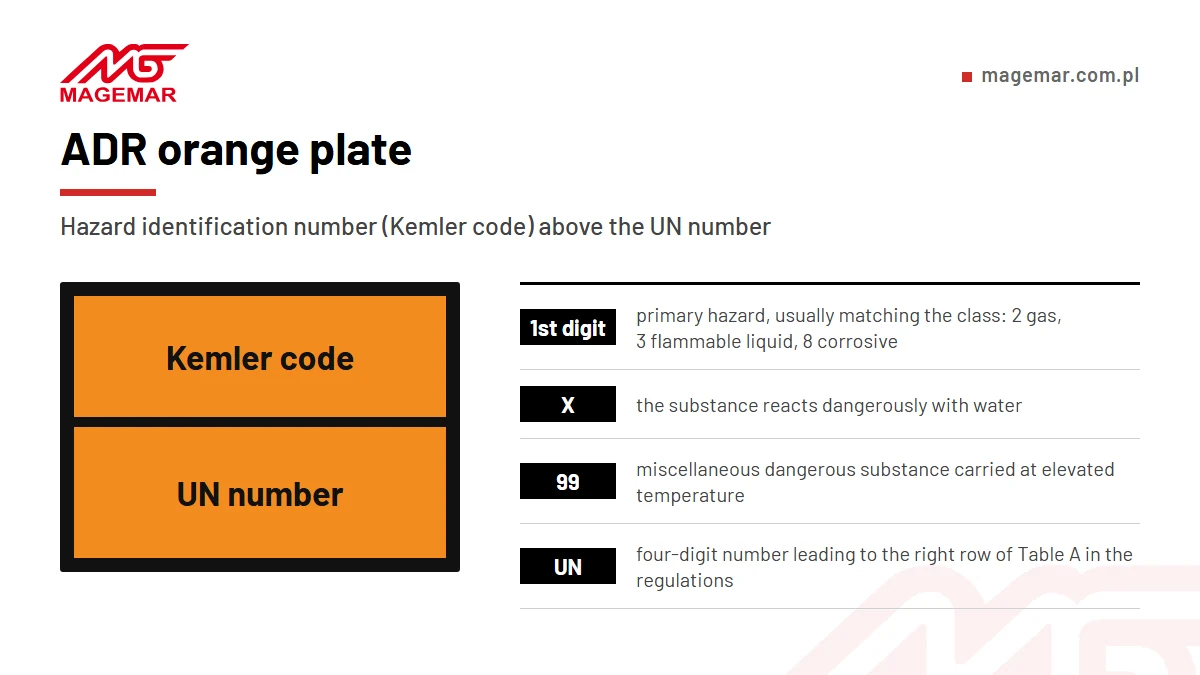
As a rule, classes 1, 2 and 7 have no packing groups, and neither do self-reactive substances in class 4.1 or organic peroxides in class 5.2. The UN number leads to the right row of Table A in the regulations, which gives the packaging, marking, transport category and tunnel restriction code. On the vehicle’s orange plate, above the UN number, is the hazard identification number, known as the Kemler code. The first digit shows the primary hazard and usually matches the class (2 gas, 3 flammable liquid, 8 corrosive), and the letter X means the substance reacts dangerously with water.
Who is responsible for classifying dangerous goods
The duty to classify the goods lies with the consignor, not the carrier. The main source of data is the product’s safety data sheet. Section 14 contains the transport information: UN number, proper shipping name, class and packing group. Before we quote for ADR transport, we check this data, because safety data sheets are often out of date or incomplete. A difference of one class changes the vehicle, the equipment, the documents and the price. For mixtures, the class is determined by the properties of the whole mixture, not of a single component. Companies that regularly consign or ship ADR loads must also appoint a dangerous goods safety adviser (DGSA).
ADR requirements in transport - what depends on the class
The class decides the marking, the documents, the driver’s qualifications and what may be loaded together. This is how it works in practice in the transport of dangerous goods:
- ADR marking packages get class hazard labels and the vehicle gets orange plates. The ADR markings must match what is actually on the trailer.
- Documents a transport document describing the goods and instructions in writing for the driver.
- Driver’s ADR qualifications an ADR training certificate after the basic course, and specialist courses for tanks, class 1 and class 7. The certificate is valid for 5 years.
- Mixed loading some classes must not be loaded into the same vehicle because they may react with each other.
- Exemptions small quantities may benefit from relief, for example the 1,000-point rule (1.1.3.6) or the limited quantities provisions (LQ).
If the load continues by ship, the IMDG Code applies alongside ADR. The classes are the same in both systems, but they differ in areas such as documentation and the stowage of the load in the container.
Load class and the ADR transport quote
The class of the load determines the vehicle, the equipment and the driver’s qualifications, so without it there is no reliable way to price the carriage. We organise domestic and international ADR transport. We check the classification of the load before quoting, choose the vehicle and prepare the documents, and customs clearance is handled by our own customs agency. We also provide sea transport, so you can ask about an onward sea leg in the same enquiry.
Get in touch and send us the safety data sheet for your goods. We will prepare an ADR transport quote matched to the class and quantity of the load.
Frequently asked questions
How many ADR classes are there?
The ADR agreement has 9 classes. Classes 4, 5 and 6 have divisions, which is why lists often show 13 entries.
What is ADR class 3 and what does it cover?
Flammable liquids, meaning liquids with a flash point up to 60°C, plus diesel fuel and light heating oil. It includes petrol, solvents, paints and varnishes.
What does ADR class 9 mean and what goes into it?
It covers ADR dangerous goods that do not fit any other class. Most often these are lithium batteries, dry ice and environmentally hazardous substances.
Does carrying class 7 goods require special training?
Yes. Class 7 is radioactive material, and the driver must hold an ADR training certificate that includes the specialist course for this class. The carriage is also subject to nuclear law, and the carrier often needs additional permits.
What does ADR code 99 mean?
Hazard identification number 99 stands for a miscellaneous dangerous substance carried at elevated temperature. It appears on the orange plate above the UN number.
Who determines the ADR class of goods?
The consignor. The data needed for classification is in section 14 of the safety data sheet. If in doubt, it is worth checking it with a dangerous goods safety adviser or a freight forwarder before booking the transport.