What Is ADR and Who the Dangerous Goods Rules Apply To
ADR is an international agreement that sets out the rules for the carriage of dangerous goods by road, such as fuels, gases, paints, acids or lithium batteries. The abbreviation comes from the French name Accord européen relatif au transport international des marchandises dangereuses par route. The ADR rules say how to classify, pack and mark the goods, which vehicle to carry them in, which documents to have in the cab and what qualifications the driver must hold. In Poland they apply not only to international transport but also to domestic transport. Below we explain what ADR means in practice for the consignor, the carrier and the consignee.
The ADR agreement - where it came from and how it is structured
The European Agreement concerning the International Carriage of Dangerous Goods by Road was signed in Geneva in 1957 under the auspices of the UN Economic Commission for Europe. Poland has applied it since 1975. Today more than 50 countries are parties to the ADR agreement, including countries outside Europe. In the European Union the ADR rules are implemented by Directive 2008/68/EC, and in Poland by the 2011 Act on the Transport of Dangerous Goods, which is why the same rules apply to a run from Poznan to Warsaw and from Hamburg to Szczecin.
The actual rules are set out in two annexes to the agreement:
- Annex A describes the dangerous goods: classification, the list of substances with UN numbers, packaging, marking of packages and documentation.
- Annex B covers vehicles and crew: vehicle construction and approval, equipment, driver training and the rules of the journey.
The ADR text is updated every two years. The current version is ADR 2025, and the next one will come into force on 1 January 2027. After each change there is usually a six-month transitional period during which the previous edition may still be applied.
What ADR considers dangerous goods
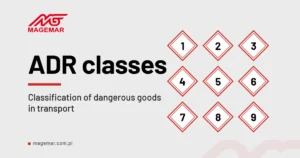
Dangerous goods are substances or articles that may endanger people, the environment or property in transport. The aim of the rules is the safety of people and the environment, which is why the regulation also covers materials that seem harmless in everyday life, such as a flammable aerosol or a battery. ADR divides them into 9 classes by type of hazard: explosives, gases, flammable liquids, flammable solids, oxidising substances, toxic and infectious substances, radioactive material, corrosive substances and miscellaneous dangerous goods. We describe the classification in detail, with examples, in our post on ADR classes.
Every dangerous good is assigned a four-digit UN number, for example UN 1203 is petrol and UN 3480 is lithium-ion batteries. The UN number, class, packing group and proper shipping name are the basis of all further obligations. The consignor will find the data for classification in section 14 of the product’s safety data sheet.
Who the ADR rules apply to
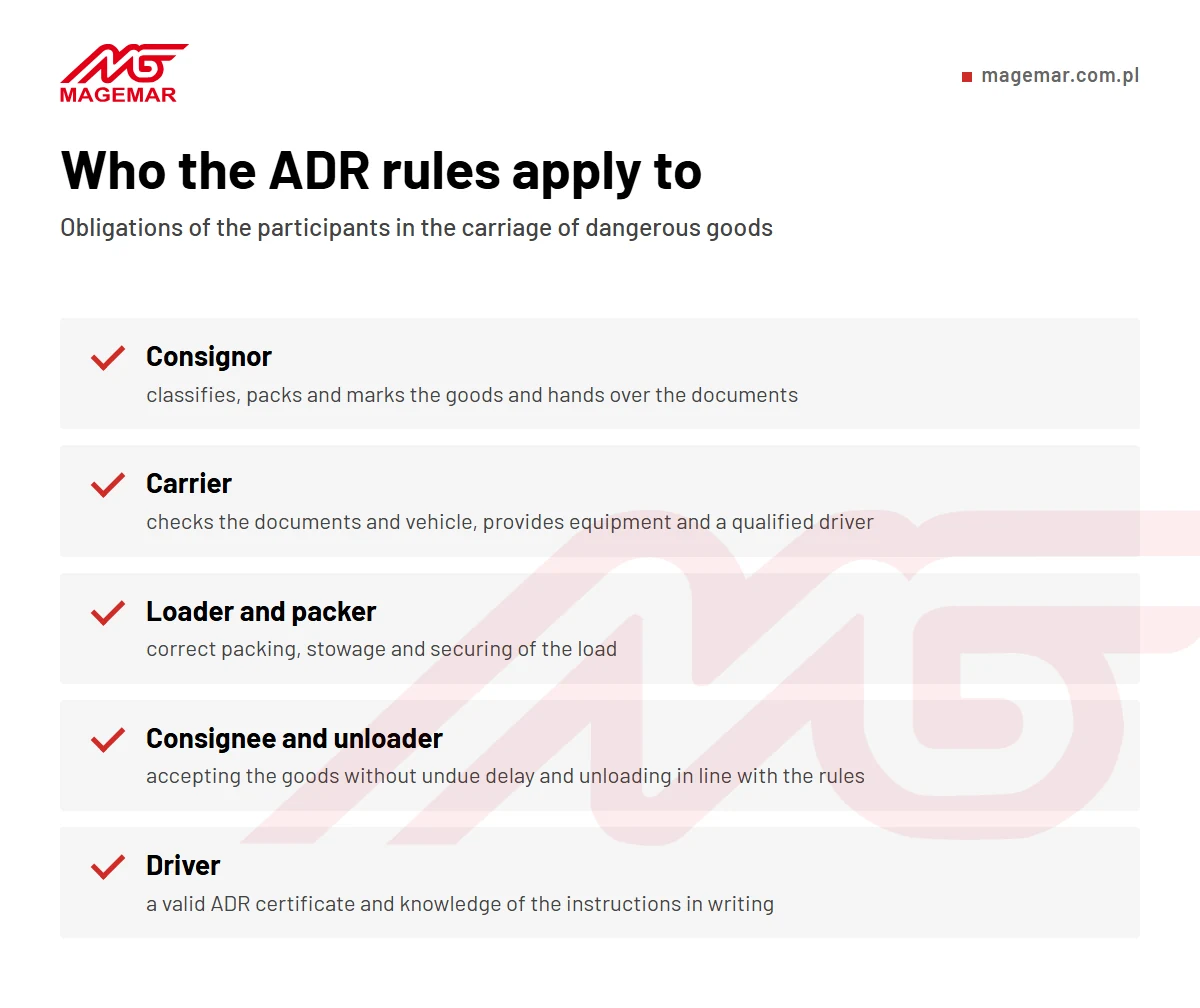
The carriage of dangerous goods involves several parties, and ADR does not place the burden on the driver alone. The agreement assigns obligations to all participants in the carriage, and a mistake at any stage can mean liability during an inspection.
- Consignor classifies the goods, chooses approved packaging, marks the consignment and hands over the transport documents.
- Carrier checks the documents and the condition of the vehicle and provides the equipment and a driver with ADR qualifications.
- Loader and packer are responsible for correct packing, stowage and securing of the load.
- Consignee and unloader must not delay acceptance of the goods without good reason and must check that unloading complies with the rules.
- Driver holds qualifications confirmed by an ADR certificate, knows the instructions in writing and knows what to do in an accident.
Companies that consign, pack, load or carry dangerous goods must also, as a rule, appoint a dangerous goods safety adviser (DGSA). The adviser monitors compliance with the rules, trains staff and prepares an annual report.
ADR requirements in road transport
The carriage of dangerous goods requires conditions to be met in four groups: driver, vehicle, marking and documentation. Their scope depends on the class, the quantity of goods and the mode of carriage (in packages, in bulk or in a tank).
ADR certificate for the driver
A driver carrying dangerous goods must complete an ADR course and pass an exam. The basic course qualifies the driver to carry packages, while specialist courses are needed for tanks, class 1 explosives and class 7 radioactive material. The ADR certificate is valid for 5 years, and renewing it requires a refresher course before it expires.
Vehicle and equipment
Vehicles carrying tanks and certain explosives require a certificate of approval issued after a technical inspection. Every vehicle with an ADR load, apart from carriage under the exemptions, must also carry the equipment listed in the rules:
- Fire extinguishers their number and capacity depend on the vehicle’s maximum permissible mass.
- Wheel chocks and warning signs at least one wheel chock and two self-standing warning signs.
- Personal equipment a warning vest, a torch, protective gloves and eye protection for each crew member.
- Eye rinsing liquid required for most classes, and for some toxic substances an emergency escape mask as well.
- Shovel, drain seal and collecting container when carrying solids and liquids of certain classes.
Marking of the vehicle and packages
A vehicle carrying dangerous goods above the exemption thresholds must display orange-coloured plates at the front and rear. For tanks and bulk carriage, the plates show the hazard identification number and the UN number. Packages are marked with the UN number and the hazard labels of the class. The orange plates tell the emergency services what they are dealing with before they approach the vehicle.
ADR documents in the cab
During carriage the driver must have a complete set of documents. Missing documents are one of the most common violations found during roadside checks.
| Document | What it contains | Who prepares it |
|---|---|---|
| Transport document | UN number, proper shipping name, label numbers, packing group, quantity and tunnel restriction code | consignor |
| Instructions in writing | what to do in an accident or emergency, in a language the crew understands | carrier |
| ADR certificate | the driver’s qualifications to carry specific goods | driver |
| Certificate of approval of the vehicle | confirmation that the vehicle meets ADR requirements (tanks, explosives) | carrier |
| Identity document | a photo ID for each crew member | crew |
Swipe the table sideways to see all columns.
When the ADR rules apply only in part
Not every package of dangerous goods requires the full procedure. ADR provides several exemptions, which most groupage shipments make use of:
- Limited quantities LQ goods in small inner packagings, for example cosmetics or cleaning products, marked with the LQ diamond.
- Excepted quantities EQ very small quantities, most often samples, with simplified marking.
- Exemption 1.1.3.6 if the load’s total points do not exceed 1,000, the vehicle does not need orange plates and the driver does not need a full ADR certificate.
- Private carriage goods packaged for retail sale, carried by private individuals for their own use.
An exemption does not remove every obligation. Under 1.1.3.6 a transport document, a fire extinguisher and a trained driver are still required, which is why it is worth calculating the points before loading rather than during an inspection.
ADR transport from Szczecin
We organise domestic and international ADR transport, i.e. the safe carriage of dangerous goods in line with the rules. We check the classification and documents before quoting and match a vehicle with the right equipment and a driver with the right qualifications.
Write to us and attach the safety data sheet of the goods. We will prepare an ADR transport quote matched to the class and quantity of the load.
Frequently asked questions
What is ADR?
ADR is an international agreement on the carriage of dangerous goods by road. It sets the rules for classification, packing, marking and documentation, and the requirements for vehicles and drivers.
Do the ADR rules apply to domestic transport?
Yes. In Poland ADR also applies to domestic carriage under the Act on the Transport of Dangerous Goods.
Who is responsible for classifying ADR goods?
The consignor. The data for classification is in section 14 of the safety data sheet of the goods.
How long is an ADR certificate valid?
Five years. It is renewed after completing a refresher course and passing an exam before it expires.
Do all dangerous goods require orange plates?
No. For limited quantities (LQ) and carriage within the 1.1.3.6 exemption, plates are not required.