Types of Granite - Colours, Varieties and Where They Come From
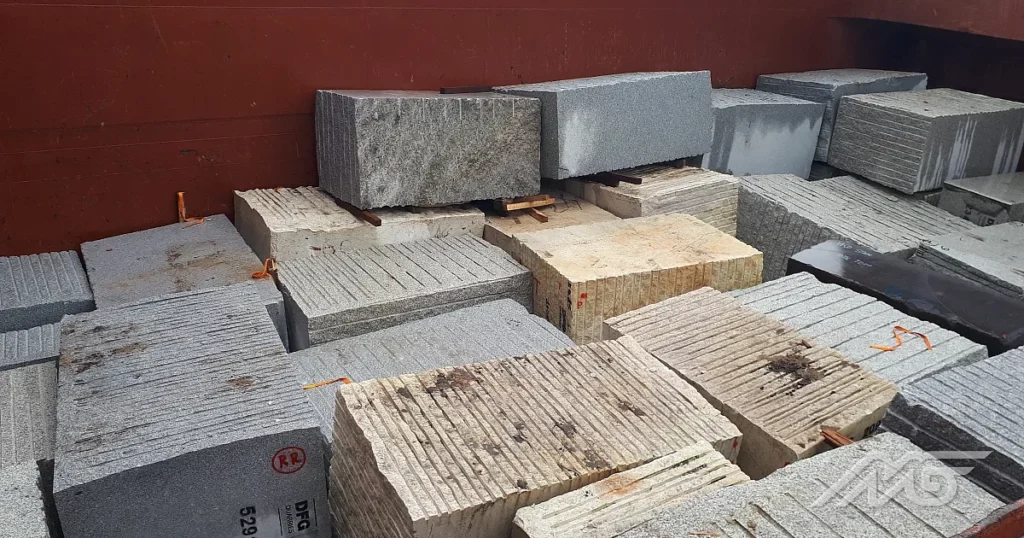
In the trade, types of granite are distinguished above all by colour (black, grey, white, red, brown, blue, green and yellow), country of origin and surface finish. Hundreds of varieties are on the market under trade names such as Absolute Black, Impala, Kashmir White or Blue Pearl, and most granite imported into Poland comes from China, India, Brazil, Africa and Scandinavia. The type affects not only the look but also the quality, durability, water absorption, stain resistance and price. Below we describe the most popular granite varieties, their uses and what to look out for when choosing.
Granite in the trade and granite in geology
Granite is a natural stone, more precisely a plutonic igneous rock made up mainly of quartz, feldspar and mica. These minerals determine the colour: feldspars give pinks and reds, quartz greys and translucent grains, and dark micas black speckles. In the stone trade, however, the word “granite” is broader than in geology. Gabbro, basalt, gneiss and other hard crystalline rocks with similar properties are also sold under this name.
For a customer choosing a worktop or stair slabs, this distinction matters less than the parameters. Many “black granites” are geologically gabbro or basalt, which does not make them worse, but it does affect their weight and how they look after processing. We write more about the weight of individual rocks in our post on granite density.
Types of granite by colour
Colour is the first selection criterion and the most common way suppliers group their range. The table lists popular granite varieties by colour and country of origin.
| Colour | Example varieties | Origin | Typical use |
|---|---|---|---|
| Black | Absolute Black, Black Galaxy, Zimbabwe Black, G684 | India, Zimbabwe, China | worktops, headstones, window sills |
| Grey | Strzegom, Impala, Padang Dark (G654), Padang Light (G603) | Poland, South Africa, China | setts, stairs, flooring, headstones |
| White and cream | Kashmir White, Viscount White, Bianco Sardo | India, Italy | worktops, interior cladding |
| Red and pink | Imperial Red, Balmoral Red, Rosa Porrino, G664 | India, Finland, Spain, China | facades, monuments, outdoor slabs |
| Brown | Tan Brown, Baltic Brown | India, Finland | worktops, window sills, stairs |
| Blue | Blue Pearl, Azul Bahia | Norway, Brazil | worktops, decorative elements |
| Green | Verde Ubatuba | Brazil | worktops, flooring |
| Yellow and gold | Giallo Veneziano, Rusty Yellow (G682) | Brazil, China | facades, outdoor slabs, worktops |
Swipe the table sideways to see all columns.
We give the origin of each variety according to the most commonly cited sources. Trade names are not protected, so the same name is sometimes given to stone from different quarries. When ordering, it is worth asking for photos of the specific batch, not just the name.
Black granite
Black granite is the most popular colour for kitchen worktops and headstones. Absolute Black from India has a uniform, deep black with no distinct pattern, while Black Galaxy has its characteristic golden flecks. Dark varieties usually have low water absorption, so they are not prone to staining, but when buying it is worth checking whether the stone has been dyed. A simple acetone test on a hidden area shows whether dye comes off on a cotton pad.
Grey granite
Grey varieties are the most versatile group. Strzegom granite from Lower Silesia has been used in construction for centuries, and imported Padang Light and Padang Dark from China compete with it on price. Impala from South Africa is dark grey with a subtle sheen and is a classic in headstone masonry. You can read more about Chinese varieties in our guide to Chinese granite.
White granite
White granite, for example Kashmir White from India, brightens an interior and looks good in modern kitchens. It makes a space look larger, but light varieties are usually more absorbent than dark ones, so they pick up stains from oil, wine or coffee more easily. They need sealing before installation and resealing during use.
Colourful and exotic varieties
Blue Pearl from Norway shimmers thanks to its feldspar crystals, and Brazilian varieties such as Verde Ubatuba or Azul Bahia have a distinctive, sometimes very decorative pattern. Exotic granites can be expensive and harder to obtain in large quantities, so for bigger projects you need to make sure the supplier has enough slabs from one batch.
Types of granite surface finish
The same granite looks completely different depending on how it is finished. The finish determines the colour, sheen, slip resistance and ease of cleaning.
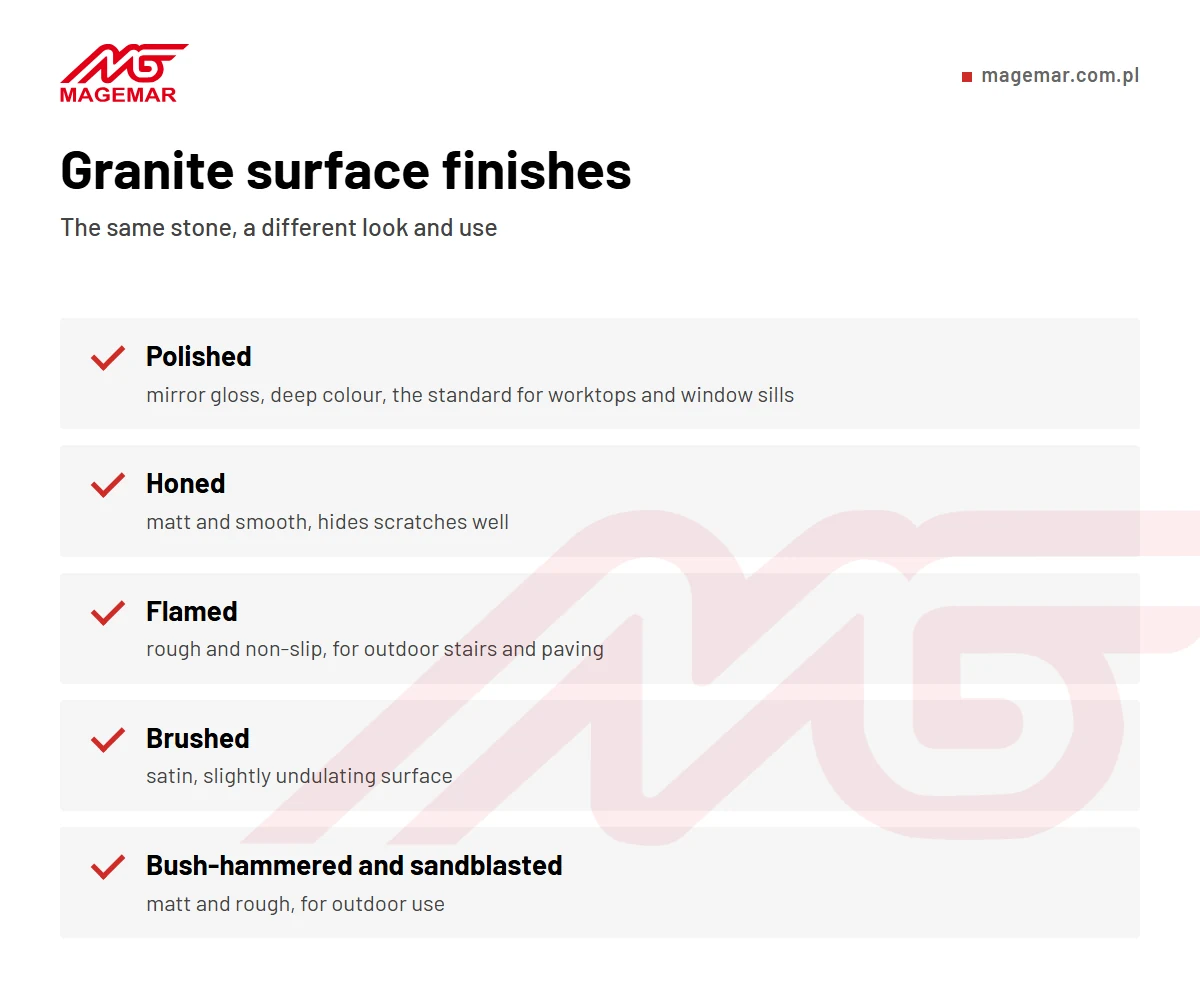
- Polished a mirror gloss, the deepest colour and a distinct pattern. The standard for worktops and window sills, but slippery outdoors.
- Honed a matt, smooth surface and a lighter colour. It hides scratches well.
- Flamed a rough surface produced with a torch. Non-slip, used for outdoor stairs and paving.
- Brushed a slightly undulating, satin surface, often applied after flaming, pleasant to the touch.
- Bush-hammered and sandblasted matt, rough finishes for outdoor use and street furniture.
How to choose a type of granite
Choosing granite combines aesthetics with technical parameters, and designers and stonemasons weigh up the same factors when selecting stone. The same stone can perform superbly on a facade and disappoint on a kitchen worktop. Before ordering, it is worth going through a few questions:
- Where it will be used outdoors, frost resistance and water absorption matter; indoors, for example for a floor or granite kitchen worktops, resistance to stains and scratches.
- How intensively it will be used for a kitchen it is better to choose a dark or medium variety with low water absorption.
- Which finish polished for worktops and window sills, flamed for outdoor stairs and terraces.
- Whether the batch is uniform for larger projects the slabs should come from one block or one batch.
- What the parameters are the declaration of performance states the water absorption, strength and frost resistance of the specific variety.
Granite care in practice
Granite is one of the most durable stones, and that is its greatest advantage over marble, but it is not entirely maintenance-free. Every granite surface, whatever its colour, needs at least basic care. Light and more porous varieties are worth sealing before installation and resealing every year or two. For everyday cleaning, water with a mild, pH-neutral cleaner is enough for a worktop or floor. Harsh acidic cleaners will not damage the stone, but they quickly remove the sealant, and then the surface starts absorbing grease and dyes.
Importing granite from around the world through Szczecin
We organise imports of natural stone for stonemasons, wholesalers and construction companies: from collecting slabs and blocks from the supplier, through sea transport to Szczecin, to clearance by our customs agency and delivery to your works. We help plan the load so that the container’s permitted weight is fully used.
Contact us with the granite variety, the format and the supplier’s country. We will prepare an import quote.
Frequently asked questions
What types of granite are there?
In the trade, granite is divided by colour, country of origin and finish. The most popular are black, grey and white varieties, imported mainly from China, India, Brazil and Africa.
Which granite is best for a worktop?
A dark or medium variety with low water absorption and a polished surface, for example Absolute Black, Impala or Tan Brown.
Does white granite stain?
Light varieties are usually more absorbent, so they pick up stains more easily. Regular sealing greatly reduces the problem.
Which granite is the hardest?
All granites have a hardness of about 6-7 on the Mohs scale. Differences in resistance come more from water absorption and structure than from hardness.
Where is granite imported into Poland from?
Mostly from China and India, and also from Brazil, South Africa, Zimbabwe and Scandinavia. Domestic granite comes mainly from the Strzegom area in Lower Silesia.