Granite Density - How Much a Cubic Metre, a Slab and a Worktop Weigh
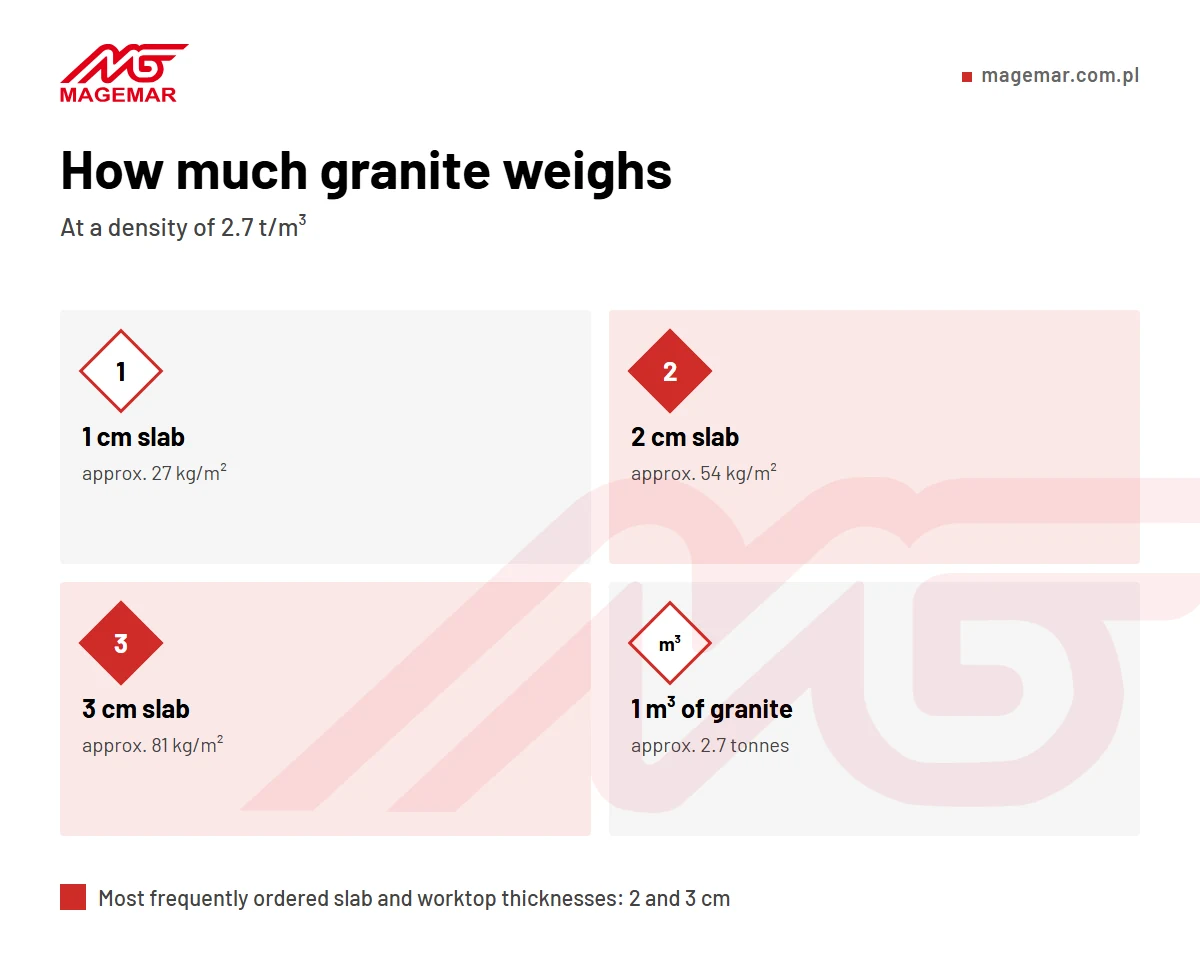
The density of granite is usually between 2.6 and 2.8 t/m³, and calculations most often assume 2.7 t/m³, i.e. 2,700 kg per cubic metre. This means that a granite slab measuring 1 m² and 2 cm thick weighs about 54 kg, and at 3 cm thick about 81 kg. The weight of granite depends on the variety and its mineral composition, which is why dark granites and similar rocks are sometimes heavier than light ones. Below we show how to calculate the weight of stone, how much typical products weigh and what this means for transport.
How much granite weighs - density and specific gravity
Granite is a plutonic igneous rock formed from magma that cooled slowly deep below the earth’s surface. It consists mainly of quartz, feldspars (including plagioclase) and micas such as biotite and muscovite. These minerals have densities of about 2.6 to 3.0 g/cm³, and their proportions determine how much a particular variety weighs.
In practice two terms are used, and they are often mixed up in conversation:
- Bulk density the mass of the stone including its pores, given in kg/m³ or t/m³. This is the value used to calculate the weight of slabs, worktops and cargo.
- Specific gravity the mass of the rock material alone, without pores. Granite has very low porosity, so the two values differ only slightly, usually by 1-2%.
For comparison, the density of Strzegom granite from Lower Silesia is about 2.6 t/m³, while dark varieties sold as black granite, which geologically are often gabbro or basalt, reach 2.9-3.0 t/m³. This is why for large orders it is worth checking the value in the technical data sheet of the specific stone rather than assuming an average.
The density of granite compared with other natural stones
Granite is one of the heavier stones used in construction and stonemasonry. The differences between rocks are not large, but with several dozen tonnes of cargo a few per cent already means several hundred kilograms.
| Stone | Density (t/m³) | Weight of a 1 m² × 2 cm slab | Weight of a 1 m² × 3 cm slab |
|---|---|---|---|
| Granite | 2.6-2.8 | approx. 54 kg | approx. 81 kg |
| Marble | 2.6-2.8 | approx. 54 kg | approx. 81 kg |
| Quartzite | 2.6-2.7 | approx. 53 kg | approx. 80 kg |
| Basalt and gabbro | 2.9-3.0 | approx. 59 kg | approx. 89 kg |
| Travertine | 2.4-2.5 | approx. 49 kg | approx. 74 kg |
| Sandstone | 2.2-2.5 | approx. 47 kg | approx. 70 kg |
Swipe the table sideways to see all columns.
The values in the table are approximate. We calculated the slab weights for the middle of the density range. Marble weighs practically the same as granite, so the difference between granite and marble lies in hardness and resistance, not in weight.
How to calculate the weight of granite
The calculation is simple if you know the dimensions and the density. Just work out the volume in cubic metres and multiply it by the density of granite.
- Convert the dimensions to metres for example, a 300 × 60 cm worktop that is 3 cm thick is 3.0 × 0.6 × 0.03 m.
- Calculate the volume 3.0 × 0.6 × 0.03 = 0.054 m³.
- Multiply by the density 0.054 m³ × 2,700 kg/m³ = about 146 kg.
- Add a margin when planning transport we add the weight of pallets, A-frames and timber, usually 5-10% of the stone’s weight.
A quick rule of thumb for slabs: each centimetre of thickness is about 27 kg per square metre. A 2 cm slab therefore weighs approx. 54 kg/m², and a 3 cm slab approx. 81 kg/m².
How much typical granite products weigh
Granite is used in construction, gardens and interiors, and weight matters both during installation and when pricing transport. Below are approximate weights of the most frequently ordered items.
Kitchen worktops and window sills
A granite kitchen worktop is usually 2 or 3 cm thick. A 3 cm worktop measuring 300 × 60 cm weighs about 146 kg, so installing it takes at least four people or a lift. The cabinets under a granite worktop must be sturdy, because the weight is spread over several metres. A 150 × 30 cm window sill that is 3 cm thick weighs about 36 kg.
Granite setts
Granite setts have the same density as solid stone, but the weight per square metre of paving depends on the height of the setts and the joints. As a rough guide, a tonne of 4/6 cm setts covers about 8-10 m², 8/11 cm setts about 4-5 m², and 15/17 cm setts about 2-2.5 m². This conversion is used when ordering, because setts are sold by the tonne and laid by the square metre.
Headstones and blocks
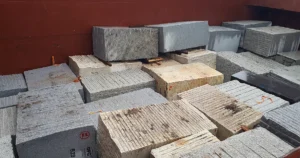
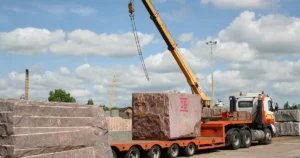
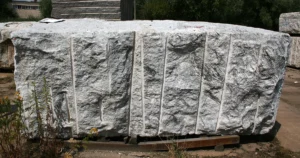
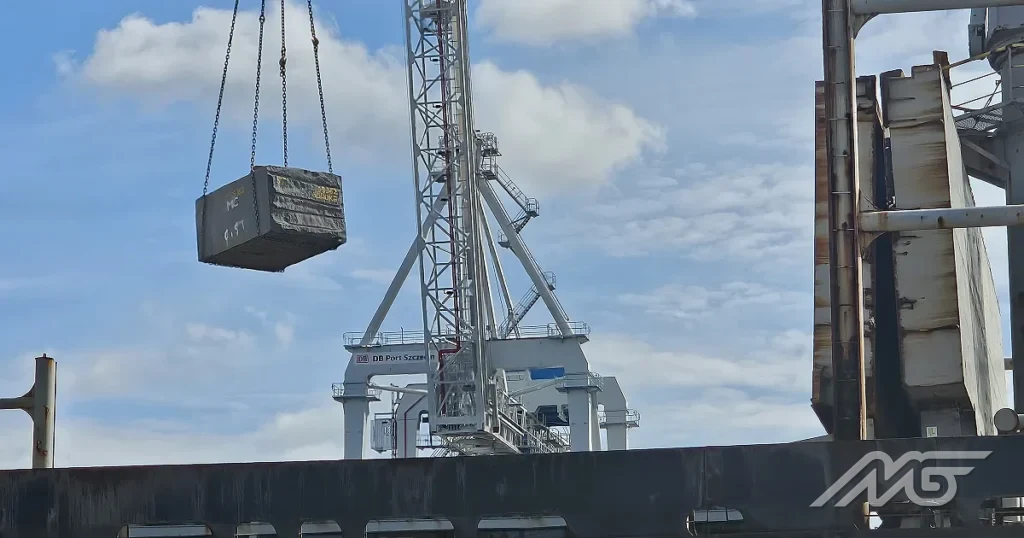
A single granite headstone usually weighs from 500 kg to more than a tonne, depending on the thickness of the slab and the base. A raw granite block measuring 2.5 × 1.5 × 1.5 m has a volume of about 5.6 m³ and weighs about 15 tonnes. Blocks of this weight are handled by a port crane, and special equipment is needed to transport them.
Granite weight, transport and the container
The high density of granite means that on imports a container fills up by weight, not by volume. A standard 20-foot container has a capacity of about 33 m³, but in road transport in Poland and the EU it carries about 21-25 tonnes of cargo in practice. At a density of 2.7 t/m³ that is only 8-9 m³ of stone, about a quarter of the capacity.
- 2 cm slabs with 24 tonnes of cargo, a container holds about 440 m² of slabs.
- 3 cm slabs at the same weight, that is about 300 m² of slabs.
- 40-foot container gives no advantage with granite, because the weight limit is similar and there is plenty of space left anyway.
This is why granite is most often imported in 20-foot containers. Heavy slabs must stand on A-frames and be well secured, because a dozen or so tonnes shifting during the voyage risks damage to both the cargo and the container.
Density, durability and resistance of granite
High density goes hand in hand with low water absorption, which translates into the durability of granite. The stone absorbs little moisture and copes well with weather and freeze-thaw cycles, which is why it performs well outdoors. Granite has a Mohs hardness of about 6-7, so it resists scratching and wear. Its high mass also gives stability, an advantage for stairs, window sills and street furniture, but it requires a solid base.
Importing granite through Szczecin
We organise imports of natural stone from China, India, Brazil and other countries. Before booking a container we calculate the weight of the cargo so as to use the permitted weight without exceeding the limits in sea transport and on the road. Customs clearance is handled by our own customs agency, and oversized blocks travel as oversized cargo.
Contact us with the type of stone, the slab format and the quantity. We will calculate the weight and prepare a transport quote.
Frequently asked questions
What is the density of granite?
The density of granite is 2.6-2.8 t/m³. Calculations usually assume 2,700 kg/m³.
How much does 1 m³ of granite weigh?
A cubic metre of solid granite weighs about 2.7 tonnes. Dark varieties can weigh up to 3 tonnes.
How much does a 3 cm granite slab weigh?
About 81 kg per square metre. A 2 cm slab weighs about 54 kg/m².
Is granite heavier than marble?
No, both stones have a similar density of about 2.7 t/m³. They differ in hardness and resistance, not in weight.
How many tonnes of granite does a 20-foot container hold?
In practice about 21-25 tonnes, depending on road restrictions along the route. That is about 300 m² of 3 cm slabs.