EUR 1 and Certificate of Origin - How They Differ and When You Need Them
EUR.1 (also written as EUR 1 or EUR1) is a movement certificate that confirms the preferential origin of goods and allows the importer to pay lower duty or none at all. It is used in trade between the European Union and countries with which the EU has free trade or preferential agreements, for example Norway, Switzerland, the Western Balkans or Egypt. The document is issued by the customs office in the country of export at the exporter’s request. A certificate of origin issued by a chamber of commerce is something else: it confirms non-preferential origin and does not reduce duty rates. Below we explain what the EUR.1 document is, how to obtain it and when an invoice declaration is enough.
What the EUR 1 document is
EUR.1 (the EUR.1 movement certificate) is an official form, commonly called the EUR 1 certificate, which travels with the goods to the importer’s country. On its basis, the customs authorities of the country of destination apply the preferential duty rate provided for in the trade agreement, often zero. Without proof of origin, the importer pays duty at the conventional rate, even if the goods actually originate in a country covered by the agreement.
“Origin” here does not mean the place of dispatch. Goods originate in a given country if they meet the rules of origin set out in the agreement: they were wholly obtained there (for example quarried stone) or underwent sufficient processing. Goods from China transhipped in Turkey do not become Turkish as a result.
EUR 1 versus a non-preferential certificate of origin
Both documents are used in international trade and confirm the country of origin of the goods, but they serve different purposes. In conversations with suppliers the names often get mixed up, and the mistake is costly: a non-preferential certificate will not reduce duty, however official it looks.
| Feature | EUR.1 | Certificate of origin (non-preferential) |
|---|---|---|
| Type of origin | preferential | non-preferential |
| Purpose | reduced or zero duty rate | confirming the country of origin, e.g. for anti-dumping duties, embargoes or the importing country’s requirements |
| Issued by | the customs office of the country of export | a chamber of commerce or another authorised body |
| Legal basis | the EU’s preferential agreement with the country | EU rules on non-preferential origin |
| Name in trade | EUR.1, movement certificate | Certificate of Origin |
Swipe the table sideways to see all columns.
When the EUR 1 certificate is used
EUR.1 is needed only in trade with countries whose agreement with the European Union provides for this document as proof of origin. In newer agreements, for example with Canada, Japan or the United Kingdom, it has been replaced by statements on origin made out by the exporter, without the involvement of a customs office. In trade with Turkey, industrial goods move on the basis of the A.TR certificate, which confirms the status of the goods within the customs union, not their origin.
From the point of view of an importer from Asia, one thing matters: the EU has no preferential agreement with China, so the EUR.1 document is not used for imports from China, and duty is paid at the standard rate. This is why preferential origin will not reduce costs when importing stone from China, while for deliveries from countries covered by agreements it is always worth asking the supplier about it.
How to obtain the EUR 1 document
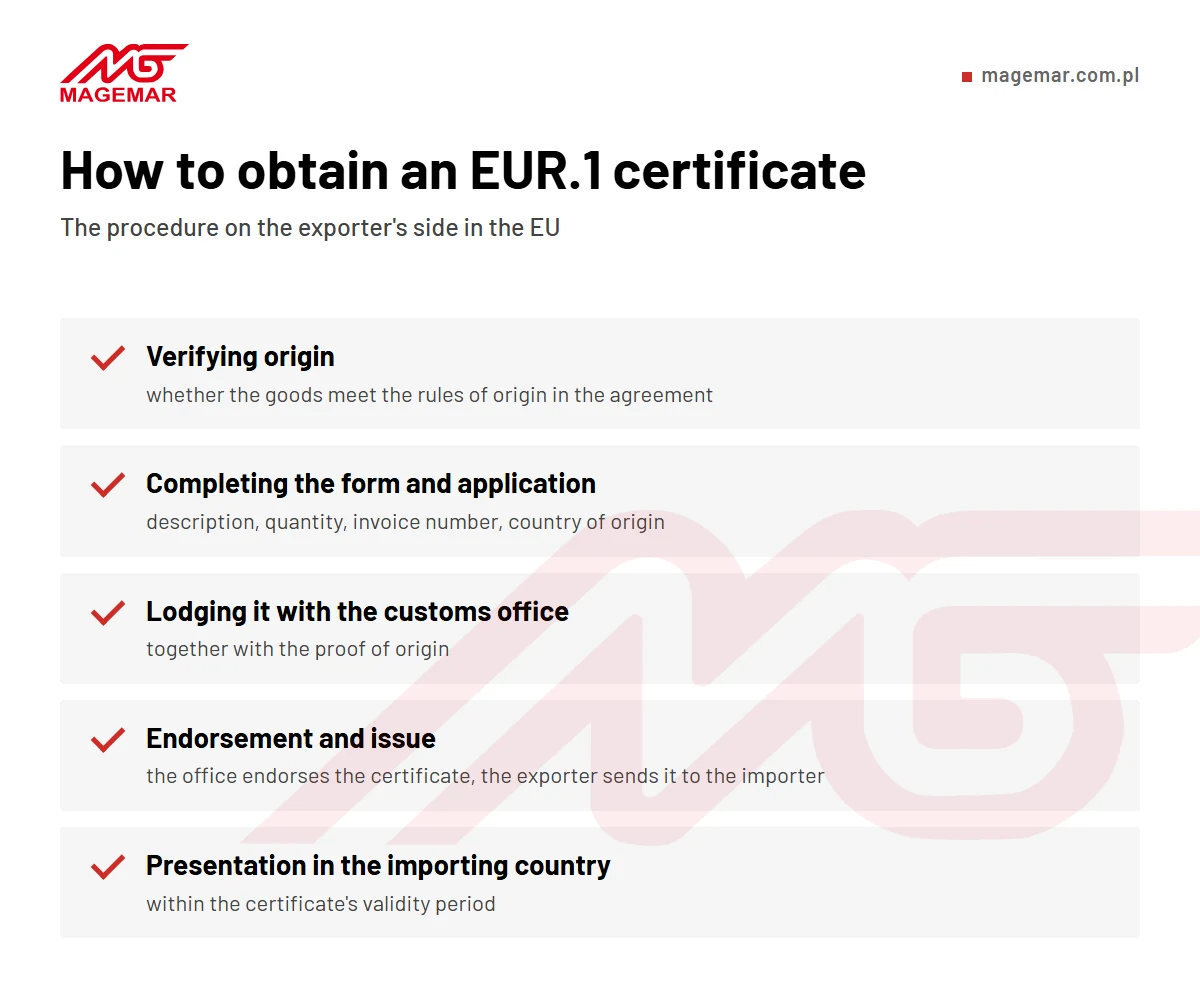
The certificate is issued by the customs office of the country of export, most often together with the export declaration. On the EU side the procedure usually looks like this:
- Verifying origin the exporter checks whether the goods meet the rules of origin in the agreement, based on production records and supplier’s declarations.
- Completing the form the exporter fills in the EUR.1 form and the application for its issue, describing the goods, the quantity, the invoice number and the country of origin.
- Lodging it with the customs office the exporter’s application goes to the customs office together with the proof of origin. The office may request additional documents.
- Endorsement and issue the office endorses the certificate with its stamp and returns it to the exporter, who sends it to the importer together with the commercial documents.
- Presentation in the importing country the importer submits the EUR.1 to the customs office of the country of destination within the certificate’s validity period.
The certificate is valid for a set period from the date of issue, usually 4 or 10 months, depending on the agreement. If for good reasons it was not issued at the time of export, a retrospective issue can be requested. If it is lost, the office issues a duplicate.
An invoice declaration instead of EUR.1
Not every consignment requires an official certificate. In many cases preferential agreements allow origin to be confirmed by an invoice declaration, i.e. a statement of origin written on the invoice or another commercial document.
- Consignments up to EUR 6,000 for a consignment worth up to EUR 6,000, any exporter can make out an invoice declaration without the customs office’s consent.
- Approved exporter a company that has been granted approved exporter status can make out declarations with no value limit.
- REX system under some agreements and the Generalised Scheme of Preferences, exporters registered in the REX system make out statements on origin instead of certificates.
A declaration is more convenient and cheaper to handle, but the exporter is just as responsible for its accuracy as for the data on an EUR.1. The customs authorities can verify origin even several years after import, including at the request of an office in another country, because cooperation between customs administrations is international.
The most common mistakes with the EUR 1 certificate
The EUR.1 document is simple in form, but it is easy to make mistakes that cost the importer the preference. The most common are:
- Inconsistent description of the goods the description or quantity on the certificate does not match the invoice and the customs declaration.
- Expired certificate the document is presented after its validity period.
- No direct transport the goods were transhipped in a third country without documents proving that they were not processed there.
- The wrong document instead of EUR.1, the supplier sends a certificate of origin from a chamber of commerce.
Customs clearance with preference in Szczecin
Our customs agency checks the origin documents before the goods arrive and applies preferential duty rates where the documents allow. We combine the formalities with sea transport and port handling. We describe the clearance itself in our post customs inspection step by step, and who pays the duty under each delivery term in our guide to Incoterms 2020.
Contact us and send the invoice and the documents from the supplier. We will check whether the goods can benefit from a preference before they reach Poland.
Frequently asked questions
What is EUR 1?
A movement certificate confirming the preferential origin of goods. It allows a reduced or zero duty rate to be applied under an EU trade agreement.
Who issues the EUR 1 certificate?
The customs office of the country of export, at the exporter's request, after checking the proof of origin of the goods.
Is EUR.1 the same as a certificate of origin?
No. EUR.1 concerns preferential origin and reduces duty. A certificate of origin from a chamber of commerce confirms non-preferential origin.
Do you need EUR.1 for imports from China?
No. The EU has no preferential agreement with China, so duty is paid at the standard rate.
When is an invoice declaration enough instead of EUR.1?
For consignments worth up to EUR 6,000 or when the exporter has approved exporter status.