IMDG Code - Dangerous Goods in Sea Transport
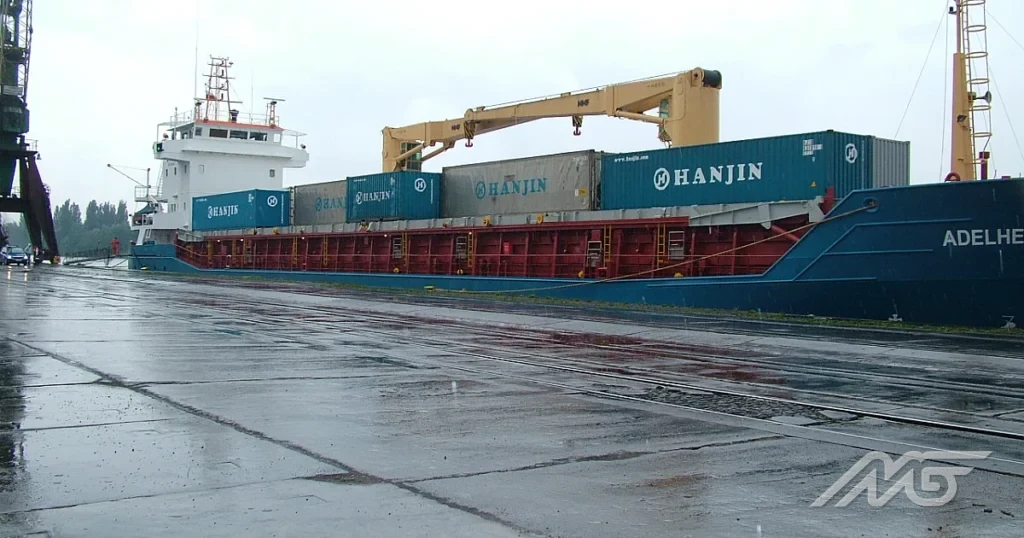
The IMDG Code (International Maritime Dangerous Goods Code) is an international set of rules on the carriage of dangerous goods by sea in packages and containers. It is issued by the International Maritime Organization (IMO), and since 2004 it has been mandatory for states party to the SOLAS Convention. The IMDG Code sets out how to classify, pack, mark and document the cargo and how to stow it on board so that dangerous substances do not react with each other. If the goods travel by lorry first, ADR also applies. Below we explain what the IMDG Code is, how it differs from the road rules and what the shipper has to prepare.
What the IMDG Code is and who it applies to
The International Maritime Dangerous Goods Code was created in 1965 as an IMO recommendation. Since 1 January 2004 it has been mandatory under Chapter VII of the SOLAS Convention on the Safety of Life at Sea. It applies to the carriage of dangerous goods in packages, containers, portable tanks and vehicles on ships, including ro-ro ferries.
The rules cover everyone involved in the transport chain: the shipper, the forwarder, the company packing the container, the terminal and the carrier. Each of them has specific obligations, and shore-side staff who handle dangerous goods must receive training matched to the scope of their duties.
The Code is amended every two years. Each amendment has its own number and year, and for the first year it can be applied on a voluntary basis before it becomes mandatory.
Structure of the IMDG Code
The IMDG Code has two volumes and a supplement. Volume 1 contains the general provisions, classification and the rules for packing, marking, documentation and stowage. Volume 2 is the dangerous goods list in the form of a table, in which each UN number has its requirements assigned. The supplement contains, among other things, the EmS emergency procedures and the MFAG medical first aid guide.
- Volume 1 general provisions, training, classification, packagings, marking, documentation, stowage and segregation of cargo.
- Volume 2 the dangerous goods list with UN numbers, special provisions, limited and excepted quantities.
- Supplement EmS emergency procedures for fire and spillage, the MFAG guide for the crew and other related IMO documents.
The IMDG Code does not apply to cargo carried in bulk. Chemicals in bulk are covered by the IBC Code, liquefied gases on gas carriers by the IGC Code, and solid bulk cargoes by the IMSBC Code.
Classes of dangerous goods under IMDG
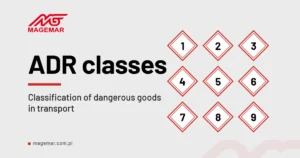
Classification under IMDG is the same as under ADR, because both sets of rules are based on UN recommendations. Goods are divided into 9 classes, and each substance has the same four-digit UN number regardless of the mode of transport. We describe the classes in detail, with examples, in our post on ADR classes.
An additional category in sea transport is marine pollutants. These are substances harmful to the aquatic environment, marked with a separate mark showing a fish and a tree. Some of them are not dangerous in road transport in small quantities, but on a ship they require marking.
IMDG and ADR - the key differences
Cargo that travels from a warehouse to the port by lorry and then by ship is subject to both sets of rules. Most of the requirements overlap, but a few differences cause shippers the most trouble.
| Area | ADR (road transport) | IMDG (sea transport) |
|---|---|---|
| Legal basis | the ADR agreement, in Poland also for domestic carriage | SOLAS Convention, Chapter VII |
| Transport document | ADR transport document | Dangerous Goods Declaration (DGD) |
| Container | no separate certificate | container packing certificate signed by the packer |
| Environmental marking | environmentally hazardous substance mark | marine pollutant mark |
| Stowage of the cargo | mixed loading prohibitions | stowage categories and the segregation table on board |
| Route restrictions | tunnel codes | none, the carrier and the port decide |
| Emergency procedures | instructions in writing for the driver | EmS schedules and the MFAG guide for the crew |
Swipe the table sideways to see all columns.
ADR makes carriage easier in a chain that includes a sea leg. When delivering to or collecting from a port, packages marked and documented in accordance with IMDG can be carried by road without repacking, provided the ADR requirements for the vehicle and the driver themselves are met.
Documents and marking for IMDG carriage
Safe sea carriage starts with the paperwork. The carrier accepts a booking for dangerous goods only after receiving a complete set of data, and the terminal compares it with the marking on the container.
Dangerous Goods Declaration
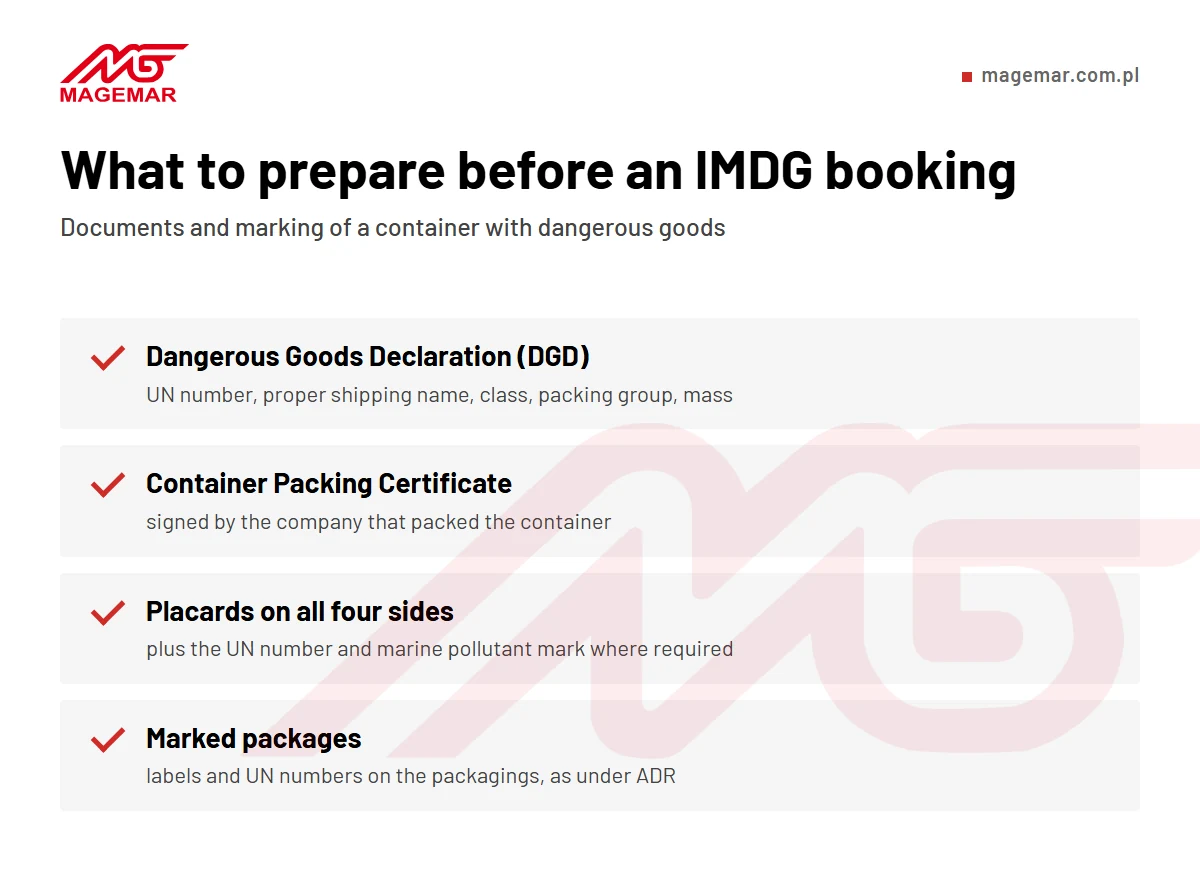
The shipper prepares a Dangerous Goods Declaration, most often on the multimodal form. It must state the UN number, the proper shipping name, the class, the packing group, the flash point for liquids, whether the goods are a marine pollutant, the number and type of packages and the mass. The declaration is signed by a trained person, who confirms that the goods have been correctly classified, packed and marked.
Container Packing Certificate
The company that loads dangerous goods into a container issues a Container Packing Certificate. In it, it confirms that the container was clean and dry, the cargo is secured, incompatible substances have not been loaded together and the container bears the correct placards. Without this document the container will not go on board.
Marking of the container
A container with dangerous goods is marked with placards on all four sides. For larger quantities of a single substance the UN number is added, and for substances harmful to the environment the marine pollutant mark. The packages inside have their own labels and UN numbers, just as under ADR.
Stowage and segregation on board
On a ship, containers cannot be placed next to each other at random. The IMDG Code assigns each item a stowage category, which determines whether it may travel under deck or only on deck, as well as segregation rules. The segregation table shows how far apart substances of different classes must be, for example oxidisers and flammable materials. The carrier is responsible for the stowage plan, but it relies on the data in the shipper’s declaration, which is why a mistake in the declaration can end in a dangerous combination of cargoes.
Dangerous goods transport from Szczecin
We organise the carriage of dangerous goods by road as domestic and international ADR transport. We check the classification, packaging and documents before quoting, and customs formalities are handled by our customs agency. If the cargo is to continue by ship, the IMDG requirements have to be taken into account at the packing and marking stage, so it is worth mentioning this when placing the order. We describe the basics of the road rules in our post what is ADR.
Write to us and send the safety data sheet of the goods together with the places of loading and delivery. We will check the classification and prepare a quote.
Frequently asked questions
What is the IMDG Code?
The IMO's international set of rules on the carriage of dangerous goods by sea in packages and containers, mandatory under the SOLAS Convention.
Do IMDG and ADR have the same classes?
Yes. Both are based on UN recommendations, have 9 classes and the same UN numbers, but differ in documentation, marking and stowage rules.
Who prepares the Dangerous Goods Declaration?
The shipper, or a trained person acting on its behalf, who confirms that the classification, packaging and marking are correct.
Does the IMDG Code cover bulk cargo?
No. Chemicals in bulk are covered by the IBC Code, liquefied gases by the IGC Code, and solid bulk cargoes by the IMSBC Code.
How often does the IMDG Code change?
Every two years. A new amendment may be applied voluntarily for a year, after which it becomes mandatory.