Stone Transport - How to Move Blocks, Slabs and Setts Safely
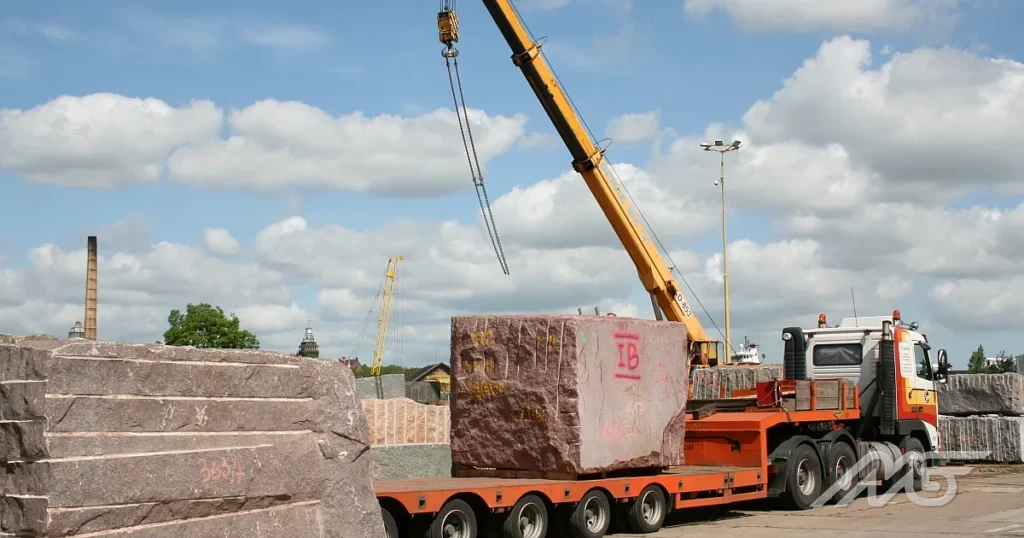
Stone transport requires matching the vehicle and the method of securing to the weight and form of the load. Blocks are carried on low-loader trailers or platforms, slabs upright on A-frames, and setts and aggregate on pallets or loose in tipper trucks. Natural stone is heavy (granite weighs about 2.7 t/m³), brittle at the edges and sensitive to shifting, which is why most damage happens not during the journey but because of poor loading and securing. Below we show how the different types of stone are transported, how much material fits on a truck and in a container, and what to remember when importing.
Types of stone cargo and how they are transported
In transport, the word “stone” covers very different loads. A raw block from a quarry is carried one way, polished slabs for worktops another, and aggregate for a building site yet another. The form of the material determines the type of vehicle, the loading equipment and the cost of transport, and a transport company has to know these differences before accepting the job.
| Form of stone | Typical vehicle or container | Securing | Loading and unloading |
|---|---|---|---|
| Raw blocks | low-loader trailer, platform, flat rack | timber bearers, chains, wedges | crane, gantry crane, loader |
| Slabs | trailer with racks, 20′ container | A-frames, spacers, straps | forklift, gantry crane with clamp |
| Cut slabs and worktops | curtainsider, container | wooden crates, foam on the edges | forklift, vacuum lifters |
| Setts and kerbs | trailer, truck with a loader crane | pallets, netting or strapping | loader crane, forklift |
| Aggregate and crushed stone | tipper truck | carried loose under a sheet | wheel loader, tipping |
Swipe the table sideways to see all columns.
Stone blocks
A granite block measuring 2.5 × 1.5 × 1.5 m weighs about 15 tonnes, and the largest quarry blocks exceed 20 tonnes. Such loads require a low-loader trailer or platform and often an abnormal load permit if they exceed the permitted axle load or dimensions. The block is laid on timber bearers, which spread the pressure and protect the deck, and secured with chains and tensioners. At sea, blocks travel on flat racks, in open top containers or as conventional break bulk.
Stone slabs
Transporting stone slabs is the most demanding kind of stone transport. Large slabs 2-3 cm thick are stood upright, slightly tilted, on steel or timber A-frames. Spacers are placed between the slabs so that the surfaces do not rub against each other. A slab laid flat cracks under its own weight at the first big jolt, and a slab stood up without support falls over when braking. Polished slabs and finished worktops are additionally packed in wooden crates, and the edges are protected with foam or corner guards.
Setts, kerbs and aggregate
Granite setts and kerbs are transported on strapped pallets, most often by a truck with a loader crane, which unloads the goods without extra equipment on site. Aggregate and crushed stone are carried loose in tipper trucks. A tipper loaded with a wheel loader is the cheapest way to move large quantities, but it is not suitable for products that must arrive undamaged.
How much stone fits on a truck and in a container
With stone, the permitted weight almost always runs out before the space does. An articulated lorry in Poland may weigh 40 tonnes in total, so the load usually does not exceed 24-25 tonnes. That is only about 9 m³ of granite, a volume that takes up a small part of the trailer.
- 2 cm slabs with 24 tonnes of cargo, that is about 440 m² of slabs.
- 3 cm slabs at the same weight, that is about 300 m² of slabs.
- 20-foot container in practice 21-25 tonnes of stone, depending on road restrictions on the way to and from the port.
- 40-foot container rarely pays off for stone, because the weight limit is similar and the extra volume stays empty.
The weight also has to be distributed evenly. A whole load concentrated against one wall of a container or at the end of a trailer overloads the axles and makes securing harder. We show how to calculate the weight of stone from its dimensions in our post on granite density.
How to secure stone in transport
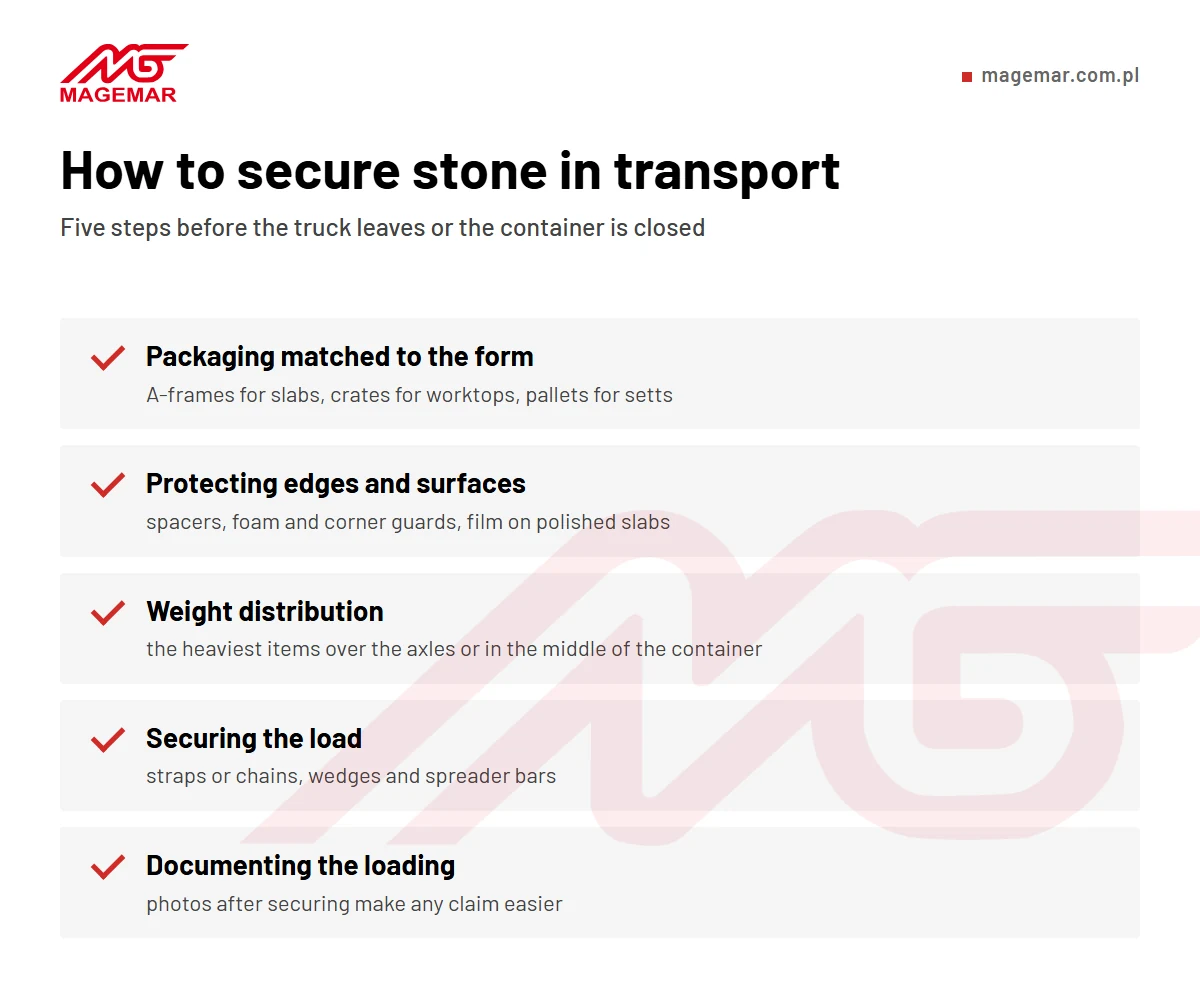
Safe stone transport starts before loading. Most damage consists of chipped edges, cracked slabs and scratched polished surfaces, which occur when the load shifts on a bend or under braking.
- Match the packaging to the form of the stone A-frames for slabs, crates for cut slabs and worktops, pallets for setts.
- Protect edges and surfaces timber or plastic spacers between slabs, foam and corner guards on the edges, film on polished surfaces.
- Distribute the weight the heaviest items over the vehicle’s axles or in the middle of the container, evenly on both sides.
- Secure the load straps or chains of adequate strength, wedges and spreader bars, so that nothing can shift or tip over.
- Document the loading photos of the load after securing make a claim easier if something arrives damaged.
Under road traffic law, both the loader and the carrier are responsible for the correct placement and securing of the load. The highway code makes no exception for “heavy material that will not move anyway”, and checking how loads are secured is standard during roadside inspections of heavy goods vehicles. The experience of a driver who knows how a dozen or so tonnes of stone behave on a bend really matters for safety here.
Transporting imported natural stone
Stone from China, India, Brazil or Turkey sails to Europe in 20-foot containers. Slabs travel on A-frames fixed to the container floor, and smaller items in crates. The voyage takes several weeks and the container goes through several handlings, so the securing has to withstand not only the road but also the rolling of the ship. We write about the length of the sea voyage itself in our post how long a ship from China to Poland takes.
After arrival, the container has to be cleared. Raw blocks and processed products have different customs tariff codes, and the duty rate depends on the code, which is why the description of the goods in the supplier’s documents should be precise: type of stone, form, thickness and finish. If you import granite from Asia, it is also worth checking the quality of the batch in advance. We describe what to look out for in our guide to Chinese granite.
The cost of stone transport - what it depends on
The cost of transporting stone depends above all on the weight and form of the load, the distance, the type of vehicle and the equipment needed for loading and unloading. Oversized blocks cost more because they require permits and often an escort. For imports, ocean freight, port charges, customs clearance and delivery from the port are added. A well-planned load that uses the container’s permitted weight lowers the cost per square metre of slabs. This efficiency matters especially for stonemasons’ businesses, for which transport is a fixed part of production and sales costs.
Stone import and transport through Szczecin
We handle imports of natural stone from the port of loading to the consignee in Poland. We organise sea transport, handling in the port of Szczecin and road transport of slabs, blocks and setts. Blocks and loads with unusual dimensions travel as oversized cargo, and customs clearance is handled by our customs agency.
Write to us with the type of stone, its form, dimensions and the weight of the load. We will match the vehicle, check the access conditions and prepare a transport quote.
Frequently asked questions
How should stone slabs be transported?
Upright, slightly tilted, on A-frames, with spacers between the slabs and protected edges. Never flat and never without support.
How many tonnes of stone can one truck carry?
An articulated lorry usually carries 24-25 tonnes of cargo at a maximum permissible mass of 40 tonnes.
What are stone blocks transported on?
On low-loader trailers or platforms, and heavier blocks as abnormal loads, with a movement permit.
What is aggregate transported in?
Loose, in tipper trucks loaded with a wheel loader. It is the cheapest method, but it is not suitable for stone products.
What container is stone imported in?
Most often a 20-foot container, because with stone the weight limit runs out before the space does.