Chinese Granite - Varieties, Colours and How to Assess Quality Before Ordering
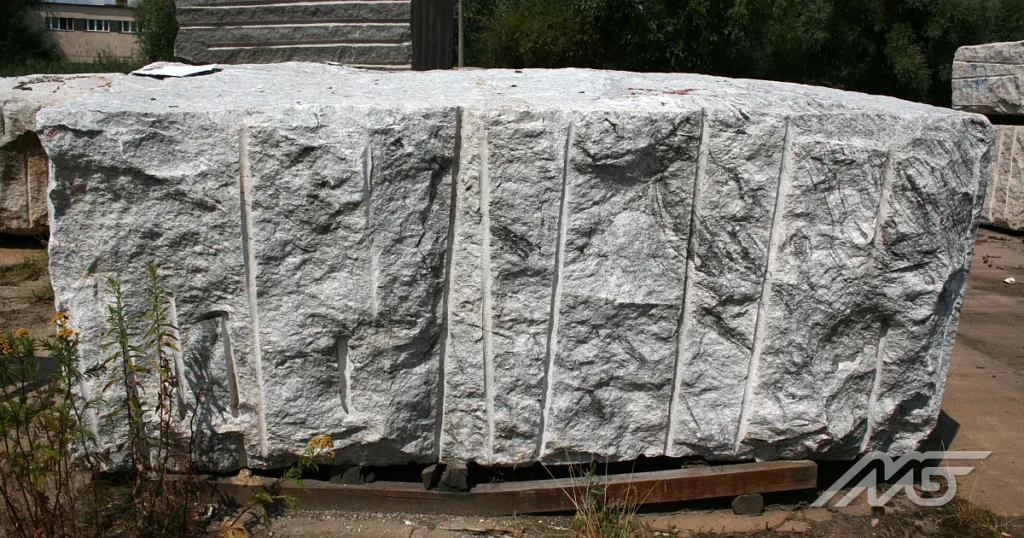
Chinese granite is natural stone quarried mainly in the provinces of Fujian and Shandong and sold under codes starting with the letter G (G603, G654, G664, G682) and under trade names such as Padang. It is not inferior by definition to Polish or Indian granite. Quality depends on the specific quarry and the specific batch, not on the country of origin, which is why the same code can stand for an excellent stone and for one that loses its polish after two winters. Below we describe the popular varieties and colours of Chinese granite, show how to recognise it and explain what to check before placing an order with a producer in Asia.
What Chinese granite is and where it comes from
Granite is an igneous rock formed from magma that cooled slowly deep below the earth’s surface. It consists mainly of quartz, feldspar and mica, and their proportions determine the colour and grain of the stone. China is the world’s largest exporter of stone products, and quarrying and processing are concentrated in two provinces. Granite quarried in Fujian, in the south-east of the country, goes to the largest processing base in the region: the works around the town of Shuitou alone process stone from all over the world. Shandong in the north supplies mainly grey and pink granites. Every March, Xiamen hosts Asia’s largest stone fair, which we attended in 2026. We described the visit in our post on the Xiamen Stone Fair 2026.
In the trade, the term “Chinese granite” covers a lot. It includes hundreds of varieties from different quarries, and some of them are not geologically granite at all. Black G684 is in fact basalt, which does not make it worse, but it matters when choosing stone for a particular use and for customs classification.
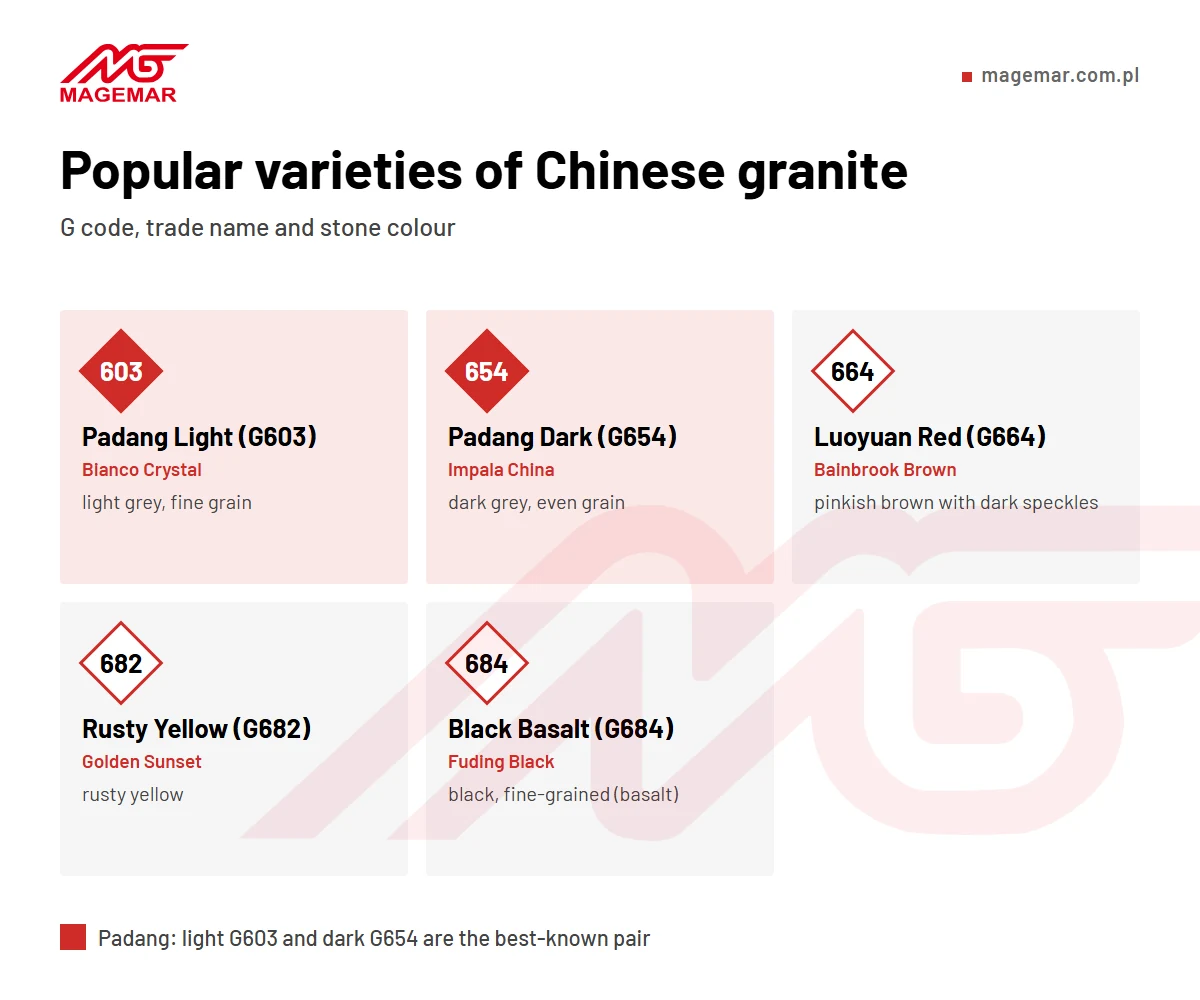
Colours of Chinese granite and the most popular varieties
Chinese varieties are labelled with a G code and a number, which exporters use interchangeably with trade names. The code is more practical, because trade names are not protected and the same name is sometimes given to stone from different quarries. The colour range is wide: from light grey through pinks and yellows to deep black, so almost every type of granite known in Europe has a Chinese counterpart. The table lists the varieties that most often reach Poland.
| Code | Trade names | Colour and pattern | Typical use |
|---|---|---|---|
| G603 | Padang Light, Bianco Crystal | light grey, fine grain | setts, outdoor slabs, stairs, window sills |
| G654 | Padang Dark, Impala China | dark grey, even grain | headstones, flooring, worktops, window sills |
| G664 | Luoyuan Red, Bainbrook Brown | pinkish brown with dark speckles | headstones, cladding, stairs |
| G682 | Rusty Yellow, Golden Sunset | rusty yellow | facades, paving, street furniture |
| G684 | Black Basalt, Fuding Black | black, fine-grained (basalt) | setts, terrace slabs, paving |
| - | Shanxi Black | deep, uniform black | monuments, headstones, worktops |
Swipe the table sideways to see all columns.
Padang - G603 and G654
Padang is today the best-known pair of Chinese granites. Light G603 and dark G654 are used for setts, stairs and a granite monument in the same project, because they work well together and are attractively priced. They are also the varieties where you are most likely to come across a poor batch, because many quarries produce them at the same time.
Colour differences between batches
The colour of a stone varies even within a single quarry. Differences in shade between batches are natural and do not mean the exporter is unreliable, which is why for a larger project all the material is ordered from one batch, and when adding slabs years later you have to expect a different shade.
Chinese granite and Polish granite - how they differ
Poland has its own deposits around Strzegom, Strzelin and Sobótka in Lower Silesia. Polish granite is proven and durable, but its colour range is narrow, in practice from light grey to yellowish and pinkish shades. Chinese granite wins on choice of colour, on price for large orders and on the availability of finished products. It loses on delivery time and on a wider spread of quality between works.
| Feature | Polish granite | Chinese granite |
|---|---|---|
| Colours | greys, yellows, pinks | from light grey to black, including exotic varieties |
| Price at high volume | higher | usually lower, despite freight and clearance |
| Finished products | processed in a Polish works | headstones, worktops and slabs cut to size at source |
| Delivery time | days | about 5-7 weeks from when the goods are ready |
| Spread of quality | small, known deposits | large, depends on the producer and the batch |
Swipe the table sideways to see all columns.
How does granite from Asia differ from domestic stone if you compare stone with similar parameters? In practice, in nothing significant. The strength and durability of granite come from its structure, not from the country where the quarry is. The difference is that on the Chinese market it is easier to end up with a cheaper, lower-quality batch, so the parameters need to be checked more carefully than with a well-known domestic deposit.
Chinese or Indian granite
India is the second large import route and often the only real alternative. Indian granites win on colour and structure: Black Galaxy with its golden flecks, Absolute Black or Kashmir White are hard to replace with a Chinese variety. Chinese granite wins on price, consistency of dimensions and a wide range of greys, which dominate the headstone segment. Importing from India also brings a formal difference: the goods may benefit from tariff preferences that reduce the duty on processed products. We cover both routes in more detail on our sea freight page.
How to recognise Chinese granite
You cannot tell for certain where a stone comes from by its appearance alone. Many Chinese varieties were developed as a cheaper equivalent of granites from other countries, so in a photo they look similar. Origin and quality are recognised by several signals at once.
By name, code and documents
A code starting with the letter G is an almost certain sign of Chinese origin. The trade name, on the other hand, can be misleading: Impala China, i.e. G654, is a different stone from the Impala quarried in South Africa, although both are dark grey. The most reliable source is the paperwork. The country of extraction must appear on the invoice, the certificate of origin and the customs declaration, so the importer always knows what was bought. The end customer, for example a client of a stonemason’s works, should ask about the country of origin and the petrographic name of the stone.
By the surface and the underside of the slab
It is worth looking at the underside of the slab. Fibreglass mesh bonded with resin means the stone needed reinforcing because it is brittle or cracked. On the surface you can sometimes see resin fill in natural pores and micro-cracks. This does not disqualify the stone, but it should be stated in the offer. A simple absorption test is a drop of water on an unsealed surface: if the stone darkens within a minute, it absorbs more water than granite intended for outdoor use should.
The acetone test for black granites
Black granites are sometimes dyed to achieve a uniform, deep black. A cloth with acetone wiped over the underside or edge of the slab will turn black if the stone has been dyed. The dye fades in sunlight over time, so such stone is not suitable for a headstone or a facade.
How to assess the quality of Chinese granite before ordering
The biggest losses in stone imports do not come from freight or duty, but from material that turns out to be different from the photo once it is unloaded. Quality assessment therefore starts long before loading and rests on three things: technical parameters, batch documentation and the terms of the contract.
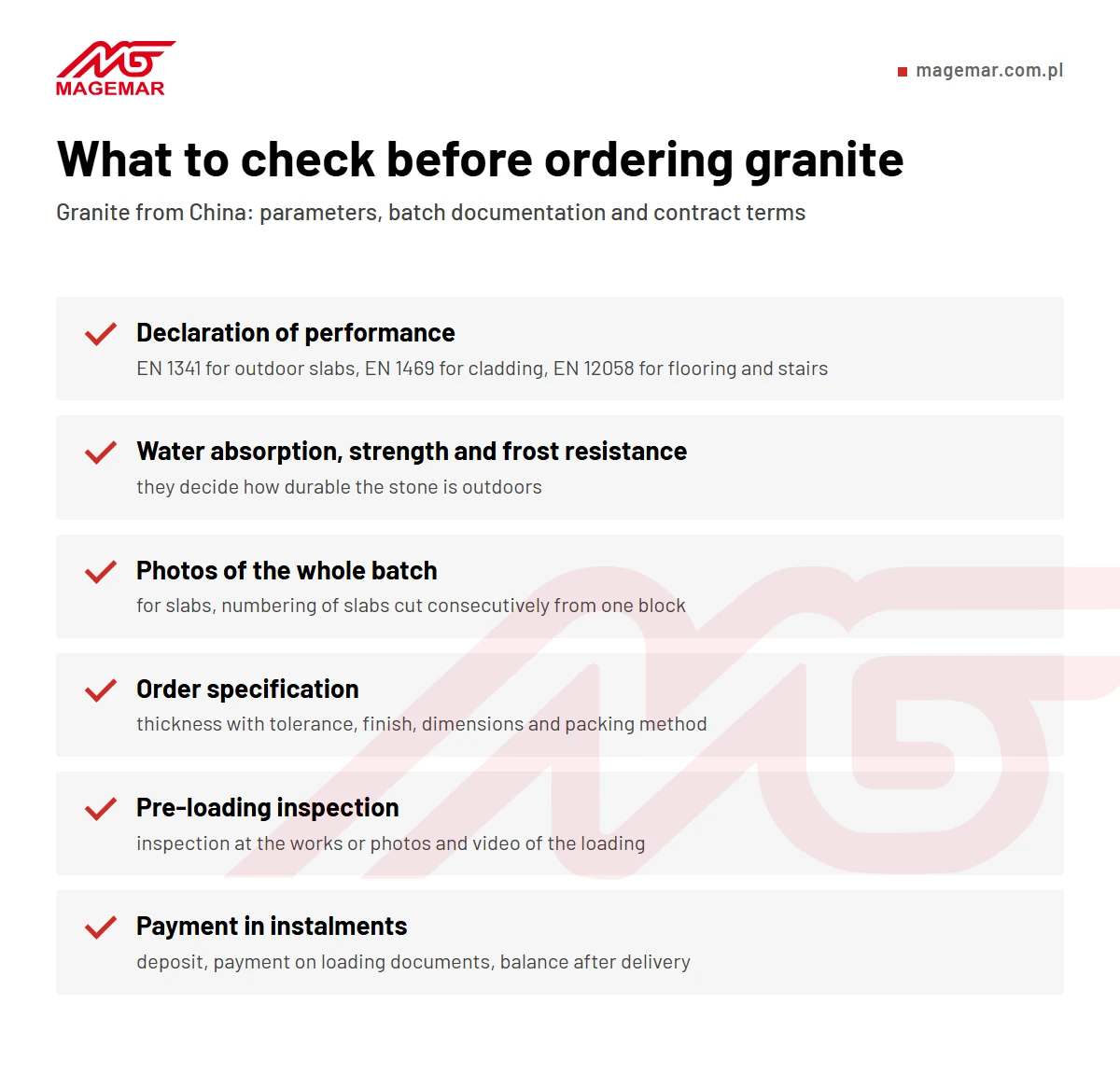
Durability and resistance parameters
The supplier should provide a declaration of performance in line with the standard for the product: EN 1341 for outdoor paving slabs, EN 1469 for cladding, EN 12058 for floor and stair slabs. The key parameters are water absorption, flexural strength, frost resistance and abrasion resistance. The most durable stone will have low water absorption: good granite intended for outdoor use absorbs less than 0.4 per cent water and keeps its strength after freeze-thaw cycles. With light G603 you need to watch out for iron minerals, which can oxidise outdoors and cause rusty staining. For outdoor use it is better to choose a tested batch or a variety less prone to this effect.
The batch, not the sample
A 10 by 10 cm sample will not show the pattern of a whole slab. The standard is photographic documentation of the entire batch before loading and, for slabs, numbering of the slabs cut consecutively from one block, so that the pattern on adjacent slabs matches. The order should state the thickness with its tolerance, the finish (polished, honed, flamed, sandblasted), the dimensions and the packing method. Polished granite works well indoors and on headstones, while flamed granite is better for outdoor stairs because it is less slippery.
Pre-loading inspection and payment terms
For larger orders an inspection at the works pays off; for smaller ones photos and a video of the loading are enough. It is worth splitting payment into instalments: a deposit, a payment on receipt of the loading documents and the balance after delivery. A demand for the full amount up front on a first order is a warning sign.
The price of granite from China - where the differences come from
Chinese granite is cheaper than many European equivalents thanks to scale: a huge processing base in Fujian, standard formats and strong competition between works. The price per square metre depends on the variety, thickness (usually 2 or 3 cm), finish and order size. The cheapest offer for the same code often means the weakest batch from the quarry, so you need to compare parameters, not just the price.
The cost of importing is added to the price of the stone. Blocks and slabs enter the EU duty-free, while processed products such as polished slabs or monuments carry a rate of 3.7 per cent. Polish import VAT at 23 per cent is always due, unless the importer settles it in the VAT return under the procedure in Article 33a of the Polish VAT Act. The density of granite is about 2.6-2.7 tonnes per cubic metre, so a 20-foot container reaches its weight limit, about 21-22 tonnes, before it runs out of space. The voyage from Xiamen to Szczecin alone takes 28-38 days, and the whole import, from the goods being ready to unloading at the works, usually takes 5-7 weeks.
Where Chinese granite is used
Granite is hard and resistant to weather and acids, which is why it performs where marble would not last. Chinese granite goes into housing, landscaping and, above all, stonemasons’ works. The variety is chosen to suit the place where the stone will be laid.
Headstones and granite monuments
Most Chinese granite reaches Poland as headstones and monuments, because in this segment consistent dimensions and price matter. Headstone sets arrive finished, in wooden crates. For a headstone, resistance to frost and moisture is what counts, and the aesthetics come down to the colour and the quality of the polish, which should not turn matt over time.
Window sills, worktops and stairs
Window sills, kitchen worktops and indoor stairs are uses in which the stone has to resist scratching and wear. Granite meets these requirements better than marble, while also looking good and standing up well to cleaning products. A polished surface brings out the pattern of the stone, which is why varieties with a distinct grain are usually chosen for interiors.
Setts, slabs and facades
Outdoors, Chinese granite is used for setts, terrace slabs, facade cladding and street furniture. Here frost resistance and low water absorption matter, and a flamed or sandblasted finish gives a non-slip surface. As a facade finishing material, granite from Asia is competitively priced compared with European stone cladding.
Importing Chinese granite through Szczecin
We handle stone imports from Asia from the port of loading to the gate of your works. We organise sea freight from Chinese ports to Szczecin, and customs clearance is handled by our own customs agency with AEO status. Our office is next to the Szczecin Free Zone, where blocks and slabs can wait for a buyer without being cleared on entry, and duty and VAT are paid only on the part of the batch that has been sold. We do not sell stone, so we have no interest in any particular supplier. What we do check is that the invoice, specification and documents match what is actually travelling in the container.
Contact us with the port of loading, the granite variety and the weight of the batch. We will prepare a calculation of freight, duty and delivery.
Frequently asked questions
Is Chinese granite good quality?
It can be very good, but the spread between producers is wide. Whether the stone is durable depends on water absorption, strength and frost resistance confirmed in the declaration of performance.
Is Chinese granite worse than Polish granite?
Not as a rule. With comparable parameters, durability is similar. Chinese granite offers more colours and a lower price on large orders, while Polish granite offers shorter delivery and a smaller spread of quality.
Is it worth buying Chinese granite?
Yes, if the order is large and the schedule allows a wait of several weeks. The price advantage grows with the batch size, because the freight cost is spread over more square metres. For a single window sill needed tomorrow, a local wholesaler will win.
Is Chinese granite radioactive?
All granite, including Polish granite, contains natural radioactive elements. For stone used indoors it is worth asking for the activity concentration index test result. For building materials in the EU the reference level is 1 mSv per year.
How can you tell Chinese granite from other granite?
Most reliably by the documents: the country of extraction is on the invoice and the certificate of origin. A code starting with G is also a clue. Appearance is not enough, because many Chinese varieties resemble granites from other countries.
Which country has the best granite?
There is no single country. India is known for colourful and black granites, Brazil for exotic varieties, South Africa for Impala and Blue Pearl, and China for a wide range at a good price. The best granite is the one whose parameters suit the application.
How long does granite take to ship from China to Poland?
The voyage from Xiamen or Ningbo to Szczecin takes about 28-38 days with transhipment in Hamburg. Including booking, clearance and delivery, allow 5-7 weeks.