Customs Warehouse and Free Zone - How to Defer Duty on Imports
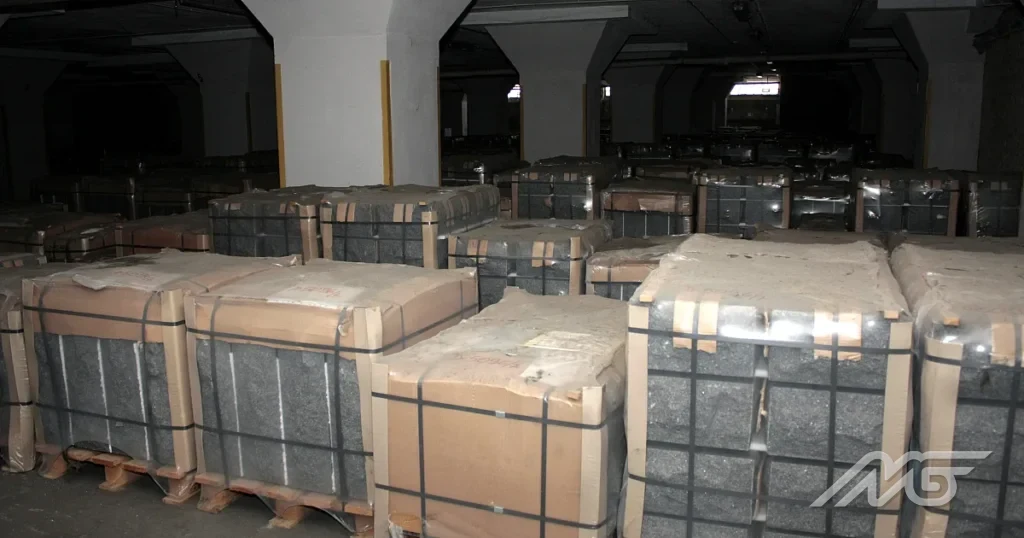
A customs warehouse is a place approved by the customs authorities where goods from outside the European Union can be stored without paying duty, VAT or excise. The charges are paid only when the goods are released for free circulation in the EU, and if they leave the Union, they are not paid at all. Customs warehousing has no statutory time limit, so an importer can keep the cargo until a buyer is found or the next batch is needed. Below we explain how the procedure works, how it differs from a temporary storage facility and a free zone, and when it pays off.
What a customs warehouse is
In legal terms, a customs warehouse is a place where non-Union goods can be stored under a special procedure called customs warehousing. It is governed by the Union Customs Code (Articles 240-242). The goods are formally in the customs territory of the EU, but they have not yet been released for free circulation. They remain under customs supervision the whole time, and the warehouse keeper is responsible for keeping records and for making sure they do not leave the warehouse without a declaration.
For an importer, placing goods under this procedure has three key effects:
- Deferred charges duty, VAT and excise are paid only on release for free circulation, not on the day the cargo arrives.
- No charges on re-export goods that leave the EU straight from the warehouse bear no duty or taxes.
- Unlimited time the regulations set no maximum period for customs warehousing, although the authority may set a deadline in exceptional cases.
How customs warehousing works step by step
The procedure looks similar whatever the goods. The differences mainly concern who runs the warehouse and who is liable for the charges.
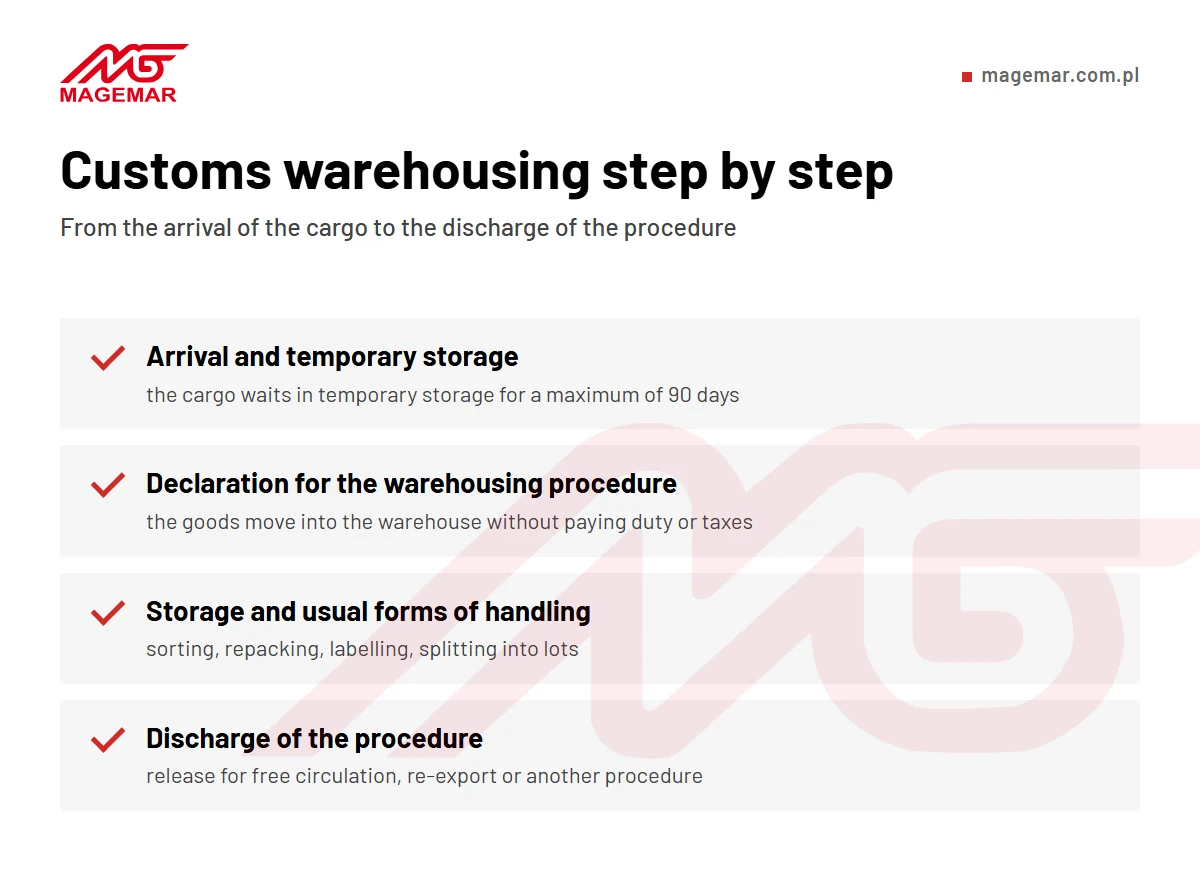
- Arrival and temporary storage after entering the customs territory of the EU, the cargo goes into a temporary storage facility on the basis of a temporary storage declaration.
- Declaration for the warehousing procedure the customs agency lodges a declaration and the goods move into the customs warehouse. At this stage no duty or taxes are paid yet.
- Storage and usual forms of handling in the warehouse the goods can be stored, sorted, repacked, labelled or split into smaller lots.
- Discharge of the procedure the goods are released for free circulation (and the charges are paid), taken out of the EU as a re-export or placed under another procedure, for example transit.
When goods are taken out of the warehouse in lots, duty and VAT are paid only on the part that is released for free circulation. The rest stays in the warehouse with no charges, which for large deliveries genuinely improves a company’s cash flow.
Types of customs warehouse
The Union Customs Code provides for two kinds of customs warehouse: public and private. The distinction depends on who may store goods in them and who is responsible for the records towards the customs authorities.
- Public customs warehouse type I any company can use it, and the warehouse keeper is responsible for the obligations arising from the procedure.
- Public customs warehouse type II also open to anyone, but the responsibility lies with the business that stores the goods.
- Private customs warehouses intended for storage of goods by the warehouse keeper itself, most often a large importer or manufacturer.
Running your own warehouse requires an authorisation, a guarantee covering the charges and meeting the requirements for record keeping and warehouse security. For most small and medium-sized companies the simpler solution is a public customs warehouse run by a logistics operator in the port.
Customs warehouse versus temporary storage facility
These two terms are often confused, because in both cases the goods sit in a warehouse under customs supervision. They differ in purpose and duration. A temporary storage facility is where cargo waits to be placed under a customs procedure after arriving in the EU, for a maximum of 90 days. A customs warehouse is a destination procedure in which the goods can stay without a time limit.
| Feature | Temporary storage facility | Customs warehouse | Free zone |
|---|---|---|---|
| Storage period | maximum 90 days | no limit | no limit |
| Status of the goods | before being placed under a procedure | customs warehousing procedure | free zone procedure |
| Duty and VAT | not paid until the declaration | paid on release for free circulation | paid on release for free circulation |
| Declaration | temporary storage declaration | customs declaration for the procedure | usually none on entry |
| Typical use | a short stop after unloading | deferring charges, selling in lots | transhipment and storage in the port |
Swipe the table sideways to see all columns.
In practice, temporary storage is a stop on the way, and a customs warehouse is a way of managing stock. If the goods are to stay longer than a few weeks and the company does not want to pay duty and taxes straight away, it is worth moving them into a warehouse before the 90 days of temporary storage run out.
Free zone - how it differs from a warehouse
A free zone is a designated, fenced-off part of the EU customs territory, most often in a port or at an airport, where non-Union goods are stored without import charges. It works much like a customs warehouse, but it covers a whole area rather than a single warehouse. In Poland, free zones operate in the ports of Szczecin and Gdansk, among others.
In a free zone goods can be stored, transhipped, sorted and subjected to the usual forms of handling. The choice between a warehouse and a free zone depends mainly on location: if the cargo arrives at a port with a free zone anyway, storing it there saves transport and handling.
When a customs warehouse pays off
The customs warehousing procedure is not needed for every import. It works best in a few situations:
- Large deliveries sold in lots you import a full container but sell a few pallets a month and do not want to pay duty and VAT on the whole lot at once.
- Re-export part of the goods will go to customers outside the European Union, so there is no point paying charges on it.
- Goods without a buyer the cargo has arrived, but the sales contract has not yet been signed.
- High duty rates the higher the duty, the greater the benefit of deferring payment.
For goods with a low duty rate and fast turnover, the cost of storage and of running the procedure may exceed the benefit of deferral. In that case it is simpler to release the goods for free circulation straight after arrival.
Customs clearance and warehousing in Szczecin
Our customs agency in Szczecin prepares declarations for the customs warehousing procedure, for release for free circulation and for re-export. We keep track of the 90-day temporary storage deadline, and for sea imports we combine the formalities with port forwarding and sea transport. We describe how officials actually examine the goods in our post customs inspection step by step.
Contact us and describe the cargo and your plan for selling it. We will tell you whether a customs warehouse pays off and prepare the declaration.
Frequently asked questions
What is a customs warehouse?
A place approved by the customs authorities where goods from outside the EU are stored without paying duty, VAT or excise until they are released for free circulation or exported.
How long can goods stay in a customs warehouse?
The regulations set no time limit for the customs warehousing procedure. The 90-day limit applies to temporary storage.
Do you pay duty in a customs warehouse?
Not during storage. Duty and taxes are paid on release for free circulation, and on re-export outside the EU they are not paid at all.
How does a customs warehouse differ from a free zone?
A customs warehouse is a specific warehouse covered by the procedure, while a free zone is a designated area, most often in a port, where similar rules apply.
What can be done with goods in the warehouse?
Usual forms of handling such as repacking, labelling, sorting or splitting into lots. Processing requires a different procedure.