Importing natural stone comes down to three sets of numbers. Duty: zero on blocks and slabs that have only been cut, 3.7 percent on worked products, and 23 percent VAT in every case. Delivery time: 25 to 38 days at sea from China and India, 20 to 28 from Brazil, 10 to 18 from Turkey, and a realistic 5 to 7 weeks once booking, clearance and delivery are included. Origins: China and India for granite and finished products, Brazil for quartzite, the Mediterranean for marble and travertine.
Below we set out each of these in detail: CN codes and rates for eleven tariff lines, a full breakdown of import costs, how to vet a supplier, the most common importer mistakes, and storage in the Szczecin Free Zone, where blocks and slabs stay without clearance on entry and you pay duty and VAT only on the goods you sell. The service is provided by Magemar Polska, a customs agency with AEO status and an ocean freight forwarder with an office in the port of Szczecin, next to the Customs and Tax Office. We have been operating since 1999.
Stone import in three numbers
EU customs duty0 - 3.7%Zero on raw material and slabs, 3.7 percent on worked products. 23 percent VAT whatever the form.
Delivery time from Asia5 - 7 weeksFrom goods ready at the supplier to unloading at your site, including clearance and delivery.
20' container payload21-22 tStone hits the weight limit before it runs out of space, which is why it travels in 20-foot boxes, not 40.
Fig. 1. Three parameters that determine the budget and schedule of a natural stone import.
Why importing natural stone pays off, and when Polish deposits are enough
Poland has its own granite deposits: the Strzegom, Strzelin and Sobotka areas of Lower Silesia have supplied domestic construction for decades. Local stone has two limits, however: a narrow colour range, in practice from light grey to yellow and pink tones, and block prices that stop being competitive on larger orders.
Importing solves both. Quarries in Asia, South America and Africa offer colours that are not available in Europe, and when you order a full container the unit cost can fall below the price of the domestic equivalent, even with freight and formalities added. Finished products are the other factor: monuments, worktops and cladding made on site by specialist manufacturers cost less than the same processing in Poland.
When should you stay with domestic stone? For one-off, small orders with short deadlines. Importing takes weeks, so if you need the material in ten days a local wholesaler will always win. With repeat deliveries and larger volumes, the sums swing in favour of importing.
Where we source stone from: import routes and specialities
The best stone does not come from one place. Each of the main origins has its own profile: different colours, different delivery forms and different transit times. Below are the markets we handle most often, and what each one is actually good for.
The start of the supply chain: a quarry face. A block is split from the bedrock along drilled lines, and its size already determines how many pieces will later fit in a container.Import routes and sailing time to Szczecin
Fig. 2. The six stone import routes handled by Magemar, with sailing time alone. Asian and South American cargo arrives via transhipment hubs in Hamburg and Rotterdam, Turkey and Portugal on direct services. Booking and loading, clearance and inland delivery come on top of these figures.
Stone imports from China: construction granite and monuments
28-38 days · Xiamen, Ningbo
China is the most common first route for Polish stone companies, because it is the world's largest exporter of stone products. Fujian and Shandong provinces combine quarries with huge processing capacity, so blocks, slabs and finished products can all come from one place. Well-known varieties are G654 (dark grey), G664 (pink), G603 and Padang. Chinese granite dominates the memorial segment, where repeatable dimensions and price matter most. Loading ports: Xiamen, Ningbo, Qingdao, Shanghai.
India: coloured granite and finished products
25-35 days · Mundra, Chennai
India wins on colour and structure. It is the source of Black Galaxy with its golden flecks, Absolute Black, Kashmir White and Red Multicolor. Indian factories turn blocks into finished goods locally, which makes it a natural route for complete memorial sets and worktops. One important formality: goods from India may qualify for tariff preferences, which reduce the duty. Ports: Mundra, Nhava Sheva, Chennai, Tuticorin.
Brazil: quartzite and exotic granite
20-28 days · Santos, Vitória
Brazil is now the main source of quartzite, a material harder and more stain-resistant than marble, which is why it is quickly gaining ground in the worktop market. Taj Mahal, Fantasy Brown and Sea Pearl come from there, as do the granites Verde Ubatuba and Giallo Veneziano. Loading: Santos and Vitória.
Italy, Turkey, Greece and Portugal: marble and travertine
7-18 days · direct services
The Mediterranean is the marble route. Carrara and Statuario from Italy remain the benchmark for premium interiors, Turkey supplies Crema Marfil, Emperador and most of Europe's travertine, Greece provides Thassos White and Kavala, and Portugal Estremoz Cream and limestone. The advantage of these routes is speed: from Turkey and Portugal, stone travels by sea two to three times faster than from Asia.
South Africa and other parts of the world
22-30 days · Durban
From South Africa we bring in Impala and Blue Pearl, stones with a distinctive blue-grey sheen used in architecture and memorial masonry. We also handle deliveries from Egypt, Iran, Finland and Norway. If your supplier is in a country not listed here, we will check the sea services available for that port.
Types of natural stone and delivery forms
The type of material and the form in which it leaves the country of origin determine how it is packed, how it is classified and how much duty it attracts. These are three questions to answer before you place an order.
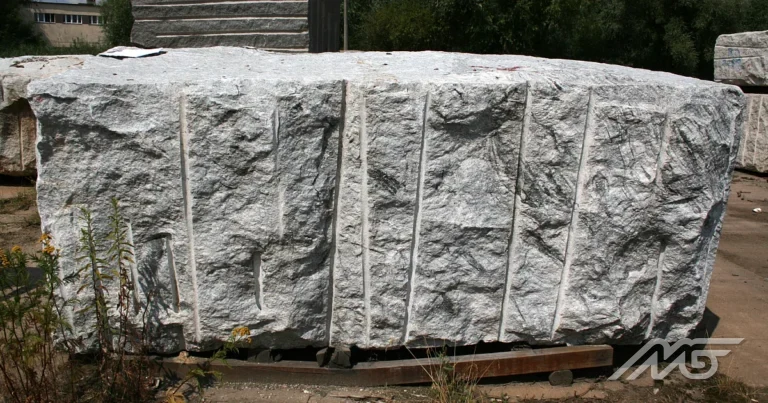
A raw block: the delivery form with the lowest price per square metre and a zero duty rate. The vertical marks are left over from drilling when the block was split off in the quarry.Delivery form and duty rate
Fig. 3. The customs line is drawn at surface working, not at cutting. Blocks and slabs enter the EU duty free; only polishing or edge working moves the goods to heading 6802 at 3.7 percent. This is the most common source of tariff classification errors for stone.
Granite
hard · indoors and outdoors
The most commonly imported natural stone in Poland, valued for its hardness and weather resistance. It goes into kitchen worktops, floors, stairs, facades and memorials. The surface finish, whether polished, honed, flamed or sandblasted, is set at the order stage, because it affects both the price and the classification.
Marble
soft · mainly interiors
Soft, decorative and sensitive to acids and abrasion. Used mainly inside buildings: prestige floors, wall cladding, window sills and bathroom elements. It needs more careful protection in transit than granite, because edges chip more easily.
Quartzite
stain resistant · worktops
Close to marble in appearance and to granite in performance. Resistant to scratches and stains, which is why it is replacing marble on kitchen worktops. Sourced mainly from Brazil and India.
Travertine, basalt and slate
facades, floors, roofs
Travertine, a porous sedimentary rock with a distinctive pattern, is used for floors, facades and cladding, mostly from Turkey and Iran. Basalt in the form of setts, slabs and columns serves landscape architecture and road construction. Roofing and facade slate, sourced from Brazil and China, is returning to favour in traditional building and the premium segment.
Blocks, slabs and finished products: how stone arrives
Raw blocks6-15 tonnes · duty 0%
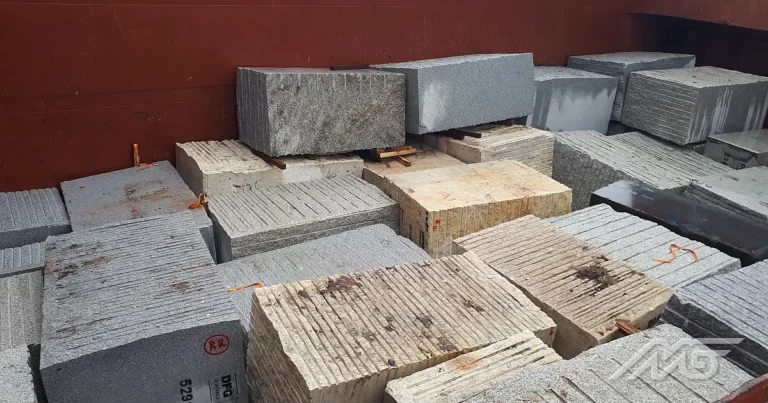
Rectangular blocks straight from the quarry, weighing from a few to more than a dozen tonnes, for further processing at a plant in Poland. They need your own saw and yard, but give the lowest cost per square metre and zero duty.
Stone slabs2 and 3 cm thick · duty 0%
Sheets cut from a block, arriving in standard thicknesses of 2 and 3 cm and standing upright on A-frame racks. This is the most popular form for workshops that process material into worktops and floors but have no gang saw of their own.
Finished productswooden crates · duty 3.7%
Granite tiles cut to size, worktops, setts, monuments and complete memorial sets, packed in wooden crates. They save processing on site, but this is the only category where duty applies.
Engineered quartz and sintered stone are not natural stone
Engineered quartz and sintered stone are manufactured from aggregate and resin. They have different CN codes and different rates, so they should not go into the same declaration as natural stone without checking.
How to choose a stone supplier abroad and check material quality
The biggest losses in stone imports come not from freight or duty but from material that turns out to differ from the photo once unloaded. Stone comes from natural deposits, so differences in shade and pattern between batches are normal, and a perfect match between two deliveries from the same quarry is not possible. Natural variation is one thing, however, and a gap between the sample and the container caused by plain unreliability is quite another.
Six supplier checks
01 · counterpartyWho is on the other sideQuarry operators and trading companies are two different models. Ask for an export licence, a registration number and references from the European market.
02 · sampleMatch with the batchA 10 by 10 cm sample will not show the pattern of a slab. Photographs of the whole batch before loading are standard, with an on-site inspection for larger orders.
03 · standardsRefer to a standardEN 12058 for floor and stair slabs, EN 1469 for cladding, EN 12057 for modular tiles, EN 12440 for denomination. A clause in the contract gives you grounds for a claim.
04 · nameA trade name is not enoughThe same name can be used for material from different deposits. It is not protected, so the contract should add a petrographic identification and the country of extraction.
05 · propertiesNot just appearanceWater absorption, flexural strength and frost resistance decide whether stone is fit for outdoor use. The supplier should provide a declaration of performance.
06 · paymentInstalments, not the full sumA deposit, a payment after loading documents, and the balance after delivery. A demand for the full amount up front on a first deal is a warning sign.
Fig. 4. A checklist to go through before sending the deposit. Each point can be written into the contract, which moves the risk from you to the supplier.
We are not a trading intermediary and we do not sell stone, so we have no stake in any particular supplier. What we do is check documents for clearance purposes, and we can spot discrepancies early between the invoice, the specification and what is really in the container.
Duty rates and VAT on stone imports (EU tariff)
The rule is simple and worth remembering, because it feeds straight into your budget: raw stone enters the EU duty free, and duty applies only to worked products, usually at 3.7 percent. VAT at 23 percent applies in every case, whatever the form of the goods. So the same granite brought in as a block and as a finished monument carries different charges, and the CN code decides which.
Duty rates by CN code
Goods
CN code
Duty
Notes
Raw granite, blocks
2516 11 00
0%
No duty, 23% VAT only
Cut granite, slabs and sheets
2516 12 00
0%
No duty, 23% VAT only
Worked granite: polished slabs, monuments
6802 23 00
3.7%
Preferences for India may reduce the rate
Raw marble, blocks
2515 11 00
0%
No duty
Cut marble, slabs up to 25 mm
2515 12 91
2%
Lower than the finished product
Worked marble
6802 21 00
3.7%
Raw quartzite
2506 20 00
0%
Worked quartzite
6802 99 00
3.7%
Worked travertine
6802 29 00
3.7%
Basalt, blocks
2516 20 00
0%
No duty
Slate
2514 00 00
0%
No duty
Table 1. Erga omnes rates, meaning without preferences, as at August 2026.
Source: European Commission TARIC and the PUESC tariff browser. The tariff changes during the year and additional measures apply to some goods. Before every shipment we check the rate for the specific goods and country of origin.
Tariff classification and choosing the CN code
The CN code is the most important decision in the whole clearance, because the rate, the required documents and any non-tariff measures all depend on it. The line between heading 2516 (stone merely cut) and heading 6802 (worked stone) is not always obvious: cutting a block into slabs does not yet make a worked product, but polishing the surface or working the edges does. Misclassification ends in a back payment with interest and proceedings, so for repeat deliveries it is worth applying for a Binding Tariff Information decision, which gives certainty for three years.
Tariff preferences and origin of goods
A reduced rate is not automatic: it has to be supported by a certificate of origin issued in the exporting country. Depending on the route this will be a Form A, an EUR.1 certificate or an invoice declaration. The document must match the invoice and the bill of lading, because a discrepancy in the goods description is enough for customs to refuse the preference.
Import VAT and settlement in the return
Import VAT is normally paid at clearance and recovered only in the next return, which ties up cash. The simplified procedure under Article 33a of the Polish VAT Act lets you settle the tax directly in the return, with no physical payment. On a container of granite worth EUR 40,000, that means tens of thousands of zloty staying in the company. We help set up this procedure and meet its formal conditions.
Szczecin Free Zone: storage without clearance on entry
No other Polish container port offers this in the same form, and it is the main reason stone traders choose Szczecin. Our office is right next to the Szczecin Free Zone, the largest granite block depot in Europe.
Block storage yard in the port of Szczecin. Goods stay here without clearance on entry, and duty and VAT apply only to the batch that is sold and leaves the zone.Clearance on entry versus free zone storage
Fig. 5. The difference comes down to when the obligation to pay duty and VAT arises. In Gdynia and Gdansk the goods must be cleared on entry, so tax is paid even on the part of the batch that has no buyer yet. In the Szczecin Free Zone, charges apply only when the goods leave.
In the free zone you can store blocks and slabs without customs clearance on entry. The goods wait for a buyer without generating any charges, and duty and VAT apply only to the part that is actually sold and leaves the zone. For an importer in the trade this means three things:
no VAT tied up in goods that have not yet found a buyer,
the option of bringing in a larger batch as stock without a tax penalty for holding inventory,
the option of re-exporting outside the EU without entering the Polish import procedure at all.
Europe's largest granite block depot is 200 metres from our office
The Szczecin Free Zone is the only place in Polish ports where blocks and slabs wait for a buyer without customs clearance on entry. Our office is right next to the zone and the Customs and Tax Office, so we deal with the formalities on site, the same day.
Ocean freight for stone: containers, FCL and LCL
Stone is one of the heaviest general cargoes in container trade, so weight decides everything, not volume. A 20-foot container reaches its maximum permitted weight before it runs out of space, and that is the starting point for all the logistics.
Inside a loaded container. Crates stand against the walls, and braces and straps stop the cargo shifting. With a load measured in tonnes, badly secured stone can tear through the container wall in heavy seas.
repeat deliveries
FCL: a full container
The standard for blocks and slabs is a 20-foot container with a payload of about 21 to 22 tonnes net, which suits the density of stone. A 40-foot container with the same goods would reach the weight limit half full, so it is used only for lighter finished products.
20-foot payload: about 21-22 tonnes net,
gross weight of a container of granite: usually 20-24 tonnes,
gross weight also matters for road delivery.
first trial order
LCL: groupage cargo
For smaller batches we consolidate your goods with other cargo, and you pay for the space actually used or for the weight, whichever works out higher.
with stone, weight almost always decides,
sensible for a first trial delivery,
quickly stops paying off for repeat deliveries.
Packing and securing the cargo
How the goods are arranged in the container determines the condition in which the stone arrives. Three things matter most:
Slabs travel upright only, on A-frame racks, separated with cardboard or polystyrene and strapped. Stacking slabs flat is the quickest way to cracks at the first serious roll.
Blocks are secured directly to the container floor, while finished products are packed in wooden crates with filling.
Moisture in the container. Temperature changes along the route cause condensation, so desiccants are used with marble and limestone.
We review the loading photographs before the container leaves the port.
Why not rail or air freight
With stone, the arithmetic gives the answer. Rail freight from China works with weight limits per loading unit that a container of granite simply exceeds, and the rate per tonne is many times higher than ocean freight. Air freight is out of the question for goods of this unit value. Stone is heavy and cheap per kilogram, which makes it the textbook case where the sea has no alternative.
What importing stone from China and India costs and how long it takes
There is no single import price, because ocean freight changes from week to week and the share of each component depends on the route and the form of the goods. What we can show is what the bill consists of and how long you realistically have to wait.
What makes up the import cost
TransportOcean freightThe basic rate per container, varying with the season. On Asian routes it is usually the largest single item.
TransportTHC terminal chargesOn both ends of the route, at the port of loading and the port of destination.
TransportRoad deliveryFrom the port to your site. A container over 20 tonnes is priced differently from ordinary general cargo.
ChargesCustoms dutyZero on raw material and slabs, 3.7 percent on worked products.
ChargesVAT at 23 percentOn the customs value plus duty, unless you use the Article 33a procedure.
ServiceCustoms agencyPreparing and lodging the declaration. The smallest item on the whole bill.
RiskCargo insuranceA fraction of a percent of the cargo value. The only item that pays for itself many times over in a claim.
RiskDemurrage and detentionCharges for keeping a container beyond the free time. This item does not have to arise at all.
Fig. 6. Eight components of the bill grouped by what they are: transport, public charges, service or risk protection. The last group is the only one you have full organisational control over.
Delivery time by route
The values below are sailing time alone, counted from the vessel leaving the port of loading. For the full schedule, add production at the supplier, booking and loading, and finally clearance and delivery.
Route
Via
Sailing time
India
via Hamburg or Rotterdam
25-35 days
China
via Hamburg
28-38 days
Brazil
via Rotterdam
20-28 days
South Africa
via Rotterdam
22-30 days
Turkey
direct to Szczecin
10-18 days
Portugal
feeder from Setubal or Lisbon
7-12 days
Table 2. Sailing time alone, without booking, clearance and inland delivery.
In practice, for a first import from Asia, plan on about five to seven weeks from goods being ready to unloading at your site, and start talking three months ahead. Punctuality depends mainly on two things: complete documents, and whether the supplier kept to the ready date. We report the status at every stage, so you will hear about a delay before it becomes a problem.
Incoterms for stone imports: FOB, CIF, EXW and DDP
The Incoterms 2020 rule written into the contract settles who pays for which leg and when the risk passes to you. With cargo as heavy and as easily damaged as stone, this has real monetary value, and choosing the right rule is the simplest import cost saving available.
FOB - the supplier is responsible for the goods until they are loaded on the vessel, and you arrange freight and insurance. The best choice for regular deliveries, because it gives you control over the carrier and the real freight rate.
CIF - the supplier pays freight and insurance to the port of destination. Simpler to start with, usually dearer overall, and it takes away your say in the choice of carrier.
EXW - you collect the goods from the supplier's plant. Maximum cost control, but it requires an agent in the exporting country and handling of export clearance.
DDP - the supplier delivers with duty paid. Convenient on the face of it, risky in practice: a foreign supplier rarely knows Polish regulations, and liability for a faulty declaration will fall on you as the consignee anyway.
Let's price your container
Give us the port of loading, the type of stone and the weight, and we will send back a freight, duty and delivery calculation within 24 hours.
Stone logistics has one particular feature: damage often shows up only when the container is unpacked, and by then it is hard to prove at which stage it happened. That is why we treat insurance and documenting the condition of the cargo as part of the service, not an add-on.
Cargo insurance
The real risks are specific: slabs cracking in a storm, a badly secured rack shifting, a flooded container, chipped edges on polished slabs. We offer a cargo policy matched to the type and value of the shipment, on both All Risks and Named Perils terms. A policy usually costs 0.1 to 0.3 percent of the CIF value of the cargo.
What to do if stone arrives damaged
The key is to document the damage at collection from the terminal, with a report and photographs, before the goods leave the port. A claim made after delivery to your site is much harder to defend. We help draw up the damage report and handle the case with the carrier or insurer.
Customs clearance for stone imports: documents and procedure
As a customs agency with AEO status, we lodge declarations on behalf of the importer and answer for their accuracy. Below is what we need and what happens when the container arrives.
Clearance documents
commercial invoice,
packing list with the goods specification,
Bill of Lading or Sea Waybill,
certificate of origin: Form A, EUR.1 or Certificate of Origin, depending on the country,
for some products, a declaration of performance.
How the declaration proceeds
Once we have the documents, we prepare the declaration in the AIS system, secure the charges and present the case to the Customs and Tax Office. With a complete set of documents, standard clearance takes one to two working days. We also handle special procedures: inward processing, temporary admission and T1 and T2 transit, and we represent the importer before the authority if there is an inspection.
Port forwarding in Szczecin and delivery to your site
Proximity is a practical argument here, not a marketing one. Our office is next to the Customs and Tax Office in Szczecin, inside the port and beside the free zone.
documents move on site, with no papers sent between cities,
we have direct contact with stevedores, container terminals and customs officers,
we respond to a problem during unloading, such as damage or a shortage, the same day.
Road transport from the port, including oversized loads
After unloading we arrange delivery straight to a stone workshop or warehouse anywhere in Poland. We work with hauliers who run low-loaders and platforms for heavy cargo, and for blocks above standard dimensions we set up oversized transport with all the permits.
carriage of the whole ISO container straight to the customer's site,
transhipment at the terminal and delivery by road vehicle,
distribution to several consignees from one container.
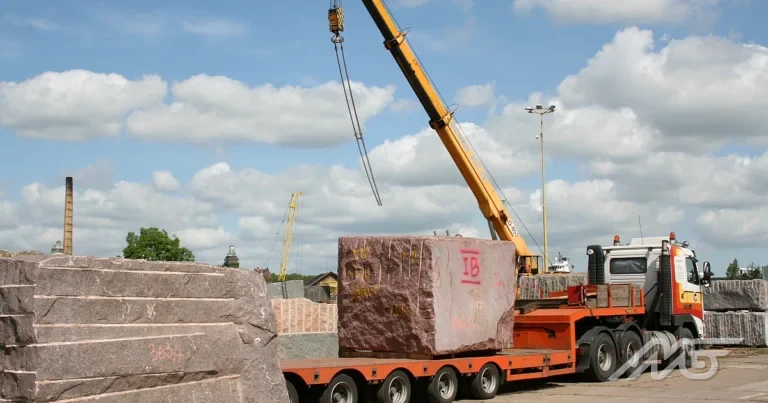
Delivery from the quay to a stone workshop. A single block can weigh more than twenty tonnes, so it travels on a low-loader, and larger pieces go as oversized cargo with all the permits.
Which port to choose for stone imports: Szczecin, Gdynia or Gdansk
Choosing the port of entry is one of the first decisions in planning an import, and there is no universal answer. It depends on where the consignee is, the loading route and whether you plan to take the goods at once or store them. Szczecin is about 130 km from Berlin and 520 km from Prague, with direct access to the A6 and S3 motorways, which gives clearly shorter delivery than the Tricity ports for western and southern Poland and for re-export to the German market. The table below sets out the other criteria.
Ports of entry compared
Criterion
Szczecin
Gdynia
Gdansk
Western Poland, Silesia, Lower Silesia
Favourable
Higher costs
Higher costs
Central Poland (Lodz, Warsaw)
Favourable
Comparable
Comparable
Eastern Poland
Higher costs
Favourable
Favourable
Deep-sea links with India and China
Feeder via Hamburg or Rotterdam
Direct services
Direct services
German market and re-export
Ideal location
Weaker
Weaker
Customs clearance requirement
on exit
on entry
on entry
Magemar Polska office and customs agency on site
Yes
No
No
Table 3. The clearance row matters most when importing larger batches for trading. In Gdynia and Gdansk the goods must be cleared on entry; in Szczecin, thanks to the free zone, only on exit. For a manufacturer taking the container at once this makes no difference, but for a trading company it can be decisive.
Natural stone import step by step
Importing looks complicated mainly because it combines three separate worlds: dealing with the supplier, shipping and customs procedure. Set out in stages, it stops being complicated, and you can see where you need to act yourself and what we take over.
The last stage inside the port: taking the cargo out of the container with a heavy-duty forklift. This is also when any damage is documented, and a report made before leaving the terminal is the basis of a claim against the carrier or insurer.Six stages, from order to unloading
Order and commercial documents YouYour supplier should send a proforma or commercial invoice, the goods specification and confirmation that production is ready. This is a good moment to contact us, because we can check the documents for the later clearance before they turn into a problem.
Freight booking and loading instructions MagemarWe book space with the carrier and send the supplier a shipping instruction with the bill of lading details. An error on the B/L can block container release for several days.
Loading and securing Supplierchecked by usSlabs go on racks, blocks are lashed to the floor, finished products go into crates. We review the loading photos and pick up any irregularities before the container sails.
Voyage and tracking MagemarWe track the vessel, give you the expected arrival time and plan collection from the terminal.
Customs clearance on arrival MagemarWe lodge the declaration, and once customs release the goods the container is ready for collection. With complete documents this takes one to two working days. If you use the free zone, this step moves to the moment the goods are sold.
Delivery and container return MagemarWe deliver to your site, document any damage and return the empty container to the terminal on time, so that no detention charges build up.
Fig. 7. Division of responsibility along the process. The labels show who carries out each step: in practice the order with the supplier and the commercial decisions stay with you, and the rest is on us.
The most common stone importer mistakes and how to avoid them
This list comes from situations we have really handled. Each one cost the importer money or time, and each could have been avoided by a decision made a few weeks earlier.
Accepting the supplier's CN code without checking it. A Chinese exporter gives a code from its own export classification, which need not match the EU one. Liability for the declaration lies with the importer, not the seller.
A goods description on the invoice that does not match reality. A vague "granite products" instead of the specific item is the most common reason for a request for explanations and a physical inspection.
No certificate of origin, or one with an error. The preference is lost, the duty goes up, and issuing the document after the event may be impossible.
Choosing DDP for a first import. Convenient in theory; in practice you hand control of the customs declaration to a company that does not answer to the Polish authority.
Slabs loaded flat. A classic supplier saving on racks that ends in cracks. Require loading photographs and a contract clause.
Ignoring container free time. Demurrage and detention add up fast. If you have nowhere to unload the goods, sort it out before the vessel arrives, not after.
Skipping insurance on a "short and safe" route. Damage happens most often during transhipment, and a feeder route has more than one.
Planning with no time buffer. A construction or contract deadline based on an optimistic transit time, with no margin for a customs inspection or a vessel delay.
Frequently asked questions about natural stone imports
These are the questions we hear most often at a first meeting with an importer. If yours is not here, just ask; we answer the difficult ones too.
What documents are needed for customs clearance of stone?
A commercial invoice, packing list, bill of lading or sea waybill, and a certificate of origin. When importing finished products from India the certificate of origin matters most, because it decides whether a reduced duty rate applies. Some construction products also need a declaration of performance.
What is the customs duty on natural stone from China?
Blocks and slabs that have only been cut are duty free, so you pay 23 percent VAT and nothing else. A 3.7 percent duty applies to worked stone, which includes polished slabs and monuments. The CN code decides this rather than the country of origin, although the country does affect which preferences are available.
How long does it take to import stone from China or India?
Counting from the moment the goods are ready at the supplier: booking and loading take 5 to 10 days, the voyage 25 to 38 days depending on the route, clearance and port collection 2 to 5 days, and inland delivery 1 to 2 days. That is about 5 to 7 weeks in total. For a first shipment, start planning three months ahead.
How much does customs clearance for stone imports cost?
It depends on the number of tariff lines and how complex the declaration is, so we quote each case individually. Bear in mind that the agency fee is the smallest item on the whole bill. The correct CN code and complete documents have a far greater effect on cost, because they determine the duty and whether the container gets stuck at the terminal.
Does Magemar hold AEO status?
Yes. AEO, or Authorised Economic Operator, status is recognised by customs authorities across the European Union and brings priority treatment of declarations and access to procedural simplifications. In practice this means shorter clearance times.
Can I store stone in the port without paying duty and VAT?
Yes, in the Szczecin Free Zone. Blocks and slabs stay there without clearance on entry, and charges apply only to the batch that is sold and leaves the zone. This suits trading companies that bring in larger volumes and sell them gradually.
What happens if the goods arrive damaged?
The damage has to be documented with a report and photographs at collection from the terminal, before the container leaves the port. We help draw up the report and handle the claim against the carrier or insurer. This is why we recommend cargo insurance for every stone shipment.
Is it better to import stone as blocks or as finished slabs?
Blocks give the lowest price per square metre and zero duty, but you need your own gang saw, yard and people to process them. Slabs are the compromise: no duty on material that has only been cut, and ready for cutting to size. Finished products save the whole production stage, but the 3.7 percent duty applies. For one container a year, slabs usually win; for steady production, blocks do.
How can I check that the supplier will ship the material shown in the sample?
Write compliance with a specific standard and batch number into the contract, ask for photographs of the entire loading and split the payment into stages, with the last instalment tied to delivery. For a first deal or a larger order, consider a pre-shipment inspection on site.
Do you handle imports through ports other than Szczecin?
Yes. We lodge customs declarations electronically, so we also handle cargo entering through other Polish ports and land border crossings. Our own office, customs agency and the free zone are in Szczecin, and that is where we provide the full on-site service: terminal collection, storage without clearance on entry and delivery to your site. For stone imports this usually settles the choice of port of entry.
Magemar Polska: who we are
Magemar Polska Sp. z o.o. belongs to the Magemar, Magetra, Magemon and Dongemar logistics group, whose history goes back to the 1930s, when Magemon started out as a cargo handling operator in Liège, Belgium's largest river port. Today the group handles more than 6 million tonnes of cargo a year and has a network of offices in Europe and in China, where Dongemar Xiamen operates. Magemar Polska has been in business since 1999, and its own customs agency since 2004.
We will prepare a free calculation covering freight, clearance and delivery. Give us the country and port of loading, the type and form of stone, the estimated weight or number of containers, the destination port and the place of delivery. We reply within 24 hours.
Aby zapewnić jak najlepsze wrażenia, korzystamy z technologii, takich jak pliki cookie, do przechowywania i/lub uzyskiwania dostępu do informacji o urządzeniu. Zgoda na te technologie pozwoli nam przetwarzać dane, takie jak zachowanie podczas przeglądania lub unikalne identyfikatory na tej stronie. Brak wyrażenia zgody lub wycofanie zgody może niekorzystnie wpłynąć na niektóre cechy i funkcje.
Funkcjonalne
Always active
Przechowywanie lub dostęp do danych technicznych jest ściśle konieczny do uzasadnionego celu umożliwienia korzystania z konkretnej usługi wyraźnie żądanej przez subskrybenta lub użytkownika, lub wyłącznie w celu przeprowadzenia transmisji komunikatu przez sieć łączności elektronicznej.
Preferencje
Przechowywanie lub dostęp techniczny jest niezbędny do uzasadnionego celu przechowywania preferencji, o które nie prosi subskrybent lub użytkownik.
Statystyka
Przechowywanie techniczne lub dostęp, który jest używany wyłącznie do celów statystycznych.Przechowywanie techniczne lub dostęp, który jest używany wyłącznie do anonimowych celów statystycznych. Bez wezwania do sądu, dobrowolnego podporządkowania się dostawcy usług internetowych lub dodatkowych zapisów od strony trzeciej, informacje przechowywane lub pobierane wyłącznie w tym celu zwykle nie mogą być wykorzystywane do identyfikacji użytkownika.
Marketing
Przechowywanie lub dostęp techniczny jest wymagany do tworzenia profili użytkowników w celu wysyłania reklam lub śledzenia użytkownika na stronie internetowej lub na kilku stronach internetowych w podobnych celach marketingowych.