Incoterms 2020 - All the Rules and How to Choose the Right One
Incoterms 2020 are 11 rules of the International Chamber of Commerce (ICC) that determine who in a transaction is responsible for transport, insurance and customs clearance, and at what point the risk of loss of or damage to the goods passes from the seller to the buyer. Seven rules (EXW, FCA, CPT, CIP, DAP, DPU, DDP) apply to any mode of transport, and four (FAS, FOB, CFR, CIF) only to sea and inland waterway transport. The Incoterms® 2020 rules have applied since 1 January 2020. Below we discuss each rule, put them together in a table and suggest which one to choose when importing from Asia.
What Incoterms are and what they cover
The name Incoterms is short for International Commercial Terms. Incoterms define the terms of delivery: where the seller has to deliver the goods, who bears the costs of delivery and how risk and costs are shared along the way. The ICC published the first version in 1936, and later editions bring them up to date with changes in international trade. The Incoterms rules are short, and a rule written into a contract replaces several pages of arrangements: with one three-letter code the parties state where the seller delivers the goods, who pays for transport and when the risk passes to the buyer.
It is worth remembering what Incoterms do not cover. They say nothing about the price, the payment date and method, the transfer of ownership of the goods or the consequences of breach of contract. These matters have to be set out separately in the contract.
How to write an Incoterms rule into a contract
A correct entry contains three elements: the code of the rule, the named place and the version of the rules. For example “FOB Xiamen, Incoterms® 2020” or “DAP Szczecin, 1 Example Street, Incoterms® 2020”. The more precisely the place is defined, the fewer disputes about who pays for the last leg of the journey and for unloading. The parties may still use earlier versions, for example Incoterms 2010, but then they have to state this clearly in the contract.
Incoterms 2020 rules for any mode of transport
The seven rules in this group can be used for road, sea, air and multimodal transport. We have arranged them from the fewest to the most obligations for the seller.
EXW - Ex Works
The seller makes the goods available at its works or warehouse, and that is where its obligations end. The buyer bears all costs and risks from that moment: loading, export clearance, transport and import clearance. What does EXW mean in practice? That the importer needs someone in the seller’s country to handle the export formalities, which can be awkward when importing from China.
FCA - Free Carrier
The seller delivers the goods, cleared for export, to the carrier nominated by the buyer at the agreed place. If that place is the seller’s premises, the seller loads the goods onto the means of transport. From that moment the risk passes to the buyer. In the 2020 version the parties can agree that the buyer will instruct the carrier to issue the seller with an on-board bill of lading, which makes payment by letter of credit easier.
CPT - Carriage Paid To
The seller pays the transport costs to the named place of destination, but the risk passes to the buyer when the goods are handed to the first carrier. Costs and risk therefore part ways at two different points, which the buyer must bear in mind when arranging insurance.
CIP - Carriage and Insurance Paid To
As CPT, but the seller pays for both transport and insurance, taking out a policy for the buyer’s benefit. Since 2020, CIP requires broad cover corresponding to ICC Clauses (A), for at least 110% of the value of the goods.
DAP - Delivered at Place
The seller has to deliver the goods to the named place of destination and bears the risk of carriage until the goods are ready for unloading. Unloading and import clearance, including duty and VAT, are the buyer’s responsibility.
DPU - Delivered at Place Unloaded
The rule that replaced DAT from the 2010 version. The seller delivers the goods to the place of destination and also unloads them. It is the only rule in which unloading at destination falls on the seller.
DDP - Delivered Duty Paid
The maximum of obligations for the seller. It delivers the goods to the place of destination cleared for import, with duty and taxes paid. The buyer only unloads and collects. DDP can be convenient for the consignee, but a foreign seller must be able to declare the goods in the country of import and account for VAT, which is not always straightforward in the EU.
Incoterms rules for sea transport - FAS, FOB, CFR, CIF
The four maritime rules link delivery to the port and the vessel. They work well for bulk cargo and conventional break bulk loaded directly on board.
FAS - Free Alongside Ship
The seller delivers the goods, cleared for export, alongside the vessel nominated by the buyer in the port of loading. From that moment the buyer bears the costs and risks, including loading onto the vessel.
FOB - Free on Board
The seller loads the goods onto the vessel in the port of loading, and once the goods are on board the risk passes to the buyer. Ocean freight, insurance and everything on the import side are paid by the buyer. FOB is one of the most commonly used rules when importing from China, because it gives the importer control over the choice of forwarder and the freight rate.
CFR - Cost and Freight
The seller pays the freight to the port of destination, but the risk passes to the buyer in the port of loading, once the goods are on board. The buyer pays for unloading in the port of destination unless it is covered by the contract of carriage.
CIF - Cost, Insurance and Freight
As CFR, but the seller also takes out marine insurance. Unlike CIP, CIF only requires minimum cover under ICC Clauses (C), so an importer who wants full protection often buys an additional policy of its own.
Incoterms 2020 in a table
The way Incoterms divide the parties’ obligations is easiest to compare in a single overview. The table below shows how risk and charges are split for all eleven Incoterms 2020 rules. The “risk passes” column shows the moment from which the buyer is responsible for loss of or damage to the goods.
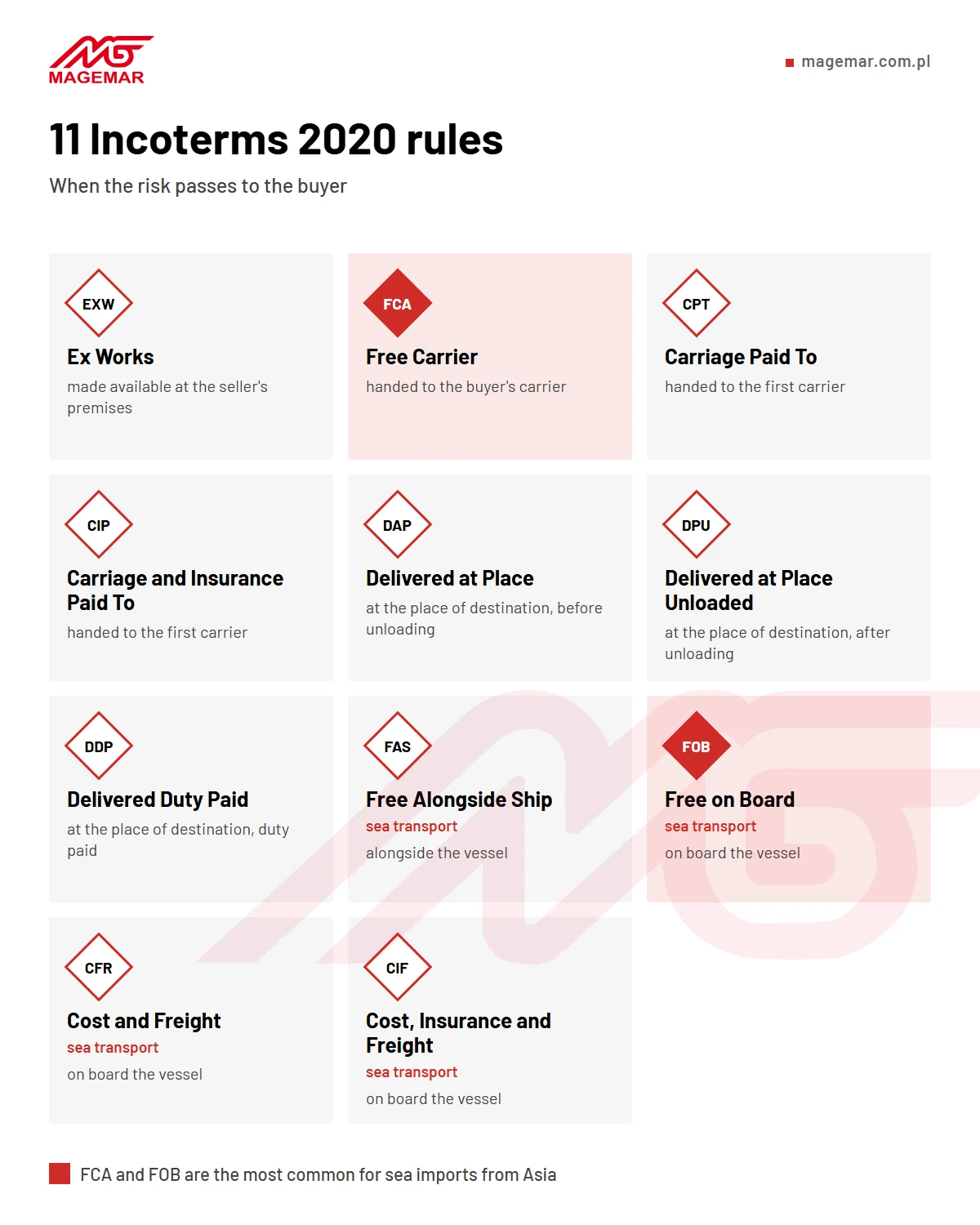
| Rule | Transport | Risk passes to the buyer | Main carriage paid by | Insurance | Import clearance |
|---|---|---|---|---|---|
| EXW | any | made available at the seller’s premises | buyer | buyer (optional) | buyer |
| FCA | any | handed to the buyer’s carrier | buyer | buyer (optional) | buyer |
| CPT | any | handed to the first carrier | seller | buyer (optional) | buyer |
| CIP | any | handed to the first carrier | seller | seller, ICC (A) | buyer |
| DAP | any | at the place of destination, before unloading | seller | seller (optional) | buyer |
| DPU | any | at the place of destination, after unloading | seller | seller (optional) | buyer |
| DDP | any | at the place of destination, before unloading | seller | seller (optional) | seller |
| FAS | sea | alongside the vessel in the port of loading | buyer | buyer (optional) | buyer |
| FOB | sea | on board the vessel in the port of loading | buyer | buyer (optional) | buyer |
| CFR | sea | on board the vessel in the port of loading | seller | buyer (optional) | buyer |
| CIF | sea | on board the vessel in the port of loading | seller | seller, ICC (C) | buyer |
Swipe the table sideways to see all columns.
Which Incoterms rule to choose for imports
There is no single best rule. The choice depends on who can organise transport better, who has cheaper freight and whether the importer wants to control the supply chain. A few principles that work in practice:
- Sea imports from Asia FOB or FCA gives the buyer the choice of forwarder and transparent freight costs. With CIF and CFR the seller chooses the carrier, and surcharges in the port of destination can come as a surprise.
- Containerised goods the ICC recommends FCA, CPT or CIP instead of FOB, CFR and CIF, because a container is handed over at the terminal before it goes on board. Under the maritime rules the risk is left hanging for several days.
- First order with a new supplier EXW looks like the cheapest option, but it requires handling the formalities in the seller’s country. FCA with delivery at the works is usually safer.
- A consignee with no import experience DAP puts transport on the seller, while import clearance stays with the buyer, who can hand it over to a customs agency.
The rule also affects the customs value, and therefore the cost of clearance. In the EU, duty is calculated on the value of the goods at the place of entry into the customs territory of the Union, so with FOB the freight and insurance to the EU border are added to the price. We write about how long the voyage from Asia takes in our post how long a ship from China to Poland takes.
Transport and clearance under any Incoterms rule
We organise sea transport and ocean freight forwarding for deliveries under FOB, FCA, EXW and other rules where the main carriage is on the buyer’s side. Under CIF and CFR we take over the cargo in the port of Szczecin and handle the onward transport. The import declaration, calculation of the customs value and payment of duty are handled by our customs agency. You can read more about planning the whole delivery in our guide how to organise sea transport.
Contact us before signing the contract. We will suggest which Incoterms rule works best for your cargo and prepare a transport quote.
Frequently asked questions
What are Incoterms?
International ICC trade rules that determine how costs, risk and obligations are split between seller and buyer when goods are delivered.
How many Incoterms 2020 rules are there?
Eleven: seven for any mode of transport and four for sea and inland waterway transport only.
What does EXW mean?
Ex Works. The seller makes the goods available at its premises, and the buyer bears all costs and risks, including loading and export clearance.
What is the difference between FOB and CIF?
Under FOB the buyer pays for freight and insurance. Under CIF the seller pays for them, but in both cases the risk passes to the buyer in the port of loading.
Are Incoterms 2010 still valid?
They can be used if the parties expressly write that version into the contract. Without such a reference, the current version, i.e. 2020, is usually assumed.